Articles
Niladri Bije Mahaprabhu’s Sacred Return to the Ratna Singhasana
Aug
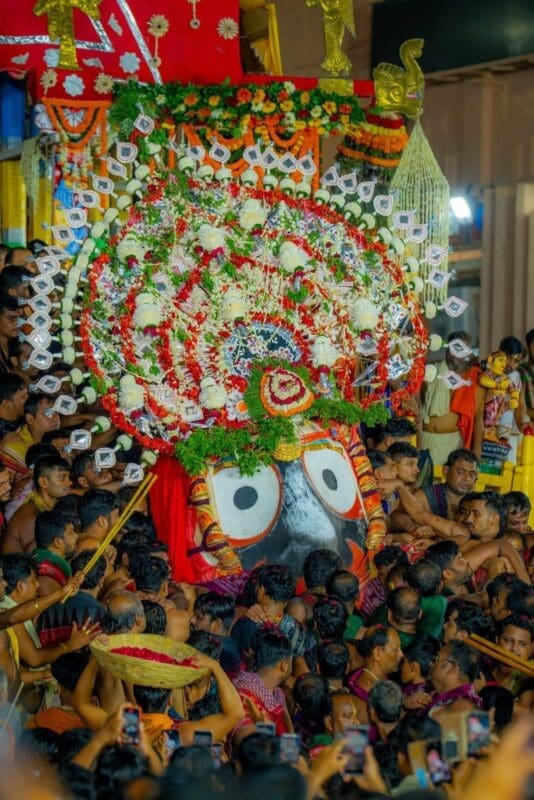
Niladri Bije is the glorious concluding ritual of Ratha Yatra, when Shri Jagannath, Shri Balabhadra, Devi Subhadra and Shri Sudarshana return from their chariots to the Ratna Singhasana of Shri Mandira. It is a celebration of divine homecoming, loving reunion, forgiveness and the sweetness of human relationships expressed through the sacred Lila of Mahaprabhu.
Jagannath culture is unlike any other devotional tradition in the world.
Mahaprabhu Shri Jagannath is worshipped as the Supreme Lord, the eternal Brahman and the Lord of the universe. Yet He is also loved as Kalia Saanta, the affectionate Lord of every Odia household.
He does not remain distant from human life.
He wakes, bathes, eats, rests, changes clothes, falls ill, travels, celebrates festivals and returns home like a beloved family member.
This deeply human expression of divine life is reflected in the traditional saying:
“Lokavat tu Lila Kaivalyam”
The Supreme Lord performs divine pastimes in ways that resemble the life of ordinary people. Through these loving actions, spiritual truths become understandable to everyone.
The Purushottama Mahatmya of the Skanda Purana presents Shri Jagannath as the Supreme Reality who accepts a sacred wooden form in Purushottama Kshetra for the welfare of the world.
His annual festivals are therefore not ordinary celebrations.
They are divine teachings expressed through ritual.
Among these festivals, Ratha Yatra is the most public and majestic. Mahaprabhu leaves Shri Mandira, travels to Shri Gundicha Temple, stays there for several days and then returns during Bahuda Yatra.
After Suna Besha and Adharapana comes the final sacred occasion:
Niladri Bije—the return of the deities to the Ratna Singhasana.
What Does Niladri Bije Mean?
The word Niladri refers to the sacred Blue Mountain or Nilachala, the holy seat of Shri Jagannath.
The word Bije means ceremonial arrival, movement or entry.
Niladri Bije therefore means the ceremonial return of the deities to Their divine residence upon Nilachala.
It is not simply the physical movement of sacred images from the chariots into the temple.
It marks:
- The completion of Ratha Yatra
- The return of Mahaprabhu to Shri Mandira
- The reunion of Shri Jagannath and Goddess Lakshmi
- The restoration of the deities to the Ratna Singhasana
- The sweet conclusion of the divine household Lila
The entire atmosphere of Bada Danda and Singhadwara becomes filled with Haribol, Huluhuli, bells, Kahali, devotional music and Sankirtana.
Devotees gather to witness the final moments of Mahaprabhu’s annual journey.
Mahaprabhu’s Human-Like Divine Lila
The beauty of Niladri Bije lies in the way the Supreme Lord expresses emotions familiar to human relationships.
According to the popular devotional understanding, Goddess Lakshmi feels neglected because Shri Jagannath travelled to Shri Gundicha Temple with Shri Balabhadra and Devi Subhadra but did not take Her with Him.
Mahaprabhu had promised to return quickly, yet He remained away for several days.
Naturally, Mahalakshmi is displeased.
In the divine Lila, She appears not merely as the Goddess of the three worlds but as a loving wife waiting for Her husband to return home.
Her anger is not ordinary anger.
It expresses intimacy, affection and the dignity of relationship.
Mahaprabhu, though the Lord of the universe, must lovingly seek reconciliation.
This divine household drama allows every devotee to understand that even the highest spiritual truth can be expressed through affection, misunderstanding, apology and forgiveness.
Preparations on the Three Chariots
On the day of Niladri Bije, the deities remain seated upon their three chariots near Singhadwara.
After the completion of the evening Dhupa and other prescribed rituals, preparations begin for the sacred Pahandi.
The Charamala, or ceremonial ramp, is tied to each Rath so that the deities may be brought down safely.
The sound of the Bije Kahali announces the ceremonial movement.
Bandapana and Dori Lagi rituals are then performed according to established temple procedure.
The atmosphere becomes charged with devotion.
The deities who had travelled openly among millions of devotees are now preparing to return to the inner sanctum.
The Sacred Tahia and Ratna Singhasana
Raghava Das Matha traditionally supplies the large floral Tahia used during the Pahandi.
The magnificent Tahia moves rhythmically above the heads of the deities as the Sevayats carry Them forward.
Before the Pahandi begins, a ceremonial canopy is arranged above the Trimundi area of the Ratna Singhasana.
The sacred seat is prepared for the return of the Chaturdha Murti.
The Akhanda lamp and other required arrangements are also maintained as part of the temple tradition.
Every step follows a sacred sequence.
Nothing is treated casually.
The Return of the Bije Pratimas
Before the principal deities enter Shri Mandira, certain accompanying deities are taken from the chariots.
The Pushpalaka and Mahajana Sevayats first carry:
- Shri Madanamohana from Nandighosha
- Rama and Krishna from Taladhwaja
These Bije Pratimas are ceremonially taken to the Dakshini Ghara.
Only after this movement do the principal Pahandi rituals continue.
This demonstrates the careful order preserved within Shri Mandira’s Niti system.
The Goti Pahandi Begins
The deities return to Shri Mandira in Goti Pahandi, meaning They are taken one after another rather than together.
The traditional order includes:
- Shri Sudarshana
- Shri Balabhadra
- Devi Subhadra
- Shri Jagannath
Shri Sudarshana enters first.
Then Shri Balabhadra, the elder Lord, is brought down from Taladhwaja and taken towards the Ratna Singhasana.
Devi Subhadra follows from Darpadalana.
Mahaprabhu Shri Jagannath comes last.
This final Pahandi is the most emotionally awaited moment because it includes the divine meeting with Mahalakshmi and the loving drama of His entry into the temple.
Rituals During the Pahandi
As the deities move through the temple, several traditional services are performed.
Near the Suasari Deula, the Sevayats conduct rituals such as:
- Prasada Lagi
- Ghasa
- Bidia Manohi
- Bandapana
Similar services are also performed in the Jagamohana.
These rituals welcome the deities at different stages of Their return.
They show that Niladri Bije is not one sudden movement.
It is a carefully ordered ceremonial homecoming.
Goddess Lakshmi Prepares to Meet Mahaprabhu
While the Pahandi is progressing, Goddess Lakshmi is ceremonially prepared near the Bhandara Ghara doorway.
Banaka Lagi is performed, and the Goddess is adorned with:
- Fine Pata garments
- Flowers
- Sacred ornaments
- Traditional decorations
The Mahajana Sevayats carry Her to Satapahacha and place Her upon a palanquin.
A grand ceremonial procession accompanies Her.
Traditional items include:
- A red ceremonial umbrella with a silver handle
- Musical instruments
- Kahali
- Chakra Dihudi
- Mashal Dihudi
- Other processional arrangements
Goddess Lakshmi travels from Satapahacha through the temple areas and proceeds towards the Bheta Mandapa, located near the southern side of Singhadwara.
There, the sovereign Goddess of the three worlds waits to meet Mahaprabhu.
The Divine Meeting at Bheta Mandapa
As Shri Jagannath prepares to descend from Nandighosha wearing His magnificent Tahia, Goddess Lakshmi remains at Bheta Mandapa.
Then comes one of the most beautiful moments of Niladri Bije.
The eyes of Mahalakshmi meet the vast eyes of Shri Jagannath.
This sacred exchange of glances is known as the divine Bheta, or meeting.
The moment carries intense devotional emotion.
The Lord of the universe stands before His beloved Goddess.
Mahaprabhu appears to recognise that He has returned later than expected.
The divine couple’s silent meeting expresses:
- Affection
- Complaint
- Repentance
- Love
- Forgiveness
- Reunion
The four eyes of Jagannath and the loving gaze of Lakshmi turn a ritual moment into a powerful expression of Bhava.
Bandapana at the Divine Meeting
During the meeting, prescribed Bandapana rituals are performed for both deities.
Pati Mahapatra performs Akshata Bandapana for Shri Jagannath upon the Rath, along with camphor Arati, Naivedya and other ceremonial services.
At the same time, Bhitarchha Mahapatra performs Bandapana before Goddess Lakshmi.
The surrounding area becomes filled with:
- Haribol
- Huluhuli
- Bells and cymbals
- Kahali
- Mridanga
- Sankirtana
- Devotional cries of victory
The divine reunion is celebrated by thousands of devotees.
Traditional belief holds that witnessing this sacred moment with sincere devotion brings blessings and spiritual fulfilment.
Does Lakshmi Immediately Allow Jagannath Inside?
Popular devotional storytelling often describes Goddess Lakshmi as still being angry with Mahaprabhu.
She is said to order that the temple doors remain closed so that Jagannath must wait outside.
Such storytelling presents the Goddess as a loving but displeased householder.
Mahaprabhu attempts to satisfy Her with sweet words, clothes, ornaments and Rasagola.
This emotional presentation is widely loved because it makes the divine couple’s relationship feel close to ordinary family life.
However, temple tradition should be understood carefully.
According to discussions based on the Shri Mandira Swatwalipi, the formal Lakshmi-Narayana Bachanika, or ritual conversation, is not conducted at Singhadwara.
The important Bachanika is traditionally associated with the Jaya-Vijaya Dwara inside Shri Mandira.
Therefore, popular storytelling and the formal recorded ritual sequence should not be treated as identical in every detail.
Both contribute to devotional understanding, but established temple procedure remains authoritative.
The Lakshmi-Narayana Bachanika
At Jaya-Vijaya Dwara, Goddess Lakshmi remains on one side of the door while Shri Jagannath remains on the other.
Bhitarchha Mahapatra represents the side of Goddess Lakshmi in the ritual mediation.
This exchange is known as the Lakshmi-Narayana Bachanika.
Traditional accounts describe the Bachanika as being performed in Sanskrit.
The sound of bells, Mridanga and other sacred instruments fills the area.
The conversation is not treated as ordinary argument.
It is divine Lila.
Through it, the Goddess expresses Her loving displeasure, and Mahaprabhu seeks reconciliation.
The emotional distance between Them gradually melts.
The Meaning of Lakshmi’s Loving Anger
Mahalakshmi’s displeasure teaches that love also requires respect and responsibility.
Even divine affection should not be taken for granted.
The household Lila expresses several human lessons:
- A promise should be honoured.
- Relationships require communication.
- Pride should be softened.
- One should apologise when another is hurt.
- Reconciliation needs humility.
- Love becomes stronger through forgiveness.
Mahaprabhu does not use His supreme authority to ignore Lakshmi’s feelings.
He lovingly responds.
The Lord who governs the universe accepts the discipline of relationship.
This is one of the most charming teachings of Niladri Bije.
Rasagola Bhoga
The most famous offering associated with Niladri Bije is Rasagola.
In popular devotional tradition, Shri Jagannath offers Rasagola to Goddess Lakshmi to calm Her anger and regain entry into Shri Mandira.
The sweet offering has therefore become a symbol of reconciliation.
However, the documentary discussion requires careful wording.
The Shri Mandira Swatwalipi does not always use the exact expression “Rasagola Bhoga” in every relevant passage.
It records Bandapana, Manohi and Bhoga connected with Shri Jagannath’s entry and the opening of the marriage knot.
Because Rasagola is traditionally offered during this ritual, the recorded “Bhoga” is understood within temple tradition as Rasagola Bhoga.
Thus, the sweet offering is supported by continuous ritual practice even where the exact food name may not appear in every line of the formal record.
Who Offers the Rasagola?
The Bhitarchha Mahapatra Sevayat traditionally prepares or arranges the Sattvika Rasagola offering and presents it on behalf of Shri Jagannath to Goddess Lakshmi.
Raghava Das Matha also has a traditional connection with Rasagola offerings during the concluding rituals.
Over time, Rasagola has also been offered at different ritual points associated with the Bheta Mandapa and the Bhandara doorway.
The precise temple procedure should always be understood according to the authorised Niti schedule and established Sevayat tradition.
Devotees and various Maths also offer Rasagola near the chariots on Niladri Bije.
As a result, the entire day becomes associated with sweetness, affection and reconciliation.
More Than a Sweet Dish
Rasagola is not important only because it is delicious.
Within Niladri Bije, it becomes a Preeti Naivedya—an offering of love.
Its round, soft and sweet form reflects the emotional conclusion of the divine disagreement.
Bitterness gives way to sweetness.
Distance gives way to reunion.
Anger gives way to affection.
The Rasagola therefore represents the restoration of harmony.
It teaches that a sincere apology should not remain empty words.
It may be expressed through a loving gesture.
Opening the Marriage Knot
After the reconciliation, another important ritual is performed.
The Gaintala, or sacred knot associated with the Rukmini Vivaha ceremony, is opened by Bhitarchha Mahapatra.
Bandapana is performed.
The prescribed Bhoga, Ghasa and Bidia Manohi services are completed.
The opening of the marriage knot is symbolically significant.
It marks the completion of one phase of the divine marital ritual cycle and the restoration of Mahaprabhu to His proper seat.
The divine couple’s disagreement has ended.
Harmony is restored.
Mahaprabhu Returns to the Ratna Singhasana
After the required services and reconciliation rituals, Shri Jagannath proceeds towards the Ratna Singhasana.
Shri Sudarshana, Shri Balabhadra and Devi Subhadra have already returned.
Now Mahaprabhu once again joins Them upon the sacred throne.
The great annual journey is complete.
The deities who came out to meet the world return to the inner sanctum.
The doors of Shri Mandira close upon one festival, but the blessings of Ratha Yatra continue within the hearts of devotees.
Niladri Bije as the Completion of Ratha Yatra
Ratha Yatra begins with departure.
Niladri Bije ends with return.
Between these two moments, Mahaprabhu reveals many divine moods:
- Public compassion
- Travel and separation
- The joy of Shri Gundicha
- Bahuda Yatra
- Suna Besha
- Adharapana
- Reunion with Lakshmi
- Return to the Ratna Singhasana
The Lord leaves the temple so that people who cannot enter may see Him.
Then He returns home, carrying the love of millions of devotees.
Niladri Bije therefore joins openness with sacred return.
The Spiritual Meaning of Homecoming
Every human being is also on a journey.
We move outward through:
- Desire
- Work
- Achievement
- Relationships
- Conflict
- Joy
- Disappointment
But the spiritual journey eventually asks us to return to the inner sacred centre.
Niladri Bije symbolises this return.
The chariot may represent the body.
The road may represent life.
Shri Gundicha may represent the heart’s sacred longing.
The return to the Ratna Singhasana may represent the restoration of divine awareness within the soul.
After travelling through the noise of the world, the mind must return to the Lord.
A Lesson in Forgiveness
The loving exchange between Lakshmi and Jagannath teaches that relationships are preserved through forgiveness.
Anger may arise.
Promises may be delayed.
Misunderstandings may occur.
But affection should not be destroyed by pride.
Mahaprabhu approaches Lakshmi.
Lakshmi expresses Her displeasure.
The disagreement is acknowledged.
A loving offering is made.
The doors open.
This sequence gives a simple lesson for every family:
Do not allow temporary anger to become permanent distance.
A Lesson in Divine Humility
Shri Jagannath is the Lord of the universe.
Yet in Niladri Bije, He lovingly accepts the role of one who must seek forgiveness.
This is divine humility.
The Lord teaches by example.
Being powerful does not mean refusing to apologise.
True greatness does not ignore another person’s feelings.
Love is greater than ego.
Respecting Temple Record and Living Tradition
Niladri Bije is preserved through a combination of:
- Shri Mandira Swatwalipi
- Established Sevayat responsibilities
- Matha services
- Oral tradition
- Devotional literature
- Public memory
These sources may not always describe every moment in exactly the same language.
Popular storytelling may expand the emotional Lila.
Formal temple records may focus on duties, locations and procedural details.
A mature understanding respects both while clearly distinguishing them.
The official ritual remains governed by Shri Mandira’s authorised tradition.
Central Teaching of Niladri Bije
The central message can be expressed simply:
Niladri Bije is the sacred return of Shri Jagannath, Shri Balabhadra, Devi Subhadra and Shri Sudarshana to the Ratna Singhasana. Through the loving meeting of Jagannath and Mahalakshmi, the ritual teaches humility, responsibility, reconciliation and the sweetness of divine family life.
The chariots stand near Singhadwara.
The Charamala is tied.
The Kahali sounds.
Shri Sudarshana enters.
Shri Balabhadra returns.
Devi Subhadra returns.
Mahalakshmi waits.
Mahaprabhu descends from Nandighosha.
Their eyes meet.
The Goddess expresses Her loving displeasure.
The Lord seeks reconciliation.
Rasagola becomes an offering of sweetness.
The doors open.
Mahaprabhu returns to the Ratna Singhasana.
🙏 Divine power accepts the discipline of love.
🙏 Anger is transformed through communication.
🙏 Pride melts through humility.
🙏 Rasagola becomes a symbol of reconciliation.
🙏 The Lord returns home, but His grace remains with the world.
Niladri Bije is not merely Madhurya Lila, or the Lila of sweetness.
It is also Audarya Lila—the Lila of divine generosity.
The Supreme Lord allows ordinary devotees to see themselves within His divine relationships.
Through His homecoming, He teaches us how to return to love.
Through His apology, He teaches us humility.
Through Lakshmi’s forgiveness, He teaches us compassion.
Through the opening of the temple doors, He reminds us that no sincere heart should remain closed forever.
❤️ The journey ends, the divine family is reunited, and sweetness returns to Shri Mandira.
🙏 Jai Jagannath Swami Nayana Pathagami Bhavatu Me