Prabarana / Odhana Sasthi
Sep

Prabarana / Odhana Sasthi
Odhana Sasthi and the Winter Clothing of the Deities
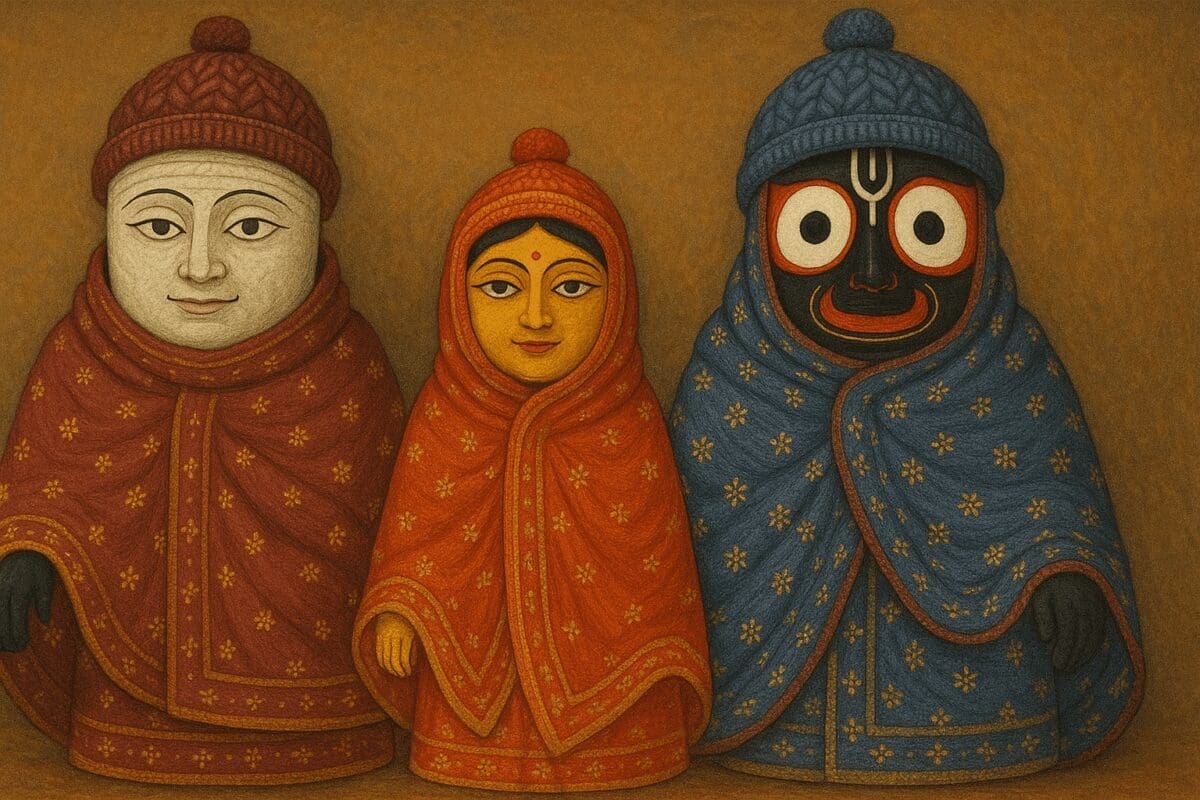
Prabarana/Odhana Sasthi marks the beginning of the winter clothing cycle for the deities. The change of season is answered with seva: Mahaprabhu, Balabhadra and Subhadra are cared for through warmer coverings and appropriate attire. The festival beautifully expresses the Jagannath principle that the Deities are served as living, beloved persons whose comfort matters.
Odhana Sasthi is a festival of divine clothing and seasonal care. As cold weather becomes established, warmer textiles enter the service of Mahaprabhu, Balabhadra and Subhadra. Theologically, the rite makes tenderness visible. The Lord who sustains the cosmos accepts cloth offered for comfort. Fabric becomes a medium of affection, and the seasonal body of the community is mirrored in the seasonal seva of the Deities.
A defining feature of Jagannath seva is the treatment of the Deities as living, beloved persons. They wake, bathe, dress, eat, rest, travel and respond to seasons. Winter clothing, summer water-play, early-morning food and festival adornment arise from this devotional intimacy. Theologically, this does not reduce the Divine to human limitation; it makes transcendence relational. The infinite Lord accepts care. Sevā therefore trains attention to another’s comfort, timing and dignity. At a deeper level, love is expressed through detail. A change of cloth, a carefully timed meal or a particular seasonal offering becomes sacred because care has been made concrete. Jagannath’s personhood teaches that devotion is not only emotion or philosophy but disciplined hospitality toward the Divine Presence.
Jagannath ritual repeatedly honours specialised craft as seva. Potters, carpenters, tailors, painters, flower workers, cooks and metal artisans do not merely supply objects to a temple; their inherited skills become part of worship. A vessel, garment, chariot component or ornament acquires sacred meaning because craft is joined to ritual purpose. This gives labour a theological dignity. Inwardly, interdependence: no major festival is produced by a single person or even by one category of sevaka. The finished darśana conceals a network of hands, measurements, materials and memories. Jagannath culture therefore preserves knowledge not only in scriptures but in practiced skill transmitted through communities.
Bhoga is one of the deepest theological languages of Jagannath culture. Food is grown, gathered, prepared, carried, offered and transformed into prasāda through relationship with the Divine. The process joins farmer, artisan, cook, sevaka, vessel, fire, water and sacred timing. Seasonal bhogas are especially revealing because they show that the Lord is served according to climate, harvest and local taste. Pithas, milk preparations, early-morning winter offerings or new-season produce are not merely menu changes; they express affection toward the Deities as living persons. The deeper teaching is that reciprocity. Human beings offer the best of material life to the Lord, and the returned prasāda dissolves the boundary between sacred worship and nourishment. Eating becomes connected with gratitude, community and grace.
Jagannath seva is deeply shaped by personal relationship. The Deities are approached through rhythms of waking, bathing, dressing, food, rest, journeys and seasonal comfort. Such service does not reduce the Divine to an ordinary human being; rather, it gives devotion a language of intimacy. Love becomes practical. A change of cloth in winter, an early offering, a cooling practice or a festive adornment says that care must notice conditions. The hidden teaching is that bhakti is attentive rather than merely emotional. To love is to observe, prepare and serve appropriately. Ritual detail becomes the grammar through which affection learns discipline.
Jagannath culture gives unusual dignity to skilled material work. Clay must have the right form, cloth must be cut and joined, wood must be measured, flowers must be arranged, food vessels must withstand heat and ornaments must sit correctly on sacred forms. Such knowledge is often transmitted through families and sevaka communities rather than through abstract manuals. Craft therefore becomes embodied memory. Its spiritual significance lies in precision offered without self-display. The object may later disappear into a larger ritual and the maker may remain unnamed, yet the seva is indispensable. This reverses the modern tendency to value only what is most visible.
Bhoga is ordinary nourishment deliberately re-situated in relationship with the Divine. Grain, milk, vegetables, spices, pitha, fruit or seasonal produce carry the labour of soil, rain, animals, farmers, cooks and sevakas. Offering gathers those dependencies into gratitude. Prasāda then returns food to the community with a transformed meaning: what sustains the body is also received as grace. This is why specific festival foods matter. They are not decorative menus but seasonal theology. Through taste and nourishment, an otherwise abstract truth becomes tangible—the devotee lives by gifts that were never created by individual effort alone.
Jagannath tradition repeatedly teaches through embodied signs: movement gives theology a route, food gives gratitude a taste, adornment gives scripture a visible form, and lunar or solar timing gives remembrance a place in the cosmos. In Prabarana / Odhana Sasthi, these signs do not function as decoration around belief; they are the way belief is enacted. The sacred meaning therefore rests in disciplined relationship—between the Deity and sevaka, memory and performance, inherited form and living devotion. What appears outwardly as a festival becomes inwardly a training in attention: to recognise dependence, honour order, restrain ego and receive divine presence through the concrete language of ritual.
The inherited name itself is part of the ritual archive. It compresses deity, action, tithi or sacred mood into a form that can be remembered and transmitted across generations, showing how sacred vocabulary carries knowledge even when the complete ceremonial sequence is not written out.
Odhana Sasthi makes seasonal tenderness visible through cloth. As winter settles in, warmer garments enter the service of Jagannath, Balabhadra and Subhadra. The theological beauty lies in the apparent paradox: the Lord who sustains the cosmos accepts human care for warmth. Devotion is therefore trained to notice conditions. Fabric, stitching and seasonal timing become a language of affection. The deeper lesson extends beyond ritual: genuine love is attentive enough to change its form when circumstances change, rather than repeating the same gesture without regard for need.
Odhana begins the winter clothing cycle of the Deities in Shree Mandira. Odhana expresses care through warmer textiles, showing that seasonal change is answered through seva. In Odhana, cloth becomes more than decoration because it carries affection and concern for the comfort of Mahaprabhu, Balabhadra and Subhadra. The tenderness of Odhana reflects the Jagannath tradition of serving the Deities as living, beloved persons. Odhana also reminds devotees that devotion is expressed through attention to changing needs. Through Odhana, winter itself enters the ritual calendar. The observance of Odhana therefore makes seasonal care visible through sacred clothing and daily service.
For the winter food-offering cycle that follows in the sacred calendar, explore Dhanu Sankranti & Pahili Bhoga.