
Makara Sankranti
Sep
Makara Sankranti
Makara Sankranti in Jagannath Tradition
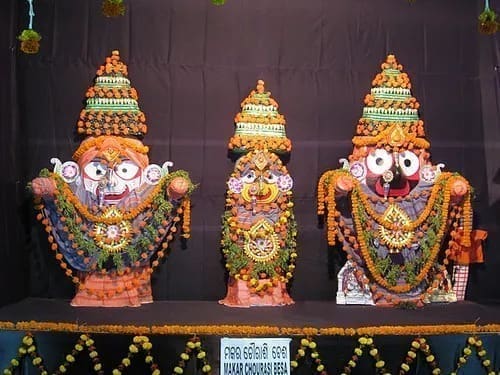
Makara Sankranti marks the Sun’s entry into Makara (Capricorn) and the beginning of Uttarayana in traditional reckoning. In Odisha it is a harvest-rich festival, and in Shree Mandira the seasonal change is expressed through distinctive offerings and adornment. The day gathers astronomy, agriculture and devotion into a single act of gratitude.
Makara Sankranti joins the Sun’s northward seasonal turn with harvest abundance. In Odisha, makara chaula and new produce embody the agricultural side of the festival, while Shree Mandira expresses the same transition through distinctive bhoga and adornment. The sacred meaning emerges from convergence: celestial movement, ripened grain, community food and divine offering all testify that life depends on rhythms larger than individual effort.
Sankranti belongs to the solar layer of sacred time. It marks the Sun’s passage from one zodiacal sign to another and therefore reminds the ritual world that time is read through more than lunar tithis. Agriculture, season, temperature, harvest and the changing path of sunlight all enter religious experience through solar observances. In Odisha, these transitions are often accompanied by characteristic foods, offerings or changes in social custom because the movement of the heavens is felt in the body and the field. The deeper symbolism is one of passage without rupture. The Sun continues its course, yet each threshold is named and honoured. Human life is similarly composed of transitions that become meaningful when consciously received. Within Jagannath culture, solar time joins lunar ritual, agricultural produce and temple sevā, showing a cosmos in which astronomy and devotion are not separate domains.
Harvest-linked observances reveal how Jagannath culture receives the agricultural year as sacred. New grain, milk, sesame, fruit, blossoms and winter produce enter the ritual world at particular seasonal thresholds. The farmer’s dependence on rain, soil, sunlight and cattle becomes visible in offerings that return a portion of abundance to the Divine. This is not simply thanksgiving after success; it is recognition that production is never entirely individual. At a deeper level, reciprocity with the living environment. Land gives nourishment, communities give labour, the temple gives sacred form to gratitude, and prasāda returns the offering into social life. Agriculture and worship thus become parts of one cycle rather than separate economic and religious activities.
Bhoga is one of the deepest theological languages of Jagannath culture. Food is grown, gathered, prepared, carried, offered and transformed into prasāda through relationship with the Divine. The process joins farmer, artisan, cook, sevaka, vessel, fire, water and sacred timing. Seasonal bhogas are especially revealing because they show that the Lord is served according to climate, harvest and local taste. Pithas, milk preparations, early-morning winter offerings or new-season produce are not merely menu changes; they express affection toward the Deities as living persons. Inwardly, reciprocity. Human beings offer the best of material life to the Lord, and the returned prasāda dissolves the boundary between sacred worship and nourishment. Eating becomes connected with gratitude, community and grace.
Solar festivals express gratitude for the visible tradition of light, warmth and biological life. Surya is experienced not only as an astronomical body but as a sacred witness to time, health and the rhythm of work. Odisha preserves especially strong solar memories through observances such as Sāmba Daśamī and Māgha Saptamī. The Sāmba narrative connects illness, repentance and healing with worship of the Sun, while Ratha Saptamī imagery evokes the solar chariot and the forward movement of light. The deeper teaching is that disciplined renewal. Sunrise returns daily without noise, making steadiness itself a sacred quality. Solar worship therefore links health with rhythm, not merely with miraculous cure, and places human vitality within dependence on cosmic order.
A defining feature of Jagannath sevā is the treatment of the Deities as living, beloved persons. They wake, bathe, dress, eat, rest, travel and respond to seasons. Winter clothing, summer water-play, early-morning food and festival adornment arise from this devotional intimacy. Theologically, this does not reduce the Divine to human limitation; it makes transcendence relational. The infinite Lord accepts care. Sevā therefore trains attention to another’s comfort, timing and dignity. Its inward teaching is that love is expressed through detail. A change of cloth, a carefully timed meal or a particular seasonal offering becomes sacred because care has been made concrete. Jagannath’s personhood teaches that devotion is not only emotion or philosophy but disciplined hospitality toward the Divine Presence.
Sankranti reminds the devotee that sacred time is astronomical and embodied at once. The Sun’s apparent movement changes the length and quality of daylight, influences agricultural work and marks seasonal shifts that are felt in food, clothing and daily rhythm. When a solar transition enters temple ritual, the cosmos is not treated as distant scenery. Human life, crop cycles and worship are placed inside the same order. This is a deep feature of Odishan tradition: ritual does not separate theology from climate and cultivation. The Sun’s continuity through each transition becomes a symbol of steady dharma moving through changing conditions.
Harvest festivals teach that food is received before it is owned. Seed, soil, water, sunlight, labour and time converge before grain or fruit reaches the hand. Offering new produce to the Divine places gratitude before consumption. It also acknowledges uncertainty: agriculture depends upon forces that no household completely controls. Seasonal offerings are therefore not primitive leftovers from an agricultural past; they express a sophisticated ethics of dependence. In Jagannath culture, new rice, milk, sesame, fruit and other seasonal foods enter sacred service at particular times, joining the temple’s ritual body with the ecological life of Odisha.
The inherited name itself is part of the ritual archive. It compresses deity, action, tithi or sacred mood into a form that can be remembered and transmitted across generations, showing how sacred vocabulary carries knowledge even when the complete ceremonial sequence is not written out.
Makara Sankranti brings together Uttarayana, harvest, new food and solar worship. The Sun’s apparent northward turn provides a celestial marker, while agricultural abundance gives the transition an earthly body. In Odisha, preparations such as makara chaula express this convergence through taste. The deeper lesson is reciprocity: grain ripens because soil, water, sunlight, labour and time cooperate. Offering before eating acknowledges that no harvest is purely individual achievement. The festival therefore transforms abundance from possession into gratitude and reminds the community that nourishment belongs within a larger cosmic ecology.
Makara marks the solar transition into Capricorn and the beginning of Uttarayana. Makara also carries the flavour of Odisha’s harvest season through new grain, seasonal food and temple offerings. In Shree Mandira, Makara becomes a meeting point of astronomy, agriculture and devotion. The sacred mood of Makara reminds devotees that human life depends on rhythms larger than individual effort. Makara therefore joins gratitude for the Sun, the harvest and Jagannath in a single seasonal observance. Remembering Makara is also a way of honouring the bond between sacred time and the land.
For another Odisha solar festival, explore Samba Dashami.