
Bakula Amabasya Sagara Bije

Sep
Bakula Amabasya Sagara Bije
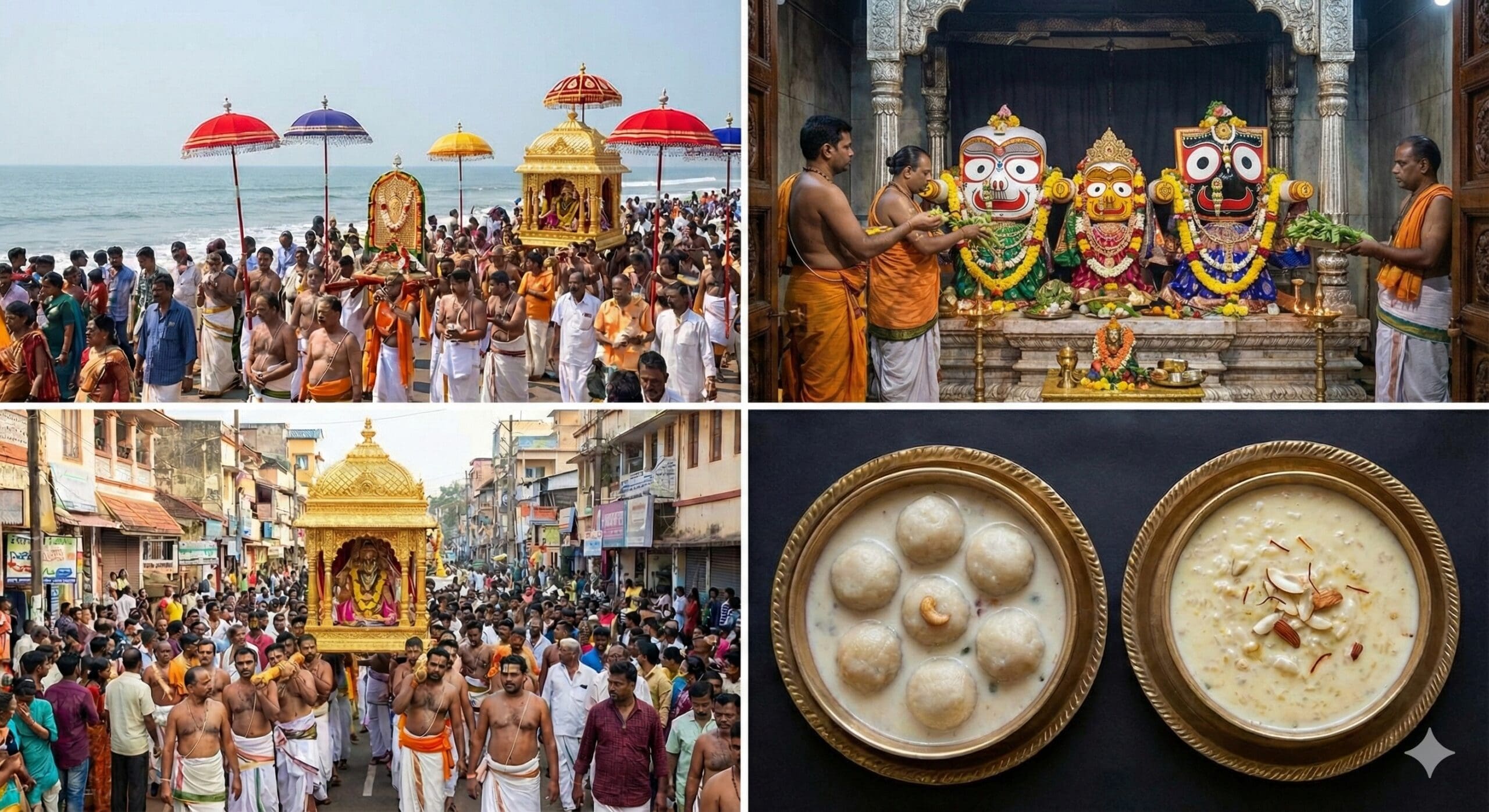
Bakula Amabasya and Sagara Bije in Puri
Bakula/Baula Amabasya is an Odishan new-moon observance associated with mango blossom and the agricultural rhythm of the coming fruit season. In Odisha, mango blossoms are treated with reverence and offered in devotional contexts. The Shree Mandira title also includes Sagara Bije, joining seasonal nature symbolism with Puri’s sacred ocean geography.
Bakula or Baula Amabasya is associated in Odisha with the first mango blossoms and the hope of future fruit. A small blossom contains a promise that is not yet visible as harvest. Sagara Bije adds the immense sea to this delicate seasonal symbol. Blossom and ocean together express two scales of dependence: the tiny beginning of future nourishment and the vast natural order within which that beginning is possible.
Amabasya is the dark-moon threshold, a lunar moment associated in many traditions with ancestors, inwardness and rites of purification. The absence of visible moonlight creates a symbolic reversal from external brightness toward memory and unseen continuity. In Odisha, particular Amabasyas acquire distinctive identities through food, seasonal plants, sea journeys or ancestral observances. At a deeper level, not negativity but depth. What disappears from sight is not necessarily absent. Amabasya trains attention toward roots, lineage and subtle dependence, making it a natural setting for tarpana, remembrance and acts of renewal.
Harvest-linked observances reveal how Jagannath culture receives the agricultural year as sacred. New grain, milk, sesame, fruit, blossoms and winter produce enter the ritual world at particular seasonal thresholds. The farmer’s dependence on rain, soil, sunlight and cattle becomes visible in offerings that return a portion of abundance to the Divine. This is not simply thanksgiving after success; it is recognition that production is never entirely individual. Inwardly, reciprocity with the living environment. Land gives nourishment, communities give labour, the temple gives sacred form to gratitude, and prasāda returns the offering into social life. Agriculture and worship thus become parts of one cycle rather than separate economic and religious activities.
The Mahodadhi, the sacred sea of Puri, is more than a landscape feature. It forms one edge of Śrīkṣetra’s ritual imagination and represents vastness, purification, origin and return. Sagara Bije makes the relationship between temple and ocean explicit through ceremonial movement. The route from the temple toward the sea allows urban streets and neighbourhood shrines to become part of a sacred circuit. Water at the boundary of land is a fitting symbol for Amabasya, when visible light diminishes and attention turns toward memory, depth and unseen continuity. The deeper teaching is that the fixed centre and the immeasurable horizon belong together: Jagannath’s presence is enthroned, yet His sacred geography opens toward the ocean’s apparent infinity.
Bije signifies ceremonial movement of a deity or representative image. It reveals a crucial feature of Śrīkṣetra: sacred presence is not imprisoned inside one architectural centre. A Bije links the principal temple with maṭhas, āśramas, subsidiary shrines, neighbourhoods, gardens, tanks or the sea, depending on the observance. The route is therefore theological geography. When a deity moves, relationships between places become visible and the city is experienced as a sacred field rather than as ordinary urban space surrounding a shrine. Procession also changes the relationship between deity and community. The Divine crosses thresholds and enters shared space, while sevakas, sound, offerings and local institutions participate in a moving network of service. The hidden meaning of Bije is extension: grace radiates from the centre and returns, binding multiple sacred nodes into one living body.
Odishan festivals often bind family affection, agricultural season and sacred symbolism into one practice. A firstborn child, an āmla tree, mango blossom, sesame, new rice, milk or a particular pitha can become the centre of ritual attention. Such observances show that culture survives through ordinary materials rather than through abstract doctrine alone. The household becomes a small theatre of memory where elders transmit names, foods, gestures and stories to the next generation. This domestic layer is deeply compatible with Jagannath culture because Mahāprabhu Himself is served through food, clothing, kinship language and seasonal care. Its inward teaching is that continuity embodied in matter: tradition is remembered through what is cooked, worn, offered, touched and shared.
Amabasya is the conjunction in which the Moon disappears from ordinary night-time sight. Ritual traditions often turn this absence toward ancestors, purification, silence or rites that acknowledge hidden continuity. Darkness here need not signify evil. It can signify the unmanifest—what is present without being visibly displayed. This makes Amabasya a natural counterpoint to Pūrṇimā. One celebrates radiance; the other teaches reverence for what cannot be seen. In Jagannath culture, particular Amabasyas acquire distinctive bhogas, journeys and ancestral associations, showing how a universal lunar condition is given local theological form.
Harvest festivals teach that food is received before it is owned. Seed, soil, water, sunlight, labour and time converge before grain or fruit reaches the hand. Offering new produce to the Divine places gratitude before consumption. It also acknowledges uncertainty: agriculture depends upon forces that no household completely controls. Seasonal offerings are therefore not primitive leftovers from an agricultural past; they express a sophisticated ethics of dependence. In Jagannath culture, new rice, milk, sesame, fruit and other seasonal foods enter sacred service at particular times, joining the temple’s ritual body with the ecological life of Odisha.
The sea at Puri is both geographical edge and sacred presence. Mahodadhi receives sunrise, wind, pilgrimage memory and rites connected with purification and ancestral remembrance. When a temple Bije reaches toward the ocean, the movement joins the enclosed order of the temple with the vast, open horizon. Water here symbolises both boundary and continuity: land ends, yet the sea connects distant shores. In Jagannath imagination this creates a powerful contrast between the carefully ordered sanctum and the immeasurable expanse of creation.
Bakula or Baula Amabasya and Sagara Bije bring a tiny mango blossom and the vast Mahodadhi into one sacred horizon. The blossom is promise rather than harvest; its fruit exists only as potential. The ocean represents an immeasurable field of forces on which human life depends. Together they teach humility before process. Much of what sustains life begins invisibly—flowering, gestation, memory, seasonal change—long before results can be possessed. Offering the first sign of future abundance acknowledges that hope itself is received and should be held with gratitude rather than entitlement.
Bakula marks the new-moon season through the delicate promise of mango blossom. Bakula connects agricultural hope with devotional gratitude, because a small blossom already carries the possibility of future fruit. In Odisha, Bakula therefore brings nature, household memory and sacred offering together. Bakula Amabasya also gains a distinct Puri dimension through Sagara Bije, where the festival reaches toward the sacred sea. The symbolism of Bakula moves from blossom to harvest, while Bakula also reminds devotees to honour beginnings before their results are visible. Remembering Bakula is a practice of gratitude for the hidden stages of growth.
For another Amabasya Sagara Bije observance in Puri, explore Madhya Deva Deepavali & Amabasya Sagar Bije.
Meaning of Bakula Amabasya
Bakula Amabasya honours the first promise of fruit carried by the mango blossom. Bakula Amabasya links the dark-moon threshold with agricultural hope. In Odisha, Bakula Amabasya is remembered through reverence for seasonal growth and future harvest. Bakula Amabasya also teaches patience because blossom comes before fruit. The devotional mood of Bakula Amabasya turns that patience into gratitude. Bakula Amabasya becomes especially distinctive in Puri when it is joined with Sagara Bije. Through Bakula Amabasya, the tiny blossom and the vast sea meet within one sacred imagination. Bakula Amabasya therefore brings together household memory, nature and temple geography. For devotees, Bakula Amabasya is a reminder to honour beginnings before results become visible. The quiet symbolism of Bakula Amabasya makes the observance both seasonal and deeply spiritual.
Sagara gives this observance its unmistakable Puri geography. Sagara links the new-moon ritual with the Mahodadhi, while Sagara also expands the festival from seasonal blossom to sacred ocean. The movement toward Sagara expresses purification and return. In Puri, Sagara is not scenery alone but part of the ritual landscape. The presence of Sagara therefore deepens the meaning of Bakula Amabasya, and Sagara becomes the vast counterpart to the fragile mango blossom.