
Articles
Adharapana Offered on the Chariots of Mahaprabhu
Aug
After Suna Besha and before Niladri Bije, one of the most meaningful rituals of Ratha Yatra is performed upon the three sacred chariots. This ritual is known as Adharapana—the offering of a specially prepared divine drink in tall earthen pots that rise up to touch the lips of Shri Jagannath, Shri Balabhadra and Devi Subhadra.
Adharapana is one of the most distinctive traditions of Shri Jagannath culture.
It is visually grand, spiritually mysterious and deeply connected with the compassionate nature of Mahaprabhu.
During this ritual, three tall earthen pots are placed before each of the three principal deities seated on their respective chariots.
Therefore, a total of nine pots are used:
- Three on Nandighosha, the chariot of Shri Jagannath
- Three on Taladhwaja, the chariot of Shri Balabhadra
- Three on Darpadalana, the chariot of Devi Subhadra
The pots are made so tall that their upper portion reaches the lips, or Adhara, of the deities.
This is why the offering is called Adharapana.
The word Adhara means the lips, while Pana means a cooling or refreshing drink.
The most surprising feature of the ritual comes after the offering is completed.
The sacred drink is not distributed among the assembled devotees in the usual manner.
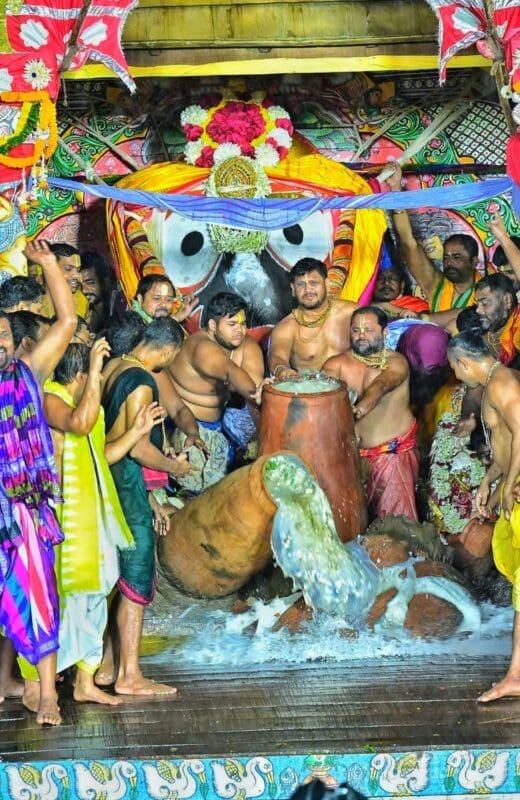
Instead, the nine earthen pots are broken upon the chariots while they are still filled with the offered Pana.
The sweet liquid flows across the platforms of the Raths.
Why are such large pots deliberately broken after being offered to Mahaprabhu?
To understand this, we must first look at the ritual, its history and its deeper spiritual purpose.
Adharapana in the Ratha Yatra Sequence
Adharapana is performed during the final stage of the annual Ratha Yatra.
By this time, the deities have completed their sacred journey to Shri Gundicha Temple and returned towards Shri Mandira during Bahuda Yatra.
The three chariots stand near Singhadwara, the Lion’s Gate of Shri Jagannath Temple.
The sequence of the concluding rituals includes:
- Bahuda Yatra
- Suna Besha
- Adharapana
- Niladri Bije
Therefore, Adharapana takes place after the magnificent golden attire of Suna Besha and before the deities re-enter Shri Mandira during Niladri Bije.
In the present tradition, the ritual is generally performed on Ashadha Shukla Dwadashi, the day following Suna Besha.
It takes place after the completion of Madhyahna Dhupa and the necessary preliminary rituals.
A Cooling Offering After the Sacred Journey
The simplest meaning of Adharapana is connected with the journey of the deities.
Mahaprabhu Shri Jagannath, Shri Balabhadra and Devi Subhadra have travelled from Shri Mandira to Shri Gundicha Temple and returned during Bahuda Yatra.
The sacred tradition treats the deities as living members of the family.
They wake, bathe, eat, rest, travel, become unwell and return home.
Just as a traveller may be offered water or a refreshing drink after completing a long journey, the deities are offered Pana to relieve the tiredness of travel.
This understanding reflects the intimate devotion of Jagannath culture.
Mahaprabhu is the Supreme Lord of the universe, yet devotees lovingly serve Him with the affection shown towards a beloved family member.
But the breaking of the pots reveals that Adharapana carries a meaning far deeper than refreshment alone.
The Earlier Observance of the Ritual
Traditional accounts indicate that Adharapana was not always performed on Dwadashi.
In earlier times, it was associated with Bahuda Dashami.
After the returning chariots reached the area near Singhadwara, the Pana was offered to the deities seated upon them.
However, the chariots did not always complete the Bahuda journey and reach Singhadwara on the same day.
The movement of the three enormous Raths depended upon many circumstances.
As a result, it became difficult to perform Adharapana regularly on Dashami.
The observance was therefore moved to Ekadashi.
At one stage, six pots—two upon each chariot—were offered on Ekadashi. The remaining three pots, one on each Rath, were offered on Dwadashi.
But this arrangement also created practical difficulties.
Ekadashi is the day of Suna Besha.
Huge numbers of devotees gather to receive the golden darshan of the deities. Hari Shayana rituals are also associated with this sacred period.
Because of the many important Nitis and the large gathering of devotees, sufficient time was not always available for Adharapana.
Eventually, all nine pots came to be offered together on Dwadashi.
This shows an important feature of living temple tradition.
The central meaning of the ritual remains protected, while its scheduling may be carefully adjusted according to the wider sequence of established Nitis.
Earlier Offerings for the Bije Pratimas
Traditional descriptions also mention that smaller pots of Pana were once offered to certain Bije Pratimas accompanying the principal deities.
These included:
- Shri Madanamohana associated with Shri Jagannath
- Rama and Krishna associated with Shri Balabhadra
Three additional smaller pots were reportedly offered for these accompanying deities.
In the present observance, the most visible and established form consists of nine large Adharapana pots—three for each of the three principal deities upon the chariots.
The Forgotten Amritakunda Offering
Historical and ritual discussions of Adharapana sometimes mention an earlier Pana offering called Amritakunda.
Towards the end of the seventeenth century and the beginning of the eighteenth century, a special drink known by this name was reportedly offered to Shri Jagannath.
The word Amritakunda suggests a vessel or reservoir of nectar.
Descriptions associated with Niladri Mahodaya mention a preparation containing ingredients such as:
- Water
- Sugar candy or crystallised sugar
- Milk
- Chhena
- Milk cream
- Ripe banana
- Camphor
- Black pepper powder
The Mahasuara prepared this rich drink according to the prescribed method and offered it to Mahaprabhu.
In earlier times, when the entire Bada Danda route was not as smooth and accessible as it is today, Balagandi served as an important resting place for the chariots.
The Amritakunda Pana was reportedly offered there.
That particular offering is no longer practised in the same form.
However, some of its ritual and culinary memory appears to survive within the Adharapana tradition.
Who Provides the Adharapana Ingredients?
The preparation of Adharapana requires the cooperation of temple institutions, Maths and authorised Sevayats.
Traditionally, the ingredients for the offering were supplied by:
- Raghava Das Matha
- Bada Odia Matha
- The Gajapati Maharaja
After the administration of Shri Mandira came under a formal governmental management structure, the temple administration began providing the portion previously associated with the Gajapati Maharaja.
The services of Raghava Das Matha and Bada Odia Matha have continued within the tradition.
This collective arrangement once again shows that no major Jagannath ritual is sustained by one individual alone.
It depends upon inherited responsibility, cooperation and continuity.
The Nine Ingredients of Adharapana
The sacred drink is prepared with nine principal ingredients.
These are traditionally described as:
- Milk
- Milk cream
- Chhena
- Sugar candy or crystallised sugar
- Ripe bananas
- Black pepper powder
- Nutmeg
- Camphor
- Water
These ingredients create a rich, fragrant and cooling drink.
The mixture contains sweetness, nourishment, aroma and mild spice.
The use of milk, cream, chhena and banana gives it fullness.
Camphor and nutmeg add fragrance.
Black pepper introduces a subtle warmth and sharpness.
The final preparation is therefore more than an ordinary beverage.
It is a carefully prepared sacred offering.
The Sacred Water Used in the Preparation
Water is an essential part of the Adharapana.
Earlier, the water was reportedly brought from Radha Ballabha Matha in Dolamandapa Sahi, located near Shri Mandira.
In the present practice, water is brought from Chhauni Matha near Singhadwara.
The Paniapata Sevayats carry the water with ritual purity and care.
The water is not treated merely as a kitchen ingredient.
Its collection and transportation form part of the sacred preparation.
The Palia Mahasuara Sevayats then prepare the Pana according to the established procedure.
The drink is first mixed in large brass vessels.
After preparation, it is poured into the nine tall Adhara pots placed upon the chariots.
The Tall Adharapana Pots
The earthen vessels used in this ritual are among its most striking features.
They are:
- Tall
- Narrow
- Tumba-shaped
- Made of fired clay
- Specially prepared for the occasion
The height of each pot is carefully arranged so that it reaches the lips of the deity seated upon the Rath.
The pots are supported at their base with raw clay so that they can stand securely upon the chariot platform.
Their shape and height are not merely decorative.
They give the ritual its name and visual identity.
The vessel rises from the chariot floor towards the divine lips, symbolising a complete offering reaching directly to Mahaprabhu.
Preparation of the Chariots for the Offering
Before the offering begins, authorised Sevayats prepare the three chariots.
Traditional descriptions associate the cloth enclosure with:
- Taluchha Mahapatra on Shri Jagannath’s chariot
- Bhitarchha Mahapatra on Shri Balabhadra’s chariot
- Palia Pushpalaka on Devi Subhadra’s chariot
A cloth screen is created around the sacred area.
The chariot is purified.
The Tera, or ritual screen, is tied before the offering.
The Pujapanda Sevayats then perform the Bhoga offering according to established procedure.
Every stage follows a defined order.
The ingredients, pots, water, preparation, placement and offering are all part of one coordinated ritual system.
Why Are the Pots Broken?
After the Pana is offered, the nine pots are broken upon the chariots.
This is the most widely discussed aspect of Adharapana.
Several interpretations are found in traditional and scholarly discussions.
These interpretations need not always be treated as mutually exclusive.
They may represent different layers of meaning that gathered around the ritual over time.
The Dahi Handi Interpretation
One view connects the breaking of the Adhara pots with the Vaishnava memory of Shri Krishna’s playful breaking of curd pots.
Krishna’s childhood pastimes often involve butter, curd and earthen vessels.
The breaking of a pot can therefore recall divine playfulness and the joy of Krishna Bhakti.
However, Adharapana has its own distinct ritual purpose within Ratha Yatra.
The resemblance may offer one symbolic association, but it does not completely explain the entire practice.
A Possible Tantric Association
Another interpretation connects the ritual with certain Tantric customs.
Some practitioners following particular vows traditionally consumed food before sunset and did not preserve the remaining food for the next day.
The used earthen vessel could be broken after the observance.
Because the Adharapana pots are made of fired clay, fixed with raw clay and filled with a preparation of multiple ingredients, some writers have looked for a Tantric ritual background.
References to texts such as Sharada Tilaka are sometimes mentioned in support of this view.
Such interpretations should be approached respectfully and carefully.
Jagannath culture has absorbed many sacred streams over centuries, including Vaishnava, Shaiva, Shakta, tribal and Tantric influences.
Its rituals may carry more than one symbolic layer.
The Symbolism of Forty-Two Bananas
Some traditional discussions state that forty-two bananas are used in preparing the Pana.
Because the three chariots together have forty-two wheels, some people connect the bananas with the total number of Rath wheels.
Taladhwaja has fourteen wheels.
Darpadalana has twelve wheels.
Nandighosha has sixteen wheels.
Together, they total forty-two.
This symbolic connection is meaningful within popular interpretation, although the principal ritual meaning of Adharapana does not depend upon this numerical association alone.
The Most Widely Accepted Traditional Meaning
The most important traditional explanation for breaking the pots concerns the divine and invisible beings associated with the chariots.
During Ratha Yatra, daily offerings are made to the Chaturdha Murti, the accompanying Bije Pratimas and the deities associated with the Rath flags.
However, many Parshva Devatas—the subsidiary deities placed around the chariots—do not receive a separate daily Bhoga in the same manner.
Temple tradition also speaks of many invisible beings, divine attendants and disembodied spiritual entities travelling with and surrounding the chariots during Gundicha Yatra and Bahuda Yatra.
They remain close to Mahaprabhu and long to receive the grace of His offered food.
The Adharapana is therefore offered to the principal deities first.
Once it has received Mahaprabhu’s touch and blessing, the pots are broken.
The sacred drink flows across the chariot platform and down around the Rath.
According to traditional belief, the Parshva Devatas, divine attendants and invisible beings receive this nectar-like offering.
They become satisfied and receive spiritual upliftment through Mahaprabhu’s grace.
This is why the drink is not distributed among ordinary devotees.
It is specially intended for the unseen beings and accompanying deities connected with the sacred journey.
Compassion Beyond the Visible World
This interpretation reveals the extraordinary compassion of Jagannath culture.
Mahaprabhu’s grace is not limited to those who are publicly visible.
It extends to:
- Subsidiary deities
- Divine attendants
- Invisible beings
- Restless spiritual entities
- Those seeking liberation
- All beings dependent upon divine mercy
The breaking of the pots therefore does not represent waste.
It represents distribution beyond ordinary human sight.
What appears to be destruction is actually an act of offering.
The vessel breaks, but grace spreads.
The liquid is not preserved for private possession.
It is released for beings who cannot stand in the public line of devotees.
Why Devotees Do Not Receive This Pana
Mahaprasada is generally shared among devotees with great reverence.
Adharapana is different because its ritual purpose is specially directed towards the beings associated with the chariots.
Once the Pana has been offered, the pots are immediately broken.
The liquid flows upon the Rath instead of being collected for public distribution.
This distinction teaches that not every sacred offering has the same ritual destination.
Some offerings are distributed among devotees.
Some are used in specific Nitis.
Some are offered to guardians, subsidiary deities or other beings within the sacred order.
The meaning of an offering depends upon the ritual for which it was prepared.
The Pot as a Symbol of the Human Ego
The breaking of the Adhara pot can also be understood symbolically.
The earthen pot resembles the human body.
It is formed from earth.
It can hold nourishment for a limited time.
Eventually, it breaks and returns to the elements.
The Pana within it may be compared to divine grace.
When the pot of ego remains tightly closed, grace is treated as private possession.
When the pot breaks, grace flows outward.
The ritual therefore invites the devotee to ask:
- Am I holding divine blessings only for myself?
- Can my wealth nourish others?
- Can my knowledge be shared?
- Can my work become service?
- Can my pride be broken so that compassion may flow?
This symbolic reading does not replace the established ritual meaning.
It helps modern readers recognise the inner teaching contained within the outward act.
Receiving, Not Possessing
Adharapana also challenges the idea that sacred things must always be possessed.
The devotees see a rich offering.
Yet they do not receive it for personal consumption.
They witness it being released for others.
This trains spiritual maturity.
Devotion is not only about asking:
“What will I receive?”
It also asks:
“Who else needs grace?”
The unseen beings around the chariots are remembered.
The ritual expands compassion beyond the visible crowd.
Respecting Living Temple Tradition
Adharapana belongs to the living ritual system of Shri Mandira.
Its preparation and performance depend upon:
- Authorised Sevayats
- Established Matha services
- Temple administration
- Ritual purity
- Correct sequence
- Traditional ingredients
- Proper chariot arrangements
A written explanation can help devotees understand its beauty.
However, it cannot replace the authority of established temple practice or qualified ritual guidance.
The exact timings and procedural details may depend upon the official Niti schedule of the year.
The tradition should therefore be approached with humility rather than personal invention.
Practical Spiritual Lessons From Adharapana
Offer Refreshment to the Tired
The ritual begins with care for those who have completed a journey.
Hospitality is a form of devotion.
Share Grace Beyond Your Own Circle
Divine blessings are not meant only for those we can see or personally know.
Do Not Treat Every Offering as Private Property
Some gifts are meant to be released for the welfare of others.
Respect Collective Service
Mathas, Sevayats, cooks, water carriers, potters, administrators and priests all participate in one sacred act.
Let the Ego-Pot Break
When pride is broken, compassion can flow more freely.
Remember the Forgotten
The ritual gives attention to beings who remain unseen and usually unacknowledged.
Preserve Sacred Sequence
Adharapana comes at a specific stage between Suna Besha and Niladri Bije. Sacred traditions gain meaning through proper order.
Central Teaching of Adharapana
The central message can be expressed simply:
Adharapana is the sacred Pana offered in nine tall earthen pots to Shri Jagannath, Shri Balabhadra and Devi Subhadra after Suna Besha. After receiving the Lord’s touch, the pots are broken so that the divine drink may be offered to the Parshva Devatas, invisible attendants and spiritual beings accompanying the chariots.
The journey is almost complete.
Mahaprabhu has returned near Singhadwara.
The golden splendour of Suna Besha has been revealed.
The tall earthen pots rise towards the divine lips.
Milk, cream, chhena, banana, sugar, spice, fragrance and water become one sacred drink.
The Pana is offered.
The pots are broken.
The nectar flows.
Visible devotees watch.
Invisible beings are remembered.
The vessel is destroyed, but the offering is fulfilled.
🙏 Adharapana refreshes the deities after their sacred journey.
🙏 Nine pots are offered—three on each chariot.
🙏 The ritual is now performed on Ashadha Shukla Dwadashi.
🙏 The drink is prepared with nine traditional ingredients.
🙏 Authorised Sevayats and temple institutions perform the service.
🙏 The Pana is not distributed among ordinary devotees.
🙏 The pots are broken for the Parshva Devatas and unseen beings associated with the Raths.
🙏 The ritual reveals Mahaprabhu’s compassion for all forms of life.
The chariots will soon become empty.
The deities will return to Ratna Singhasana during Niladri Bije.
But before entering Shri Mandira, Mahaprabhu remembers every being that accompanied His journey.
No one is forgotten.
No one is beyond His compassion.
❤️ The pots break, but grace does not end. It spreads in every direction from the sacred chariots of Mahaprabhu.
🙏 Jai Jagannath Swami Nayana Pathagami Bhavatu Me


