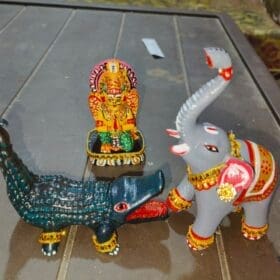
Kansabadha Prastaba, Labanikhia & Mathurahata Jura

Apr

Kansabadha Prastaba, Labanikhia & Mathurahata Jura
Kansabadha Prastaba in the Krishna Lila Cycle
Kansabadha Prastāba belongs to the narrative movement toward Kṛṣṇa’s confrontation with Kaṁsa at Mathurā. The word prastāba indicates a proposal, announcement or narrative preparation rather than merely the final act. In the sequence of temple līlās, such preparatory stages allow the story to unfold over multiple dates instead of collapsing an entire sacred narrative into one day. Labanikhia is preserved in the spelling used by the Śrī Mandira ritual cycle. It is one of the compact traditional terms whose full procedural meaning belongs to the specialised sevā vocabulary of Śrī Mandira. Mathurāhāṭa Jura evokes the Mathurā setting within the Kṛṣṇa narrative cycle. Śrī Mandira’s līlā ritual cycle often works through places, proposals and dramatic transitions, allowing devotees to move imaginatively from Vraja toward Mathurā while remaining in Śrīkṣetra. The sacred geography of story is thus recreated through temple time.
The Mathurā-oriented līlās mark a change of emotional landscape from pastoral Vraja toward confrontation with royal oppression. Kaṁsa embodies political fear: power attempts to destroy what prophecy says it cannot control. Kṛṣṇa’s movement toward Mathurā is therefore not only geographical but ethical—the sheltered child enters the public field where tyranny must be faced. Prastāba and related preparatory names preserve the drama before the decisive event, teaching that sacred action has stages and that courage develops before the moment of visible victory.
In the Jagannātha tradition, līlā is not treated as a story that has ended. Sacred narrative is allowed to enter ritual time, so a remembered episode of Kṛṣṇa can become an event with sequence, mood and dramatic movement. This is why the Bhādra period contains so many compact names connected with Kṛṣṇa’s childhood and youth. The temple preserves not only the final victory or miracle but also proposals, journeys, meetings, playful exchanges and moments of danger. At a deeper level, divine life is relational. Kṛṣṇa is known through the people, animals, landscapes and emotions around Him. Fear, friendship, tenderness, mischief and protection become theological languages. Jagannātha, though worshipped as the Lord of the Universe, therefore remains inseparable from the intimate Kṛṣṇa who enters the vulnerability of ordinary life. The līlā cycle joins cosmic divinity with remembered human feeling and turns time itself into a medium of sacred memory.
The demon-subduing and danger-resolving episodes of Kṛṣṇa-līlā carry more than the memory of a supernatural victory. Each disturbance represents a force that breaks right relationship: arrogance, violence, uncontrolled appetite, fear, deceit or the desire to dominate. Kṛṣṇa’s intervention restores order without making the vulnerable responsible for overcoming what is beyond their strength. In the theology of Jagannātha, this becomes a language of śaraṇāgati, refuge. Divine protection does not mean that danger never appears; it means that danger is not the final authority. The ‘asura’ can be understood as a condition of consciousness that consumes harmony from within. Its defeat points toward the recovery of clarity and dharma. The protective līlās are therefore remembered not as spectacles of force but as assurances that compassion, courage and right order possess a deeper foundation than chaos.
Royal imagery in Śrī Mandira reverses ordinary political hierarchy. Jagannātha is Rājādhirāja, the King of kings, so earthly authority is meaningful only when understood as service beneath a higher sovereignty. Royal beshas, ceremonial commands and abhiṣeka imagery do not merely glorify power; they relativise it. Crown, weapon, throne and procession point beyond human rulers toward divine order. The hidden teaching is responsibility. True sovereignty protects, nourishes and upholds dharma rather than demanding worship for itself. This principle has shaped the historical relationship between the Gajapati king and Jagannātha, where royal dignity is repeatedly expressed through acts of sevā. Majesty and humility thus meet in the same ritual language.
A repeated līlā does not claim that history is literally happening again. Its purpose is anubhava—renewed participation in meaning. Recitation gives the narrative words, iconography gives it form, and ritual sequence gives it time. Repetition also protects details that a single annual celebration might lose. A proposal can be remembered before a confrontation, a journey before an arrival, and a playful episode before a solemn one. The devotee therefore encounters Kṛṣṇa not as an abstract doctrine but through a sequence of relationships.
Purāṇic narratives speak about real mythic opponents, yet devotional interpretation has long recognised an inward dimension as well. A demon may embody pride, violent impulse, greed, deception, uncontrolled speed or fear. Kṛṣṇa’s victory then becomes a pattern of spiritual re-ordering. The point is not to label ordinary people as demons; it is to notice how destructive tendencies distort relationship and judgment. Protection begins when those forces no longer dictate action. In this way the victory of the Lord can be contemplated simultaneously as sacred story, assurance of divine refuge and a mirror for inner discipline.
Jagannātha tradition repeatedly teaches through embodied signs: movement gives theology a route, food gives gratitude a taste, adornment gives scripture a visible form, and lunar or solar timing gives remembrance a place in the cosmos. In Kansabadha Prastaba, Labanikhia & Mathurahata Jura, these signs do not function as decoration around belief; they are the way belief is enacted. The sacred meaning therefore rests in disciplined relationship—between the Deity and sevaka, memory and performance, inherited form and living devotion. What appears outwardly as a festival becomes inwardly a training in attention: to recognise dependence, honour order, restrain ego and receive divine presence through the concrete language of ritual.
The movement toward Kansabadha is deliberately staged rather than compressed. Prastāba, Labanikhia and Mathurā-oriented ritual names preserve the tension before the final confrontation. This matters because dharma is not restored only at the instant of victory; courage is formed through preparation, departure, uncertainty and the decision to face oppression. Kṛṣṇa’s journey from the pastoral world toward Mathurā is therefore an ethical transition. The sheltered child becomes the public challenger of tyranny, while Śrī Mandira turns that narrative progression into sacred time that devotees can revisit step by step.
Kansabadha marks the narrative movement toward Krishna’s confrontation with the oppressive king of Mathura. The Kansabadha sequence unfolds gradually through proposal, preparation and sacred enactment rather than a single isolated scene. In Kansabadha, temple time becomes narrative time, carrying devotees from Vraja toward Mathura. The ritual memory of Kansabadha therefore joins story, geography and seva. Kansabadha also expresses a recurring devotional theme: fear-based power cannot finally control divine purpose. Remembering Kansabadha turns the dramatic episode into reflection on courage, dharma and protection. Within the wider Jagannath festival calendar, Kansabadha remains part of the living Krishna-lila tradition. The Kansabadha observance preserves this sacred movement through ritual memory.
For another Krishna-lila observance, explore Dabgani Leela.