
Dabagni Leela
Apr
Dabagni Leela
Dabgani Leela and the Forest Fire
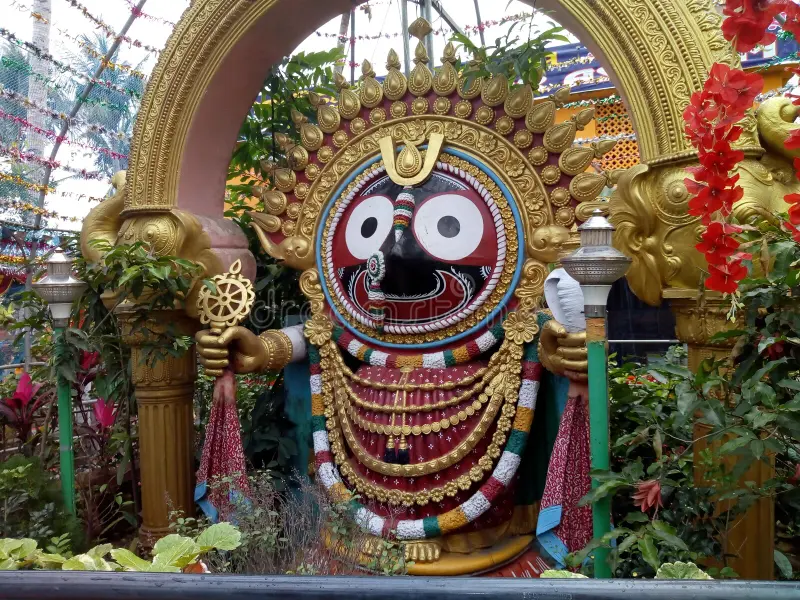
Dabgani or Dabgani Līlā recalls Kṛṣṇa’s protection of the cowherd community from a destructive forest fire. The Bhagavata tradition presents the Lord as the refuge when ordinary escape is no longer possible. In a Jagannātha setting the episode naturally becomes a meditation on protection, dependence and the astonishing ease with which divine grace can transform fear into safety.
The forest-fire episode is remembered in the Bhāgavata tradition as a moment when the cowherd community, surrounded by flames, takes refuge in Kṛṣṇa. Fire here represents a danger that cannot be negotiated with by ordinary means. Kṛṣṇa’s act of consuming or neutralising the fire reverses the expected relation between human beings and destructive nature: the uncontrollable element becomes powerless before the Lord. The narrative therefore intensifies the meaning of refuge. It is not an escape from responsibility, but acknowledgement of the point at which finite capacity must yield to trust.
In the Jagannātha tradition, līlā is not treated as a story that has ended. Sacred narrative is allowed to enter ritual time, so a remembered episode of Kṛṣṇa can become an event with sequence, mood and dramatic movement. This is why the Bhādra period contains so many compact names connected with Kṛṣṇa’s childhood and youth. The temple preserves not only the final victory or miracle but also proposals, journeys, meetings, playful exchanges and moments of danger. At a deeper level, divine life is relational. Kṛṣṇa is known through the people, animals, landscapes and emotions around Him. Fear, friendship, tenderness, mischief and protection become theological languages. Jagannātha, though worshipped as the Lord of the Universe, therefore remains inseparable from the intimate Kṛṣṇa who enters the vulnerability of ordinary life. The līlā cycle joins cosmic divinity with remembered human feeling and turns time itself into a medium of sacred memory.
The demon-subduing and danger-resolving episodes of Kṛṣṇa-līlā carry more than the memory of a supernatural victory. Each disturbance represents a force that breaks right relationship: arrogance, violence, uncontrolled appetite, fear, deceit or the desire to dominate. Kṛṣṇa’s intervention restores order without making the vulnerable responsible for overcoming what is beyond their strength. In the theology of Jagannātha, this becomes a language of śaraṇāgati, refuge. Divine protection does not mean that danger never appears; it means that danger is not the final authority. The ‘asura’ can be understood as a condition of consciousness that consumes harmony from within. Its defeat points toward the recovery of clarity and dharma. The protective līlās are therefore remembered not as spectacles of force but as assurances that compassion, courage and right order possess a deeper foundation than chaos.
A defining feature of Jagannātha sevā is the treatment of the Deities as living, beloved persons. They wake, bathe, dress, eat, rest, travel and respond to seasons. Winter clothing, summer water-play, early-morning food and festival adornment arise from this devotional intimacy. Theologically, this does not reduce the Divine to human limitation; it makes transcendence relational. The infinite Lord accepts care. Sevā therefore trains attention to another’s comfort, timing and dignity. Inwardly, love is expressed through detail. A change of cloth, a carefully timed meal or a particular seasonal offering becomes sacred because care has been made concrete. Jagannātha’s personhood teaches that devotion is not only emotion or philosophy but disciplined hospitality toward the Divine Presence.
A repeated līlā does not claim that history is literally happening again. Its purpose is anubhava—renewed participation in meaning. Recitation gives the narrative words, iconography gives it form, and ritual sequence gives it time. Repetition also protects details that a single annual celebration might lose. A proposal can be remembered before a confrontation, a journey before an arrival, and a playful episode before a solemn one. The devotee therefore encounters Kṛṣṇa not as an abstract doctrine but through a sequence of relationships.
Purāṇic narratives speak about real mythic opponents, yet devotional interpretation has long recognised an inward dimension as well. A demon may embody pride, violent impulse, greed, deception, uncontrolled speed or fear. Kṛṣṇa’s victory then becomes a pattern of spiritual re-ordering. The point is not to label ordinary people as demons; it is to notice how destructive tendencies distort relationship and judgment. Protection begins when those forces no longer dictate action. In this way the victory of the Lord can be contemplated simultaneously as sacred story, assurance of divine refuge and a mirror for inner discipline.
Jagannātha sevā is deeply shaped by personal relationship. The Deities are approached through rhythms of waking, bathing, dressing, food, rest, journeys and seasonal comfort. Such service does not reduce the Divine to an ordinary human being; rather, it gives devotion a language of intimacy. Love becomes practical. A change of cloth in winter, an early offering, a cooling practice or a festive adornment says that care must notice conditions. The hidden teaching is that bhakti is attentive rather than merely emotional. To love is to observe, prepare and serve appropriately. Ritual detail becomes the grammar through which affection learns discipline.
Jagannātha tradition repeatedly teaches through embodied signs: movement gives theology a route, food gives gratitude a taste, adornment gives scripture a visible form, and lunar or solar timing gives remembrance a place in the cosmos. In Dabgani Leela, these signs do not function as decoration around belief; they are the way belief is enacted. The sacred meaning therefore rests in disciplined relationship—between the Deity and sevaka, memory and performance, inherited form and living devotion.
Dabgani Līlā therefore turns a terrifying forest fire into a meditation on refuge. Flames surround the community from every side, just as fear can close the mind until no ordinary route seems available. Kṛṣṇa’s protection does not glorify danger; it reveals that destructive force is not ultimate. The cowherds call to Him together, and their collective dependence becomes part of the teaching. For the devotee, the story asks whether crisis produces panic, pride and isolation, or remembrance, surrender and trust in a reality greater than fear.
Dabgani remembers Krishna as refuge when the cowherd community is surrounded by fire. The Dabgani episode turns fear into surrender, while Dabgani also teaches that destructive force is not the final authority. In Jagannath tradition, Dabgani becomes a meditation on trust, protection and collective dependence on the Lord. Remembering Dabgani invites the devotee to respond to crisis with steadiness rather than panic. The sacred memory of Dabgani therefore joins Krishna-lila with the theology of refuge. Dabgani remains a distinctive reminder of divine protection in the Puri festival cycle.
For another Krishna-lila observance, explore Kekeshi Badha & Durgasayana.