Shree Ganesha Chaturthi
Apr
Shree Ganesha Chaturthi
Ganesh Chaturthi in Puri and Odisha
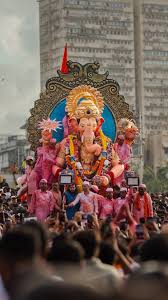
Śrī Ganesh Chaturthi honours Ganapati, remover of obstacles, guardian of auspicious beginnings and patron of learning. The Śrī Mandira ritual cycle includes the observance within its own yearly rhythm, reminding devotees that Jagannātha culture embraces a wide sacred network rather than functioning as an isolated Vaiṣṇava island.
Ganesh’s elephant head joins intelligence with memory, strength with gentleness and great physical presence with fine sensitivity. His broken tusk is widely interpreted as a symbol of sacrifice for knowledge, while the mouse as vāhana represents restless desire brought under guidance. The large ears suggest the capacity to listen, and the curved trunk combines power with precision. These iconographic teachings explain why Ganesh is invoked at beginnings: an auspicious beginning requires attention, discrimination, humility and the ability to remove the obstacles created by one’s own confusion.
A vrata is a sacred commitment expressed through restraint, worship, memory and ethical intention. Its power lies in continuity between vow and conduct. Traditional vrata literature often speaks of blessings such as protection, family welfare, children, health or restoration of prosperity, yet the deeper logic is the training of desire. A wish is placed before the Divine and simultaneously disciplined. The practitioner is asked to become more truthful, restrained, charitable and attentive. Women, elders, children, foods, seasonal plants and domestic spaces carry inherited religious memory. When such a vrata appears beside Śrī Mandira observances, the relationship between household and temple becomes visible. At a deeper level, devotion becomes durable when it enters ordinary patterns of food, family responsibility, memory and self-control.
Jagannātha ritual repeatedly honours specialised craft as sevā. Potters, carpenters, tailors, painters, flower workers, cooks and metal artisans do not merely supply objects to a temple; their inherited skills become part of worship. A vessel, garment, chariot component or ornament acquires sacred meaning because craft is joined to ritual purpose. This gives labour a theological dignity. Inwardly, interdependence: no major festival is produced by a single person or even by one category of sevaka. The finished darśana conceals a network of hands, measurements, materials and memories. Jagannātha culture therefore preserves knowledge not only in scriptures but in practiced skill transmitted through communities.
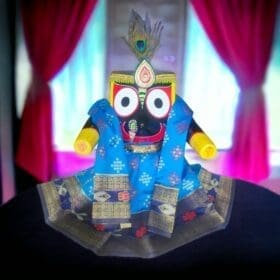
A defining feature of Jagannātha sevā is the treatment of the Deities as living, beloved persons. They wake, bathe, dress, eat, rest, travel and respond to seasons. Winter clothing, summer water-play, early-morning food and festival adornment arise from this devotional intimacy. Theologically, this does not reduce the Divine to human limitation; it makes transcendence relational. The infinite Lord accepts care. Sevā therefore trains attention to another’s comfort, timing and dignity. The deeper teaching is that love is expressed through detail. A change of cloth, a carefully timed meal or a particular seasonal offering becomes sacred because care has been made concrete. Jagannātha’s personhood teaches that devotion is not only emotion or philosophy but disciplined hospitality toward the Divine Presence.
The heart of vrata is saṅkalpa, a consciously held sacred intention. A person may begin with a human need—health, family welfare, freedom from difficulty, remembrance of ancestors or spiritual progress—but the vow asks that desire be placed inside discipline. Fasting or regulated food, truthfulness, charity, worship and restraint make the wish answerable to dharma. This is why a vrata can change the devotee even before any hoped-for result appears. Its hidden movement is from demand to dedication. The person does not merely ask the Divine to alter circumstances; the person agrees to become more ordered, grateful and responsible.
Jagannātha culture gives unusual dignity to skilled material work. Clay must have the right form, cloth must be cut and joined, wood must be measured, flowers must be arranged, food vessels must withstand heat and ornaments must sit correctly on sacred forms. Such knowledge is often transmitted through families and sevaka communities rather than through abstract manuals. Craft therefore becomes embodied memory. Its spiritual significance lies in precision offered without self-display. The object may later disappear into a larger ritual and the maker may remain unnamed, yet the sevā is indispensable. This reverses the modern tendency to value only what is most visible.
Jagannātha sevā is deeply shaped by personal relationship. The Deities are approached through rhythms of waking, bathing, dressing, food, rest, journeys and seasonal comfort. Such service does not reduce the Divine to an ordinary human being; rather, it gives devotion a language of intimacy. Love becomes practical. A change of cloth in winter, an early offering, a cooling practice or a festive adornment says that care must notice conditions. The hidden teaching is that bhakti is attentive rather than merely emotional. To love is to observe, prepare and serve appropriately. Ritual detail becomes the grammar through which affection learns discipline.
Jagannātha tradition repeatedly teaches through embodied signs: movement gives theology a route, food gives gratitude a taste, adornment gives scripture a visible form, and lunar or solar timing gives remembrance a place in the cosmos. In Shree Ganesha Chaturthi, these signs do not function as decoration around belief; they are the way belief is enacted. The sacred meaning therefore rests in disciplined relationship—between the Deity and sevaka, memory and performance, inherited form and living devotion. What appears outwardly as a festival becomes inwardly a training in attention: to recognise dependence, honour order, restrain ego and receive divine presence through the concrete language of ritual.
Ganesh Chaturthi gives special dignity to beginnings. Ganesh’s form teaches that a good beginning requires memory, listening, discrimination and disciplined strength: the large ears listen, the elephant head remembers, the trunk combines power with precision, and the mouse suggests restless desire brought under guidance. Worship before a new undertaking is therefore not merely a request that obstacles disappear. It is a commitment to remove inner obstacles—haste, confusion, ego and inattentiveness—so that action can begin under dharma rather than impulse.
Ganesh Chaturthi honours Lord Ganesh as the guardian of auspicious beginnings, wisdom and disciplined action. During Ganesh Chaturthi, devotees remember the harmony of intelligence, humility and strength represented by Ganesh. The observance of Ganesh Chaturthi also fits naturally within the broader sacred calendar of Odisha, where household worship and temple tradition continually meet. For students and families, Ganesh Chaturthi becomes a day of prayer for clarity, learning and the removal of obstacles. Ganesh Chaturthi therefore links a beloved pan-Indian festival with the devotional rhythm surrounding Puri and Jagannath culture. The prayers of Ganesh Chaturthi invite devotees to begin new work with steadiness, while Ganesh Chaturthi also reminds families to join learning with humility and responsibility. In this way, Ganesh Chaturthi becomes both celebration and discipline. Ganesh Chaturthi remains one of the most widely recognised sacred beginnings in the yearly devotional calendar.
For another Odisha vrata tradition, explore Prathamastami.