
Bahuda yatra
Apr
Bahuda yatra
Bahuda Yatra: The Sacred Return Journey to Srimandir
Bahuda Yatra is the sacred return journey of Lord Jagannath, Lord Balabhadra and Goddess Subhadra from Shree Gundicha Temple toward the main Srimandir in Puri. After the outward Gundicha Jatra and the Deities’ stay at the Adapa Mandapa, the festival cycle turns homeward. The final Sandhya Darshana at Gundicha carries the emotion of farewell, and Bahuda begins the next morning as the chariots prepare to carry the Deities back through the holy city.
The meaning of Bahuda lies in return. The first journey brings the Deities out from the main temple into the open public space of Bada Danda and onward to Gundicha Temple. Bahuda completes that movement by bringing the sacred procession back toward Srimandir. For devotees, the return is not an ending in the ordinary sense. It is the second half of one continuous pilgrimage, joining departure, stay, farewell and homecoming into a single devotional rhythm.
From Sandhya Darshana to Bahuda Yatra
The transition into Bahuda Yatra begins before the chariots move. During Sandhya Darshana, devotees receive their final darshan of the Deities at Gundicha Temple before the return journey. In the adjoining ritual sequence, the great chariots are readied and oriented toward the main Srimandir. The atmosphere therefore changes from the warmth of the Gundicha stay to the anticipation of homecoming.
JustKalinga’s archived temple update also records that preparations around Gundicha Temple were connected with the sequence of rituals required before the sacred return. Devotees were informed that they would again have the blessed opportunity to see the Deities aboard the chariots on the day of Bahuda Yatra. That detail captures one of the central devotional experiences of Bahuda: the Lord remains publicly visible on the chariot even as the journey turns back toward the main temple.
The Three Chariots on the Bahuda Route
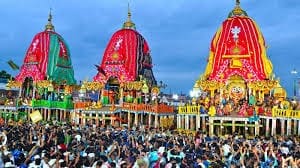
The same three monumental chariots that carry the Deities during Shree Gundicha Jatra also define the visual world of Bahuda. Nandighosha carries Lord Jagannath, Taladhwaja carries Lord Balabhadra, and Darpadalana carries Goddess Subhadra. During the outward journey these chariots travel toward Gundicha Temple; during Bahuda they become the vehicles of sacred return.
This reversal gives Bahuda Yatra a distinct emotional character. The chariots are familiar, the Grand Road is familiar, and the Deities are the same, yet the direction has changed. The movement now carries the memory of the Gundicha stay and the final evening darshan. Devotees who witness Bahuda therefore encounter both continuity and transition at once: the public festival continues, while the homecoming draws closer.
Bahuda as Public Darshan and Collective Service
Bahuda is not only a movement of chariots. It depends on a vast network of temple service, preparation and cooperation. JustKalinga’s archived Bahuda-related notice specifically recorded the need for coordination among servitor associations, or Niyogas, so the Lord’s rituals could proceed smoothly. Devotees were likewise requested to cooperate with the arrangements surrounding the return journey.
That cooperation reflects a deeper feature of Jagannath culture. The festival becomes possible through many forms of seva performed together. Temple servants, ritual specialists, administrators, devotees and the gathered public each occupy different roles, yet the movement of Bahuda Yatra depends on collective discipline. In this sense, Bahuda is both a grand public event and a demonstration of coordinated sacred service.
The Devotional Meaning of Bahuda
The outward Gundicha Jatra is often experienced as expansion: the Deities leave the main temple, enter the open road and make themselves available to an immense public gathering. Bahuda introduces the complementary movement of return. A devotional reading of this rhythm can see spiritual life itself in the same way. One goes outward into experience, relationship and service, then returns inward with memory transformed by what has been encountered.
For this reason, Bahuda Yatra carries a mood that is different from the first chariot journey. Joy remains, but it is mixed with remembrance. The stay at Gundicha is ending. The Deities are returning toward Srimandir. The chariots are once again the center of darshan, yet every turn of the wheels now points toward reunion with the main temple. Bahuda becomes a festival of movement, memory and return.
Seeing Jagannath on the Bahuda Chariot
For devotees, one of the most important features of Bahuda is the opportunity to behold Jagannath Mahaprabhu and the Deities on their chariots during the return journey. The archived JustKalinga update explicitly highlighted this darshan opportunity. The Lord who had spent the preceding days at Gundicha Temple is once again encountered in the open, surrounded by the sound, movement and collective devotion of Puri.
The chariot setting makes Bahuda Yatra profoundly accessible. The sacred return is visible in public space, not hidden behind the walls of the main shrine. The Deities’ movement through Puri turns the road itself into a ritual landscape. Every stage of Bahuda therefore combines geography with devotion: Gundicha behind, Srimandir ahead, and the Deities present on the chariots between the two sacred poles.
Bahuda Within the Larger Rath Yatra Sequence
Bahuda should be understood as part of the larger Jagannath festival sequence rather than as an isolated event. Shree Gundicha Jatra establishes the outward movement. The stay at the Adapa Mandapa creates the period of residence at Gundicha. Sandhya Darshana gives devotees a final evening encounter before departure. Bahuda Yatra begins the sacred return toward Srimandir, after which the concluding chariot and temple-entry rituals continue the homecoming sequence.
To follow that sequence on JustKalinga, read Shree Gundicha Jatra for the outward journey and Sandhya Darshana for the final Gundicha evening before Bahuda. The festival becomes most meaningful when these observances are seen as one connected narrative of departure, residence, farewell and return.
Bahuda Yatra ultimately carries Jagannath culture’s great movement back toward home. The chariots return, the public darshan continues, service remains coordinated, and the sacred geography of Puri is retraced in the opposite direction. Bahuda reminds devotees that return is not a reversal of devotion. It is devotion completing its circle.