Articles
Chapter 2 Part II: Grace, Karma and Freedom from Death
Jul
Mahaprabhu’s grace does not deny the law of karma. It gives the sincere soul the strength to change, surrender and move beyond fear.
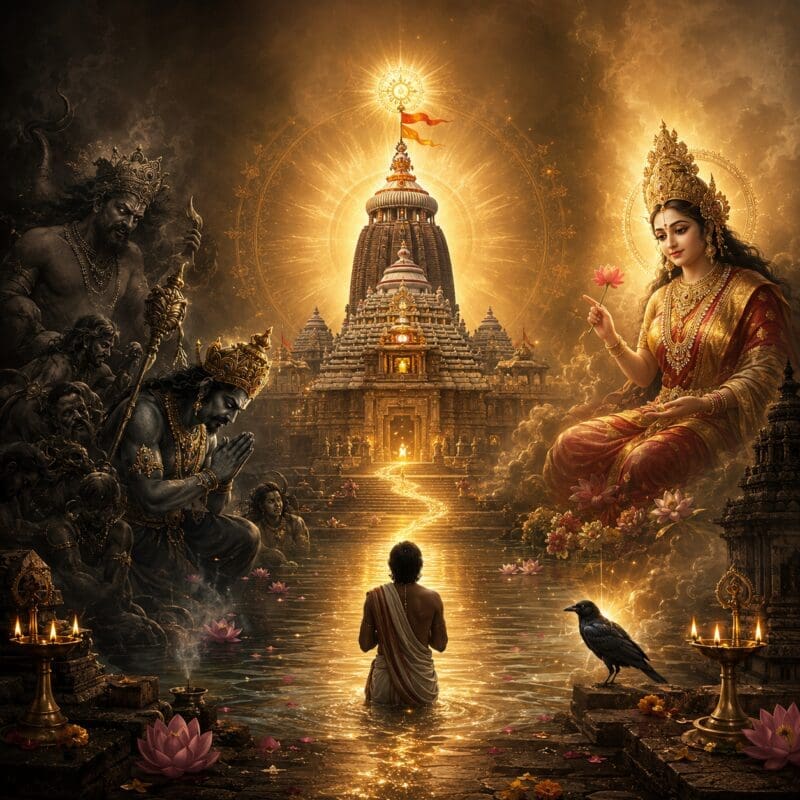
Chapter 2 — Part II continues the sacred teaching of the Skanda Purana — Utkala Khanda from Chapter 2 Part I: The Crow, Yama and Lakshmi’s Grace.
In Part I, we learned about three important events:
- The liberation of the ordinary crow
- Yama’s humble prayer before the Supreme Lord
- Devi Lakshmi’s explanation of the special freedom of Purushottama Kshetra
The crow showed that no being is too small for divine grace.
Yama showed that even the guardian of death and moral consequence remains under the authority of the Supreme Lord.
Lakshmi explained that Purushottama Kshetra belongs directly to Mahaprabhu and is governed not only by fear and judgment, but also by refuge, compassion and surrender.
Part II develops two deeper teachings:
- The relationship between grace and karma
- Freedom from the fear of death
These teachings must be understood carefully.
The chapter does not say that actions have no consequences.
It does not teach that a person may continue harming others and escape through a simple ritual.
Instead, it reveals a more balanced truth:
Karma is real, but it is not greater than God.
Grace is powerful, but it calls the devotee towards repentance and transformation.
Death is part of embodied life, but it does not remain the final authority for one who sincerely takes refuge in the Lord.
4. Grace and Karma
The shlokas on grace and karma are not merely adding another idea to the story.
They explain why the liberation of the crow, Yama’s humility and Lakshmi’s teaching are spiritually important.
The chapter’s teaching on karma accepts that moral actions produce results.
Good conduct and harmful conduct do not lead in the same direction.
Truthfulness creates clarity.
Dishonesty creates fear and confusion.
Compassion softens the heart.
Cruelty hardens it.
Generosity reduces selfish attachment.
Greed makes the mind more restless.
These consequences are part of karma.
However, the chapter also declares that karma is not an independent power standing above the Lord.
Mahaprabhu remains Supreme.
When genuine surrender arises, divine grace can burn, transform or exhaust karmic bondage.
What Is Karma?
Karma simply means action and the result created by action.
In karma, every thought, word and deed leaves an impression.
Karma can produce visible results quickly through some actions.
Other consequences may appear much later.
A kind word may immediately comfort someone.
A dishonest act may create fear that remains hidden for years.
A repeated habit shapes the mind.
Through karma, actions gradually create patterns.
These patterns influence how a person thinks, speaks and responds.
Karma therefore should not be imagined only as punishment after death.
It is active in daily life.
Anger practised repeatedly makes anger easier.
Truth practised repeatedly makes honesty stronger.
Greed increases dissatisfaction.
Service creates humility and connection.
Karma means that our choices matter.
Karma Is Not a Power Above God
The chapter makes an important distinction.
Karma is part of the divine moral order, but it is not greater than the Supreme Lord.
Mahaprabhu is not controlled by karma.
He is the source of the order in which karma operates.
Therefore, His grace can open a path through karma where the individual sees only bondage.
This does not mean the Lord makes wrongdoing good.
Grace works by transforming the person.
It may awaken regret.
It may create the courage to admit a mistake.
It may weaken harmful attachment.
It may lead the devotee towards correction, charity, service and surrender.
Grace changes the direction of life.
Grace Is Not Mechanical Magic
A person may misunderstand the chapter and think:
“If the Lord’s grace is greater than karma, then I can do anything.”
This is not a responsible reading.
Grace cannot be treated like a trick for escaping consequences.
A person cannot deliberately continue lying, exploiting or harming others while expecting one prayer or pilgrimage to remove everything automatically.
That would not be surrender.
It would be manipulation.
Genuine surrender includes:
- Honesty about one’s mistakes
- Regret for harm caused
- Willingness to correct conduct
- Acceptance of responsibility
- Trust in the Lord
- Service without pride
- Effort to avoid repeating the same wrongdoing
Grace becomes active where the heart becomes sincere.
How Grace Transforms Karma
Divine grace may not always remove every worldly result of past action.
A person may still need to repair damage.
An apology may still be required.
A debt may still need to be repaid.
A broken relationship may need patience and honest effort.
The body may still experience illness or age.
But grace changes the inner movement of the person.
Without grace, guilt may become hopelessness.
With grace, guilt may become repentance.
Without grace, fear may create hiding and denial.
With grace, fear may become courage to speak truth.
Without grace, suffering may increase bitterness.
With grace, suffering may deepen humility and compassion.
In this way, grace does not always erase the past.
It prevents the past from becoming the final ruler of the soul.
Karma, Grace and Devotion as Transformation
The chapter presents devotion as a complete reorientation of life.
Devotion is not limited to one emotion, one ritual or one festival.
Thought, speech, body, memory, work and social duty are gathered around the Lord.
The devotee begins to ask:
“Does this action honour Mahaprabhu?”
“Is my speech truthful?”
“Am I using my ability for service?”
“Is my behaviour causing harm?”
“Am I becoming less proud?”
This is why the promised fruit of devotion is not only an isolated reward.
The deeper fruit is a changed way of seeing and acting.
Thought Becomes Remembrance
Before devotion deepens, the mind may constantly move towards worry, comparison and desire.
Through remembrance, the mind gradually turns towards the Lord.
The devotee remembers Mahaprabhu during work, travel, difficulty and happiness.
This does not mean leaving all responsibilities.
It means performing responsibilities with a sacred centre.
A person may silently repeat:
Jai Jagannath.
This simple remembrance can create a pause before anger.
It can reduce fear during uncertainty.
It can control pride after success.
It can help the person return to truth.
Emotion Becomes Devotional Strength
Feelings are powerful, but they change quickly.
A person may feel deeply devotional during a sacred festival and become angry soon afterward.
The chapter therefore teaches steadiness.
Emotion becomes useful when it supports discipline.
Love for Mahaprabhu should appear through patience.
Faith should produce courage.
Gratitude should produce generosity.
Repentance should produce correction.
Devotional emotion becomes spiritually valuable when it improves behaviour.
The Body Becomes an Instrument of Service
The body is not treated as an enemy.
It becomes a tool for seva.
Hands may prepare food.
Feet may walk towards a person who needs help.
The voice may speak truth.
The eyes may look with compassion.
The body may bow before the Lord.
It may work honestly to support a family.
It may assist a pilgrim, an elderly person or someone in difficulty.
In this way, devotion becomes practical.
Memory Becomes Purified
Human memory often holds pain, insult and resentment.
People repeat old conflicts in the mind.
They remember who hurt them but forget the grace they have received.
Sacred hearing slowly changes memory.
The devotee begins to remember:
- The Lord’s name
- Sacred teachings
- Moments of protection
- Acts of kindness
- Lessons learned through difficulty
- The temporary nature of worldly conflict
Purified memory does not mean forgetting every injustice.
It means refusing to allow resentment to control the entire inner life.
Social Duty Becomes Responsible Service
Devotion does not remove social duty.
A parent must still care for children.
A worker must still perform responsibilities.
A businessperson must still act honestly.
A leader must still protect those under their care.
The chapter teaches that these duties can become service when performed with honesty and humility.
A devotee does not need to leave ordinary life to practise devotion.
Ordinary life itself can become an offering.
Steadiness Is the Measure of Devotion
The chapter does not measure devotion only by emotional intensity.
Steadiness is more important.
A person may experience one powerful moment of devotion.
But spiritual growth is shown through repeated practice.
Can the person remain truthful when lying would be easier?
Can the person remain calm when insulted?
Can the person continue serving when no one notices?
Can the person remember Mahaprabhu during hardship?
Can the person use prosperity for charity rather than pride?
These quiet actions reveal mature devotion.
Examining Pride, Fear and Possessiveness
The listener is invited to examine whether three forms of bondage are becoming weaker:
Pride
Pride says:
“I am greater than others.”
Devotion teaches:
“Every ability comes through grace.”
Fear
Fear says:
“I must control everything.”
Devotion teaches:
“I will act responsibly and trust the Lord.”
Possessiveness
Possessiveness says:
“Everything belongs to me.”
Devotion teaches:
“What I have can be used in service.”
The weakening of these habits is evidence that grace is transforming karma within the person.
A Simple Daily Practice for Karma and Grace
The teaching on grace and karma can be practised in a simple way.
At the end of the day, ask:
- Where was I truthful?
- Where did pride control me?
- Did my speech hurt anyone?
- Did I remember Mahaprabhu?
- Did I help someone?
- What should I correct tomorrow?
This short reflection makes devotion practical.
It does not require complex knowledge.
It requires honesty.
5. Freedom from the Fear of Death
The next teaching concerns freedom from death anxiety.
The chapter does not promise that the physical body will never die.
It does not ask the devotee to behave recklessly.
Instead, it offers freedom from paralysing fear.
The devotee is called to live ethically while trusting Mahaprabhu during the final passage.
Why Human Beings Fear Death
Death creates fear because it appears to take away everything familiar.
People fear losing:
- The body
- Family
- Possessions
- Social identity
- Control
- Future plans
- Relationships
- Reputation
Much of this fear comes from the belief that the temporary body and worldly identity are the complete self.
The chapter asks the reader to see more deeply.
The body is important, but it is temporary.
Social identity has value, but it is not eternal.
Possessions may support life, but they cannot define the soul.
The deepest identity of the being rests in its relationship with the Lord.
Yama Is Not the Final Authority
Yama represents death and moral consequence.
Yet Yama himself bows before Purushottama.
This is the source of hope.
The guardian of death recognises a higher Lord.
Therefore, death cannot be the final authority.
The devotee does not deny death.
The devotee places death under the rule of Mahaprabhu.
This changes fear into trust.
Freedom from Fear Does Not Mean Carelessness
A person who trusts the Lord should not become reckless.
The chapter does not encourage the devotee to ignore health, responsibility or safety.
Freedom from death anxiety means living fully and ethically without being controlled by terror.
A devotee should still:
- Care for the body
- Seek proper treatment
- Protect others
- Follow responsibility
- Avoid harmful behaviour
- Prepare spiritually
- Use time wisely
Trust in the Lord should make life more responsible, not less.
Remembering Death Can Improve Life
Although death is uncomfortable to think about, remembering its reality can improve conduct.
It reminds us that pride is temporary.
It teaches that anger wastes limited time.
It encourages forgiveness.
It reduces excessive attachment to wealth.
It makes service more urgent.
It asks us to speak with care.
A person who remembers that life is temporary may stop delaying truth, prayer and kindness.
The Final Passage
The chapter describes the Lord as the refuge during the final passage.
The devotee lives with the confidence that Mahaprabhu remains present beyond visible circumstances.
At the end of life, worldly power becomes weak.
Titles lose meaning.
Possessions cannot follow the person.
The body can no longer be fully controlled.
At that time, remembrance of the Lord becomes especially important.
The spiritual practices of daily life prepare the mind for this moment.
A person who remembers Mahaprabhu every day is more likely to turn towards Him during difficulty.
A person who practises surrender during ordinary life becomes prepared for the final surrender.
Liberation from Temporary Identity
Liberation does not mean only moving from one physical place to another.
It means freedom from ignorance.
The person no longer believes:
“I am only my body.”
“I am only my success.”
“I am only my suffering.”
“I am only my social position.”
“I am permanently defined by my past.”
The devotee begins to understand:
“I belong to Mahaprabhu.”
This simple awareness weakens fear.
Two Extremes to Avoid
A mature reading avoids two opposite mistakes.
Extreme One: Mechanical Magic
One may believe that a ritual act automatically removes every consequence, even without repentance.
This reduces sacred teaching to a transaction.
Extreme Two: Empty Praise
Another person may dismiss the entire promise of grace as exaggeration.
This removes hope and spiritual power from the text.
The balanced reading understands that Puranic language magnifies grace so that the heart becomes courageous enough to change.
The promises are not permission for carelessness.
They are an invitation to surrender.
Courage to Change
Many people continue harmful habits because they believe change is impossible.
They say:
“This is simply who I am.”
“I have always been angry.”
“I cannot forgive.”
“I cannot stop this habit.”
“My past has already destroyed my future.”
The chapter answers:
Transformation is possible.
Grace does not guarantee effortless change.
But it gives strength, direction and hope.
The heart that trusts Mahaprabhu becomes courageous enough to begin again.
Symbolic and Inner Meaning of Chapter 2
The principal movements of the chapter may be understood as stages of inner pilgrimage.
The Liberated Crow
The crow represents the ordinary or troubled self.
It carries limitation but still receives grace.
Yama’s Humility
Yama represents the recognition that even justice and authority remain under the Supreme Lord.
Lakshmi’s Explanation
Lakshmi gives a voice to compassion and reveals that refuge is available.
Grace and Karma
The devotee understands that the past matters, but it does not have to control the final direction of life.
Freedom from Death Anxiety
The devotee begins to live responsibly without being ruled by fear.
These stages form a clear inner journey:
- Recognise limitation.
- Approach the sacred.
- Accept moral responsibility.
- Receive compassionate guidance.
- Surrender to the Lord.
- Transform conduct.
- Move beyond fear.
This symbolic reading does not cancel the sacred history.
It explains why the chapter remains meaningful for readers in every age.
Water, Crossing and Purification
Water carries several levels of meaning in the chapter.
It cleanses the body.
It marks a sacred threshold.
It recalls the holiness of sacred rivers.
It represents movement from one condition to another.
The Sanskrit word Tirtha means a crossing place or ford.
A ford helps a traveller cross from one side of a river to the other.
Spiritually, a Tirtha helps the devotee cross:
- From fear to trust
- From pride to humility
- From falsehood to truth
- From greed to generosity
- From distraction to remembrance
- From bondage to freedom
The Ritual Bath
A sacred bath should not be reduced to physical washing.
The body may enter the water while the mind remains full of anger, greed and pride.
The inner purpose of the bath is to release what keeps the person spiritually unclean.
The devotee may pray:
“Mahaprabhu, cleanse my resentment.”
“Remove falsehood from my speech.”
“Reduce greed within me.”
“Free my mind from harmful distraction.”
“Help me begin again.”
The outer bath becomes meaningful when joined with inner intention.
Water and Darshan
Where the chapter joins sacred water with the sight of the Lord, purification and revelation become one movement.
The water prepares the devotee.
Darshan changes perception.
Pride, anger and distraction often prevent people from seeing clearly.
The Lord is present, but the mind remains clouded.
Purification does not create divine presence.
It makes the devotee ready to perceive it.
Respect for Living Temple Tradition
The rituals and sacred practices connected with Shri Jagannath Temple belong to a living tradition.
A written explanation may help readers understand their meaning.
However, it cannot replace:
- Established seva procedures
- Hereditary temple knowledge
- Local customs
- Proper ritual sequence
- Qualified guidance
- Traditional authority
The chapter repeatedly values continuity, correct order and service without ego.
Therefore, sacred practices should be approached with humility.
Devotees should learn respectfully rather than casually imitating specialised or confidential rituals.
Service Without Ego
The deepest meaning of ritual is not display.
It is service.
A person may possess knowledge, wealth, strength, artistic ability or ritual skill.
These gifts become sacred when offered without pride.
The correct question is not:
“How important do I look?”
The correct question is:
“How can this ability serve Mahaprabhu and His devotees?”
Practical Lessons from Chapter 2 — Part II
Accept That Karma Means Actions Matter
Do not ignore the consequences of speech and behaviour.
Trust That Change Is Possible
Do not believe that the past has permanently closed the door of grace.
Repeat the Lord’s Name
Remember Jai Jagannath during ordinary work, fear and confusion.
Correct One Habit
Choose one harmful pattern and begin changing it sincerely.
Use Prosperity for Service
Support family, charity, worship and community well-being.
Release Death Anxiety Through Right Living
Live truthfully so that fear loses some of its power.
Approach Sacred Water With Inner Prayer
Seek purification of conduct, not only cleansing of the body.
Respect Temple Tradition
Learn with humility and honour those who preserve sacred seva.
Central Teaching of Chapter 2 — Part II
The central message can be expressed simply:
Karma teaches responsibility, grace makes transformation possible, and trust in Mahaprabhu frees the devotee from paralysing fear of death.
The chapter does not deny consequence.
It reveals that consequence remains under the Lord.
It does not promise careless escape.
It calls for sincere surrender.
It does not remove the reality of death.
It removes death from the position of final authority.
It does not ask the devotee to reject ritual.
It asks the devotee to unite ritual with inner change.
🙏 Grace does not support wrongdoing; it gives strength to correct it.
🙏 Devotion becomes real when it changes thought, speech and conduct.
🙏 Sacred water represents crossing into a cleaner way of life.
🙏 Death remains part of the body’s journey, but Mahaprabhu remains the final refuge.
🙏 No sincere soul should lose hope in the transforming power of the Lord.
The crow receives grace.
Yama bows in humility.
Lakshmi explains compassion.
Karma teaches responsibility.
Grace creates a new direction.
Fear gives way to trust.
The devotee learns to live carefully, surrender sincerely and remember Mahaprabhu at every stage of life.
❤️ Jai Jagannath!