
Articles
A Discussion on Nabagunjara
Aug
Nabagunjara is one of the most distinctive divine forms described in Sarala Das’s Odia Mahabharata. The story presents Sri Krishna appearing before Arjuna in a body made from nine different beings. The Nabagunjara episode is rooted in Odisha’s literary and devotional tradition and connects Krishna, Arjuna, Shiva, Parvati and the larger story of Arjuna’s exile.
The account begins with the rule the Pandava brothers had accepted regarding Draupadi. When one brother was with her, another was not to enter that space. A breach of the rule would lead to twelve years of exile. Through a sequence involving the fire god Agni in disguise, Arjuna entered while Yudhishthira was inside and chose to accept the consequence rather than abandon his duty.
Why Arjuna Was in Exile Before Seeing Nabagunjara
According to the story, Agni’s purpose was connected with the Khandava forest. Arjuna’s exile placed him in the setting where later events could unfold. He left his family and travelled through the forest as a hunter-like wanderer, carrying his bow and arrows.
During this period, Arjuna encountered Shiva and Parvati, who were moving through the forest in ascetic forms. A confrontation followed after Arjuna shot a rhinoceros associated with them. Arjuna initially failed to recognise Shiva and fought with him. When the truth became clear, he bowed before Mahadeva.
Shiva and Parvati were pleased with Arjuna’s courage. In the narrative, Arjuna received the Pashupata Astra from Shiva and the Akshaya Tunira, the inexhaustible quiver, through Parvati’s grace. These events prepare the background for the later appearance of Nabagunjara.
Krishna’s Journey to Arjuna
Back in Hastinapura, Sri Krishna learned from Sahadeva that Arjuna was still in exile and had obtained divine weapons. Krishna wished to meet his friend and travelled toward the Manibhadra mountain, where Arjuna was staying. Before reaching him, Krishna decided not to appear in ordinary royal form.
Instead, Krishna assumed the extraordinary Nabagunjara form. In the Odia Mahabharata tradition described in the article, Nabagunjara combines nine living forms within one body. This is why the name and image of Nabagunjara occupy such a special place in Odia sacred imagination.
What Does Nabagunjara Look Like?
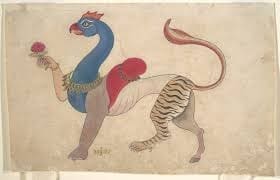
The Nabagunjara body is described through a remarkable combination: the head of a rooster, the hump of a bull, the neck of a peacock, the tail of a serpent and the waist of a lion. Its legs include forms associated with a tiger, elephant and horse, while the front limb is a human hand holding a lotus.
Sarala Das describes this composite form in the Madhya Parva of his Odia Mahabharata. The form is not presented as an ordinary animal. Nabagunjara is Krishna’s divine manifestation, deliberately unfamiliar so that Arjuna must look beyond outward appearance and recognise the presence of the Lord.
How Arjuna Recognised Nabagunjara
Arjuna first saw Nabagunjara while sitting on the Manibhadra mountain. He was astonished because he had never seen such a being in the forests he had travelled through. The unusual appearance made him pause and reflect rather than react immediately.
Arjuna then understood that Nabagunjara could not be an ordinary creature. He recognised the manifestation as divine and offered praise. In the story, he asks the Lord to leave the mysterious form and reveal His true identity.
Sri Krishna then gives up the Nabagunjara form and appears before Arjuna as himself. Their meeting becomes a moment of friendship as well as revelation. Krishna asks Arjuna to return to Hastinapura, but Arjuna refuses to break the vow of exile. He explains that only four years, six months and thirteen days have passed, and that he must complete the remaining period before returning.
Nabagunjara and the Odia Mahabharata Tradition
The importance of Nabagunjara lies not only in its unusual appearance but also in the way the episode expresses Krishna’s freedom to assume forms beyond ordinary categories. The story belongs specifically to the Odia Mahabharata tradition associated with Sarala Das, giving Nabagunjara a strong cultural connection with Odisha.
In the devotional interpretation preserved in the article, Arjuna sees the Nabagunjara form as carrying a message of harmony among different beings. A single sacred body holds many forms together without losing its unity. The episode therefore becomes a way of reflecting on coexistence, divine mystery and the ability to recognise the Lord beyond familiar appearances.
Why Nabagunjara Still Matters
Nabagunjara remains memorable because the form asks the devotee to look again. What appears strange at first becomes a sign of divine presence. Arjuna’s response moves from surprise to recognition, praise and surrender. That movement is central to the spiritual force of the story.
The Nabagunjara episode also shows how Odisha’s literary traditions expanded the devotional imagination around Krishna. Through Sarala Das’s narration, Nabagunjara became a uniquely recognisable sacred form linked with Arjuna, Krishna and the cultural memory of Odisha.
Explore more Jagannath and Odisha devotional knowledge at JustKalinga.