Articles
|| A Description of the Ratha Jatra ||
Jun
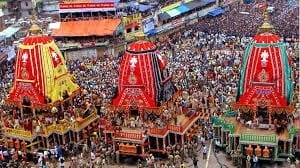
In the ‘Sri Jagannathashtakam’ composed by Sri Shankaracharya, the Ratha Jatra (Chariot Festival) is described as follows:
Ratharudho gachhan pathimilita bhudevapatalaih
Stuti pradurbhavam pratipadamupakarnya sadayah
Dayasindhurbandhuh sakalajagatam sindhu sutaya
Jagannathah swami nayana patha gami bhavatu me {5}
Ratha Jatra in Sri Jagannathashtakam
Meaning: He who, while proceeding on His chariot, becomes filled with compassion upon hearing the hymns of praise offered at every step by the multitudes of Brahmins gathered on the Grand Road; He who is an ocean of mercy, the friend of all the worlds, the Lord of the Universe, Jagannath, along with the daughter of the ocean, Mother Lakshmi—may that Lord Jagannath be the object of my vision.
Within this verse, Ratha Jatra is presented as a moving encounter between Lord Jagannath and those gathered along the Grand Road. The Lord proceeds on His chariot while hymns of praise rise at every step. The translation emphasizes His compassion: He hears the prayers, is called an ocean of mercy and friend of all worlds, and is invoked together with Mother Lakshmi. The final prayer asks that Jagannath remain before the devotee’s eyes. Read in this way, the passage is not merely a description of a procession. It centers the devotional experience of seeing the Lord, praising Him as He travels, and remembering His mercy. The image of Ratharudha Jagannath, mounted on the chariot and moving among devotees, gives the Ratha Jatra passage its emotional focus and explains why the verse closes with a prayer for divine vision.
Jai Jagannath, Om Namo Bhagavate Vasudevaya Namah.
(Victory to Jagannath, Salutations to the divine Lord Vasudeva.)