











Articles
Mahaprabhu’s Chariots Turn Homeward
Jul
The Sacred Southward Turning of Mahaprabhu’s Chariots
🙏 Ratha Dakshina Moda is one of the most important rituals performed during the sacred Ratha Yatra of Mahaprabhu Shri Jagannath. It marks the beginning of preparation for the return journey of the three chariots from the Adapa Mandapa towards Shri Mandira.
The annual Ratha Yatra is not limited to the journey of Shri Jagannath, Shri Balabhadra, and Devi Subhadra from Shri Mandira to Shri Gundicha Temple.
Every stage of the festival carries a special meaning.
The construction of the chariots, the arrival of the deities, the sacred stay at the Adapa Mandapa, Hera Panchami, Dakshina Moda, Bahuda Yatra, Suna Besha, Adhara Pana, and Niladri Bije are all connected through a carefully preserved ritual sequence.
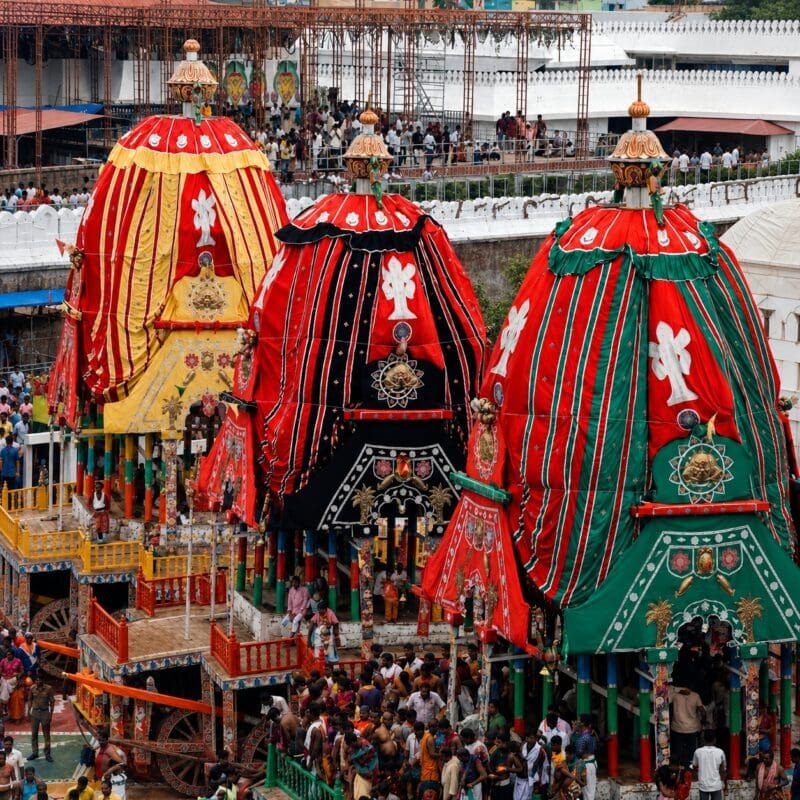
Among these traditions, Ratha Dakshina Moda, or the southward turning of the three chariots, gives the first clear indication that Mahaprabhu’s return journey is approaching.
The deities are still present inside Shri Gundicha Temple, but their chariots are turned and prepared for Bahuda Yatra.
It is as though the great wooden chariots themselves are waiting for Mahaprabhu to return to them.
What Is Ratha Dakshina Moda?
The Odia word Dakshina means south, while Moda means turning.
Ratha Dakshina Moda therefore refers to the ritual movement through which the three chariots are turned towards the southern direction.
After arriving at Shri Gundicha Temple during Ratha Yatra, the chariots remain near the temple’s Singhadwara.
They originally face the direction from which they came.
Before Bahuda Yatra, they must be carefully moved, turned, and placed near the Nakachana Gate of Shri Gundicha Temple, facing the direction required for the return journey.
This is not a simple movement.
The chariots are massive sacred structures, built according to traditional measurements and ritual rules. Moving and turning them requires careful coordination, physical effort, experience, and the participation of several groups of temple servants and officials.
Dakshina Moda therefore combines ritual permission, skilled teamwork, devotion, music, and physical service.
The First Sign of Mahaprabhu’s Return
During the sacred stay at Shri Gundicha Temple, Shri Jagannath, Shri Balabhadra, Devi Subhadra, and Shri Sudarshana are worshipped on the Adapa Mandapa.
This period is especially dear to devotees.
Darshan of Mahaprabhu at the Adapa Mandapa is considered deeply sacred because it recalls His journey to the place traditionally connected with His appearance and divine pastimes.
However, the Lord’s stay there is temporary.
Mahaprabhu must eventually return to the Ratna Singhasana in Shri Mandira.
The turning of the chariots therefore becomes the first visible sign of that return.
The deities have not yet come out of the temple, but the road home is being prepared.
For devotees, Dakshina Moda creates a new feeling.
The joyful outward journey of Ratha Yatra slowly changes into the emotional expectation of Bahuda Yatra.
Dakshina Moda After Hera Panchami
According to the traditional sequence, Dakshina Moda begins on the day following Hera Panchami.
Hera Panchami recalls the loving and dramatic divine relationship between Mahaprabhu Shri Jagannath and Mahalakshmi.
Mahaprabhu leaves Shri Mandira with His elder brother Shri Balabhadra and sister Devi Subhadra, but Mahalakshmi remains behind.
Feeling neglected, the Goddess visits Shri Gundicha Temple during Hera Panchami.
The tradition presents this event through the loving emotions of a divine household.
Mahalakshmi expresses Her displeasure and symbolically damages a part of Lord Jagannath’s Nandighosha chariot before returning quietly to Shri Mandira.
The devotional poem associated with Dakshina Moda describes this moment in a more dramatic way, saying that the Goddess, angered because Mahaprabhu did not take Her with Him, struck the chariot and broke its wheel.
This should be understood as poetic devotional expression surrounding the Hera Panchami tradition.
After this divine expression of love, separation, and displeasure, preparations begin for Mahaprabhu’s return.
The Sacred Ajnamala Is Offered
On the day of Dakshina Moda, the morning rituals are first completed inside Shri Gundicha Temple.
After the Sakala Dhupa Niti, or morning food offering, the sacred Ajnamala of the three deities is brought out.
The word Ajnamala means a garland carrying divine permission or command.
Three Palia Puja Panda Sevayats carry the Ajnamalas of Shri Jagannath, Shri Balabhadra, and Devi Subhadra.
The garlands are taken in a ceremonial procession accompanied by:
- Sacred bells
- Ceremonial umbrellas
- Kahali music
- Traditional temple attendants
- Devotional discipline and reverence
The three Ajnamalas are then offered to the three chariots.
This ritual is extremely important.
The chariots are not moved merely because workers are ready.
They are moved only after receiving the divine command of the deities.
The Ajnamala connects the physical work of moving the chariots with Mahaprabhu’s sacred will.
Only after this permission is received does the Dakshina Moda ritual begin.
Devi Subhadra’s Chariot Moves First
The three chariots are not turned randomly.
The movement follows a traditional order.
First, the chariot of Devi Subhadra is pulled.
After Her chariot is properly moved, Lord Balabhadra’s Taladhwaja is turned.
Finally, Lord Jagannath’s Nandighosha chariot is pulled and positioned.
This sequence is carefully preserved.
The chariots are gradually moved from the Singhadwara side of Shri Gundicha Temple towards the Nakachana Gate on the opposite side.
They are then placed facing south as evenly and correctly as possible.
The task requires great patience because each Rath must be moved forward and backward several times.
How the Massive Chariots Are Turned
Turning a huge wooden Rath is very different from turning an ordinary vehicle.
The chariots do not have modern steering systems.
Their direction must be changed through the controlled use of ropes, human strength, experience, and repeated movement.
Ropes are attached to both the front and rear portions of each chariot.
The chariot is first pulled slightly forward.
It is then pulled backwards.
This forward-and-backward movement is repeated many times.
With every controlled pull, the direction of the Rath changes little by little.
The process continues until the chariot reaches the required position near the Nakachana Gate and faces south.
The aim is to keep the three chariots as properly aligned as possible in preparation for Bahuda Yatra.
This movement may appear slow, but every pull requires attention.
The workers and Sevayats must observe the wheels, ropes, direction, space, road condition, and position of the Rath.
Dakshina Moda is therefore a beautiful example of collective effort offered as sacred service.
Who Participates in Dakshina Moda?
Several groups work together during the turning of the chariots.
They include:
- Shri Mandira officials
- Temple employees
- The Rath supervision team
- Government police personnel
- Bhoi Sevayats
- Maharana Sevayats
- Ghantua Sevayats
- Dakua Sevayats
- Other authorised workers and assistants
The Bhoi and Maharana communities have an important relationship with the construction, maintenance, and movement of the sacred chariots.
Their inherited knowledge and physical service help ensure that the Raths are moved safely and properly.
Temple officers and police personnel also assist in managing the movement and maintaining order around the chariots.
Every participant has a role.
The ritual is completed through cooperation rather than individual display.
Bells and Sacred Rath Songs
Dakshina Moda is not performed in silence.
As the chariots are moved, the Ghantua Sevayats stand on the Raths and ring sacred bells.
The sound of the bells fills the area around Shri Gundicha Temple.
At the same time, the Dakua Sevayats stand on the chariots and sing traditional Rath songs.
These songs provide rhythm, devotion, encouragement, and sacred energy during the movement.
The sound of bells, the chanting of the Lord’s name, the pulling of ropes, and the movement of the enormous chariots create a powerful devotional atmosphere.
The work is physically demanding, yet it is performed as seva.
The Rath songs remind everyone that they are not moving ordinary vehicles.
They are preparing Mahaprabhu’s sacred chariots for His return.
Elephants and Labourers in Earlier Times
In earlier times, the process of turning the chariots was even more difficult.
Traditional labourers known as Kala Bethia and trained elephants were used to assist with Dakshina Moda.
The elephants provided additional strength for moving the massive wooden structures.
The use of labourers and elephants shows how physically challenging the ritual was before modern road improvements and present-day arrangements.
Even today, moving the chariots requires skill and effort, but earlier generations faced more difficult surroundings.
Their service helped preserve the ritual through changing conditions.
The Difficult Road Before 1985–86
Before approximately 1985–86, the road and surrounding areas between Shri Gundicha Temple and Bada Sankha were much lower than they are today.
During the rainy season, water frequently collected on both sides of the road.
In some places, the accumulated water could reach a depth of nearly two to three feet.
Under these conditions, turning the three enormous chariots was extremely difficult.
The wet ground, standing water, heavy chariots, and limited space made the movement slow and demanding.
Sevayats and workers had to use great care.
This historical detail helps modern readers understand the dedication of those who preserved the tradition in earlier times.
They did not allow difficult road conditions or physical hardship to interrupt Mahaprabhu’s seva.
How Long Does Dakshina Moda Take?
Traditionally, the complete Dakshina Moda process may continue for two days.
The massive size of the chariots and the careful movement required can make it difficult to turn and position all three Raths within a single day.
However, historical records and temple experience show that in some years, all three chariots have been successfully turned in one day.
The duration may depend on:
- Weather conditions
- Road conditions
- Crowd management
- Available daylight
- Coordination between the teams
- The movement of each individual chariot
Speed is not the main purpose.
The ritual must be completed carefully, respectfully, and according to tradition.
The Spiritual Meaning of Turning South
Dakshina Moda has a practical purpose, but it also carries a deeper spiritual message.
The chariots are turned because the return journey is approaching.
Similarly, spiritual life sometimes requires us to turn.
A person may be moving in the wrong direction because of:
- Pride
- Anger
- Greed
- Careless speech
- Jealousy
- Dishonesty
- Excessive attachment
- Forgetfulness of the Lord
The sacred turning of the Raths reminds devotees that it is never too late to change direction.
The movement may require effort.
Just as the chariots are pulled forward and backward many times before becoming properly aligned, human transformation may also take repeated effort.
A person may improve, struggle, correct themselves, and begin again.
What matters is the final direction.
Mahaprabhu’s chariot turns towards the return path.
The devotee’s heart should turn towards truth, humility, service, and remembrance.
A Simple English Rendering of the Devotional Prayer
Salutations to Shri Jagannath, the beloved Lord of Mahalakshmi.
Salutations to His lotus feet, which hold the essence of sacred wisdom.
This universe is created and supported by Him.
He is the Lord and the cause of the entire world.
All devotees become joyful when they receive His darshan during Ratha Yatra.
Today, the sacred chariots turn towards the south.
The divine play of Mahalakshmi’s loving displeasure is remembered.
Mahaprabhu travelled to His aunt’s home with His brother and sister, leaving the Goddess behind.
In loving anger, Mahalakshmi came to see Him and symbolically damaged His chariot.
The devotees then became alert and prepared the Rath once again.
With their minds fixed upon His lotus feet, they prayed:
“O Mahaprabhu, please sit upon Your chariot and turn towards the south. Prepare now for Your sacred return.”
Holding the mind, vision, and consciousness steadily, the devotees chant:
Jaya Jaya Shri Hari!
The extraordinary divine play of the chariots fills every heart with joy.
Blessed are You, O Kalia Saanta.
Blessed are You, O Mahaprabhu.
Blessed are Your eternal pastimes.
Om Shri Lakshmi Jagannathabhyam Namah.
Jaya Jaya Jagannath!
Jaya Shri Jagannath Sharanam!
🙏 May Lord Jagannath always remain visible on the path of our eyes.
Ratha Yatra 2026 Sacred Schedule
Tuesday, 14 July 2026
Netrotsava and Nava Yauvana Darshan
Wednesday, 15 July 2026
Ratha Ajnamala Bije
Thursday, 16 July 2026
Shri Gundicha Yatra and Ratha Yatra
Monday, 20 July 2026
Hera Panchami
Tuesday, 21 July 2026
Ratha Dakshina Moda
Thursday, 23 July 2026
Mahaprabhu’s Sandhya Darshan at the Adapa Mandapa
Friday, 24 July 2026
Bahuda Yatra
Saturday, 25 July 2026
Hari Sayana Ekadashi and Suna Besha
Sunday, 26 July 2026
Adhara Pana
Monday, 27 July 2026
Niladri Bije
Central Teaching of Ratha Dakshina Moda
The central message of Dakshina Moda can be expressed simply:
Before Mahaprabhu begins His return journey, His sacred chariots must be turned in the correct direction. In the same way, devotees must turn their minds away from pride and distraction and prepare to return to the Lord.
🙏 The Ajnamala shows that every sacred service begins with divine permission.
🙏 The careful turning of the Raths teaches patience and cooperation.
🙏 The Sevayats’ effort shows the dignity of service without ego.
🙏 The bells and Rath songs transform physical labour into devotion.
🙏 The southward direction prepares Mahaprabhu’s path for Bahuda Yatra.
🙏 The ritual reminds every devotee that spiritual life sometimes requires a courageous change of direction.
The chariots move forward.
They are pulled backwards.
They turn slowly.
They finally face the correct path.
The human heart also passes through struggle, correction, and repeated effort.
Yet when devotion remains steady, the heart can once again face Mahaprabhu.
❤️ Blessed are You, Kalia Saanta. Blessed are Your chariots. Blessed are Your eternal divine pastimes.
🙏 Jai Jagannath!