Articles
|| The Ritual of Nabajouban Darshan or Ubha Jatra in Srimandir ||
Jun
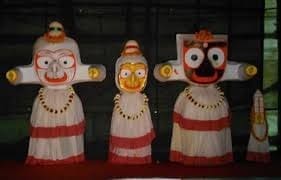
👉 Nabajouban Darshan is observed today, on the sacred Pratipada tithi (the first day of the waxing moon) of the holy month of Ashadha, after a long interval of 15 days, the Shribigrahas (the holy deities) grant their first darshan (sacred viewing) to the devotees in their Nabajouban besha (attire of renewed youth).
👉 The form or attire in which the Chaturdha Bigraha (the fourfold deities) of Srimandir are adorned after being newly painted, just before they proceed to the chariots, is called Nabajouban.
👉 Yesterday, on the tithi of Anasara Chaturdashi and Ashadha Amavasya, as per the traditional customs of Srimandir, the rituals for Nabajouban Darshan commenced after the completion of the Banakalagi ritual (the application of herbal paste on the holy faces, also known as Shrimukha Shringar) by the Datta Mahapatra servitors.
👉 During Nabajouban Darshan, in the early morning (pratyusha) of the sacred Pratipada tithi of Ashadha Shukla Paksha, after the Mangala Alati, Abakasha, and Besha rituals are completed, from among the Dashavatara deities, Nrusimha, Rama, and Krishna from Shri Balabhadra’s side, and Dolagobinda and Shri Madanmohan from Shri Jagannath’s side, are returned to the Dakhina Ghara (South Room).
👉 Among the remaining five deities, the three Pati Dian (deities painted on cloth) – Basudeba (representing Shri Balabhadra), Bhubaneswari (representing Devi Subhadra), and Narayan (representing Shri Jagannath) – are returned to the Mandani Ghara near the temple of Goddess Bimala.
👉 Sridevi and Bhudevi from Shri Subhadra’s side are returned to the Khata Seja Ghara (the Lord’s bedchamber).
👉 As preparations for Nabajouban Darshan continue, the Kotha Suansia servitors enter the inner sanctum to remove the Anasara Tati (the bamboo screen that shields the deities during their seclusion) and the cots.
👉 After the area in front of where the deities are seated is washed and cleaned, the temple is opened for Nabajouban Darshan.
Nabajouban Darshan in the Niladri Mahodaya
It is described in the fifteenth chapter of the ‘Niladri Mahodaya’. It is said: On the night of Amavasya, after three ghadis (a unit of time) have passed, the Acharya (chief priest), after taking his bath, will ritually bid farewell to the deities that were previously installed on the pata (cloth paintings). After that, the cots will be removed and the screen will be opened. The area in front of the Lords will be washed. Then, two umbrellas will be held before the deities, and with the sound of bells (ghanta), an assembly of songs, dance, and music will be held.
Nabajouban Darshan After the Anasara Period
All these rituals of Ashadha Amavasya continue late into the night, and by the time all rites are duly completed, the night has ended and dawn breaks. From that dawn, the Nabajouban Darshan of the holy deities begins. This is the first darshan that the devotees receive after the long 15-day Anasara (seclusion period), or after one and a half months during a Nabakalebara year.
Nabajouban Darshan Verses from the Niladri Mahodaya
Regarding this, it is described in the Niladri Mahodaya as follows:
“Atha pañcadaśīghasre rātrau yāmatraye gate |
Snātvā cāryastadā śīghraṁ paṭṭadevasya pūrvavat || 60 ||”
Translation: Then, on the fifteenth day, after three yamas (a period of about 9 hours) of the night have passed, the Acharya (chief priest), having bathed, shall quickly perform the rites for the deity on the pata (cloth painting) as done before. (60)
“Snānamātraṁ vidhāyātha kuryāttasya visarjanam |
Pratyarcānāṁ tathā kuryād visarjanamataḥ param || 61 ||”
Translation: After performing only the bathing ritual, he should then perform the visarjana (ritual farewell) for that deity. Thereafter, he should also perform the visarjana for the representative images (pratyarcha). (61)
“Paryaṅkaharaṇaṁ kṛtvā tvantarāvaraṇaṁ caret |
Atha prakṣālayedagraṁ devadevasya bhūpate || 62 ||”
Translation: O King (Bhupate), after removing the cot (paryanka) and taking down the screen/partition (antaravarana), one should then wash the area in front of the God of gods (Devadeva). (62)
“Punaśchatradvayaṁ dhṛtvā ghaṇṭādidhvanimācaret |
Gītaṁ nṛtyaṁ tathā bādyaṁ kārayedddevatāpuraḥ || 63 ||”
Translation: Then, holding two umbrellas, one should make sounds of bells and other instruments. Songs, dance, and music should be performed before the deity. (63)
“Tatra kāle’pi saṁprāpya pūjako devasannidhiṁ || 64 ||
Taccakṣuritimantreṇa dadyānnetradvayaṁ tadā |
Divye netradvaye jāte viṣṇornetrāmbaje’nagha || 65 ||”
Translation: At that time, the priest, approaching the deity’s presence, (64) should bestow the two eyes with the ‘Tachakshur’ mantra. O sinless one, when the two divine lotus-eyes of Vishnu are thus created. (65)
Nabajouban Darshan and the Ritual Painting
“Trayodaśyāmimaṁ karma varṇaireva vicakṣaṇaḥ |
Yathārūpaṁ prakuryyācca tadālekhyaṁ ca saukhyadam || 53 ||”
Translation: On the thirteenth day (Trayodashi), a learned person should skillfully perform this work with colors. He should paint the forms as they are, for this painting brings happiness. (53)
“Yathāvidhi nṛpaśreṣṭha citravicitryakarmaṇā |
Caturdaśadine cāpi tathā pañcadaśe dine || 54 ||”
Translation: O best of kings (Nrupasrestha), according to the prescribed rules, this work of intricate painting should also be done on the fourteenth day (Chaturdashi) and the fifteenth day (Panchadashi). (54)
“Dinadvaye’pi tatkarma citraṁ cārutaraṁ caret |
Jagadīśāṅgasamparkaṁ lepayeccandanādikam || 55 ||”
Translation: On both these days, the painting work should be made even more beautiful. Sandalwood paste and other items that have been in contact with the body of Jagadisha should be applied. (55)
“Nirodhanālayāttasmād bahiṣkuryānnṛpottama |
Dvādaśyāmeva taddadyāttubhyaṁ nirmālyamādarāt || 56 ||”
Translation: O best of kings (Nrupottama), He should be brought out from that confinement room (nirodhanalaya). On the twelfth day (Dvadashi) itself, the nirmalya (remains of offerings) should be given to you with reverence. (56)
“Taddehalepanātkiṁciccandanṁ pāpamocanam |
Bhaktyā ye manujāḥ śīghraṁ sevante’tra mahītale || 57 ||”
Translation: That sin-destroying sandalwood paste from His body—those humans on this earth who devotedly and quickly apply it, (57)
“Kuṣṭhādirogato muktāstathā niṣpāpinaśca te |
Sukhamatyantamābhujya cānte vaikuṇṭhavāsinaḥ || 58 ||”
Translation: are freed from diseases like leprosy and become sinless. They enjoy extreme happiness and, in the end, reside in Vaikuntha. (58)
“Tasmād yatnena tallepaṁ narāḥ sarve mahītale |
Dvādaśyāmeva gṛhṇantu paratra hitakāmyayā || 59 ||”
Translation: Therefore, all people on earth should, with effort, receive that paste on the twelfth day itself, for the sake of their well-being in the hereafter. (59)