Our Puranas contain descriptions of the various avatars of Lord Vishnu. Whenever the burden of sin on Earth becomes overwhelming, Lord Vishnu manifests on Earth in a new form. This is his avatar. Our Puranas describe 10 primary avatars of Lord Vishnu. However, mention of his 24 leelavatars (divine play avatars) is also found in the scriptures. But a fascinating account of Lord Vishnu assuming an even more peculiar form is found in the Odia Mahabharata by Sarala Das.
We all know that among the five Pandava brothers, Arjuna won the hand of Draupadi, the daughter of King Drupada, by succeeding in the archery contest. However, when they went to tell their mother Kunti about it, Kunti said, “Whatever you have brought, share it among the five of you.” But how could Draupadi be shared among five brothers? Therefore, after discussing among themselves, it was decided that all five brothers would marry Draupadi.
But a bride is meant for one groom. How would one bride manage with five grooms? So, they mutually agreed that while one brother was with Draupadi, no other brother would enter that space. But how would they know if someone was already with Draupadi? It was decided that whoever went inside would leave their footwear at the entrance of the room. This way, no other brother would enter at that time. Anyone who entered despite this warning would have to go into exile for twelve years.
However, a mix-up once occurred. On that day, Yudhishthira and Draupadi were in the inner chamber. Just then, a Brahmin arrived. He told Arjuna, “Call Yudhishthira immediately, I need to speak with him.” He warned that if he didn’t get to meet him, he would get angry and turn everyone to ashes.
The guest was the Madhupingala Brahmin. He threatened to curse their entire lineage to be destroyed. Therefore, Arjuna thought it better to uphold his duty, go to the inner chamber to call Yudhishthira, and accept the consequence of exile. At that time, Yudhishthira and Draupadi were in the inner chamber. However, Yudhishthira’s footwear was not at the entrance. So, unaware that Yudhishthira was inside, Arjuna entered the inner chamber.
Yudhishthira was surprised by Arjuna’s action. He asked why he had done so. Arjuna told him, “A Madhupingala Brahmin has come and wishes to meet you. He says that if he cannot meet you, he will destroy our lineage in a fit of rage. So, let me go into exile for twelve years, but let our family be saved from the Brahmin’s wrath. That is why I was forced to enter the inner chamber like this.”
Hearing Arjuna’s words, Yudhishthira became distressed. Which elder brother wouldn’t be worried knowing his younger brother would go into exile for twelve years? Composing himself slightly, Yudhishthira asked, “But my footwear was at the entrance! Didn’t you see it?”
Arjuna was astonished. Who, then, had taken Yudhishthira’s footwear from the entrance?
The truth was, Vaishvanara Agni (the fire god), in the guise of a dog, had taken Yudhishthira’s footwear from the doorway. He himself had also come in the guise of the illusory Brahmin. By the time Yudhishthira and Arjuna went to look, the Brahmin had vanished.
But whether the Brahmin was real or fake, Arjuna had broken the rule. Therefore, he was bound to go into exile for twelve years. Without delay, Arjuna prepared to leave for his exile. His brother Yudhishthira, his wife Draupadi, and his mother Kunti—no matter how much they tried to persuade him, he did not listen to anyone. Finally, Draupadi said, “If you are going into exile for twelve years, I will also go with you.” But Arjuna refused. He said, “In the Satya Yuga, when Nala went into exile, Damayanti went with him to the forest. In the Treta Yuga, when Ramachandra went to the forest, Sita accompanied him. On both occasions, they faced great danger. Therefore, you should not go to the forest with me but stay in the royal palace.”
Then, after consoling his mother Kunti and taking leave from Bhishma, Drona, Vidura, Karna, Bhurishrava, and others, Arjuna left for his exile.
Everyone was saddened to learn the reason for Arjuna’s exile. They asked Sahadeva why such a thing had happened. Sahadeva, being all-seeing, said, “The fire god Agni came in disguise and did this. This is because Agni is currently suffering from a debilitating disease. To be cured, the Khandava forest needs to be burned, and for that to happen, Arjuna needed to go into exile. Agni has been waiting hopefully for this for the past three yugas.”
Hearing Sahadeva’s words, everyone sat and contemplated. It was decided that if Arjuna’s exile could free the fire god from his ailment, then no one should prevent Arjuna from going into exile.
Therefore, taking leave from everyone, Arjuna went into exile. He wandered the forest like a tribal hunter (Kirata), with a garland of gunja seeds around his neck, his body smeared with sandalwood paste, and carrying a bow and arrow in his hands.
This story is from the time of his exile. One day, Shiva and Parvati were roaming the forest in the guise of a male and female ascetic. Feeling tired, Shiva rested his head on Parvati’s lap and fell asleep. His rhinoceros was drinking water from a nearby reservoir. As it was returning after drinking, Arjuna saw the strange creature and shot an arrow at it. The arrow pierced the rhino’s left side. It ran and fell near Shiva and Parvati, who were in the guise of ascetics, and died.
Seeing this, Parvati became distraught. She woke Shiva from his sleep and said, “Go and see who has killed our beloved rhinoceros.” Waking from his sleep and seeing the dead rhino, Shiva became enraged. After shooting the arrow, Arjuna had followed the rhino and came face to face with Shiva, who was in the guise of an ascetic. Realizing Arjuna was the killer of the rhino, Shiva grabbed a tree branch and rushed towards him. Seeing this, Arjuna mocked him, saying, “You are a mere ascetic, what makes you think you can fight me! Take your wife and get out of my sight.”
Hearing Arjuna’s words, Shiva grew even angrier. Seeing this, Arjuna looped his bow around Shiva’s neck and began to spin him like a top. Blood started streaming from Shiva’s nose and mouth. Impressed by Arjuna’s strength and valor, Shiva said, “I am pleased with you. Now, ask for any boon you desire.”
Hearing his words, Arjuna said, “Who are you to grant me a boon? If you truly have some divine power, then show me your true form.” In the meantime, Parvati, through her yogic power, had already realized that this hunter was no ordinary tribal; he was Arjuna himself. As soon as she knew this, she joyfully said, “My son Arjuna, you are fortunate. You have come face to face with the Lord of the Universe (Vishwanath) himself.”
Hearing Parvati’s words, Arjuna was suddenly brought to his senses. He dropped his weapons and prostrated before Shiva, who was in the guise of an ascetic. He cursed himself for having treated Lord Mahadeva as an enemy. Seeing this, Parvati said to Arjuna, “Why are you making your heart heavy with useless thoughts? You have pleased Mahadeva through your enmity. Now, ask for the boon you desire.”
But as Arjuna couldn’t think of what boon to ask for, Parvati quietly prompted him to ask for the Pashupata Astra. It was with this weapon that Shiva had incinerated the three cities of Tripura. Similarly, Parvati also wanted to grant Arjuna a boon. When Arjuna couldn’t decide what to ask for, Shiva quietly prompted him to ask for the Akshaya Tunira (inexhaustible quiver). During her Durga avatar in the Satya Yuga, she had wielded five hundred bows with her thousand arms and shot arrows. Even when the battle raged day and night, the arrows in that quiver never ran out. That inexhaustible quiver contained the weapons of all the gods and goddesses.
Thus, Arjuna received the Akshaya Tunira and the Pashupata Astra from Shiva and Parvati. After obtaining them, he began to spend his days fearlessly in the forest. Meanwhile, upon hearing the news of Arjuna’s exile, Sri Krishna came from Dwarka to Hastinapura.
There, he learned the reason for Arjuna’s exile from Sahadeva. Then he asked Sahadeva, “Tell me, what is Arjuna doing in the forest now?” Sahadeva, with his divine vision, informed him that in the Haraudyan forest, Arjuna had defeated Shiva in single combat and received the Akshaya Tunira and Pashupata Astra as boons. Now he roams the forest fearlessly. His exile has now completed four years and six months.
Hearing everything, Sri Krishna asked again, “But why did Vaishvanara (Agni) resort to such deceit?” Sahadeva replied, “During King Shveta’s yajna, a fire sacrifice was performed continuously for a hundred years. Thousands of tons of ghee were offered as oblations in that sacrifice. Vaishvanara, out of greed, consumed a lot of that ghee. As a result, he contracted a debilitating disease. The cure for it lies in the Khandava forest. That is why the fire god had asked the god Indra for the medicinal herbs from the Khandava forest. But Indra refused to give them. That is why the fire god devised this scheme to send Arjuna to the forest.”
Hearing this story behind Arjuna’s exile, Sri Krishna became thoughtful. He said, “My dear friend Arjuna is not here, so I do not feel good here. I will leave now.” Saying this, he prepared to depart. Seeing this, Yudhishthira said to him, “Your friend is not here, so you do not feel good. We, too, do not feel good without Arjuna. Therefore, instead of going to Dwarka, please go to Arjuna and persuade him to come back here.”
Then, Sri Krishna went and mounted Garuda. He learned from Sahadeva that Arjuna was now on the Manibhadra mountain. The Manibhadra mountain was seventy yojanas away from there. Garuda crossed that distance of seventy yojanas in just three breaths. Before reaching Manibhadra, Sri Krishna thought, “After so long, I will meet my dear friend Arjuna. And he is in the forest. Would it be appropriate to meet him in this royal attire?” Therefore, when Manibhadra mountain was a short distance away, he stopped Garuda in mid-air and assumed a novel form.
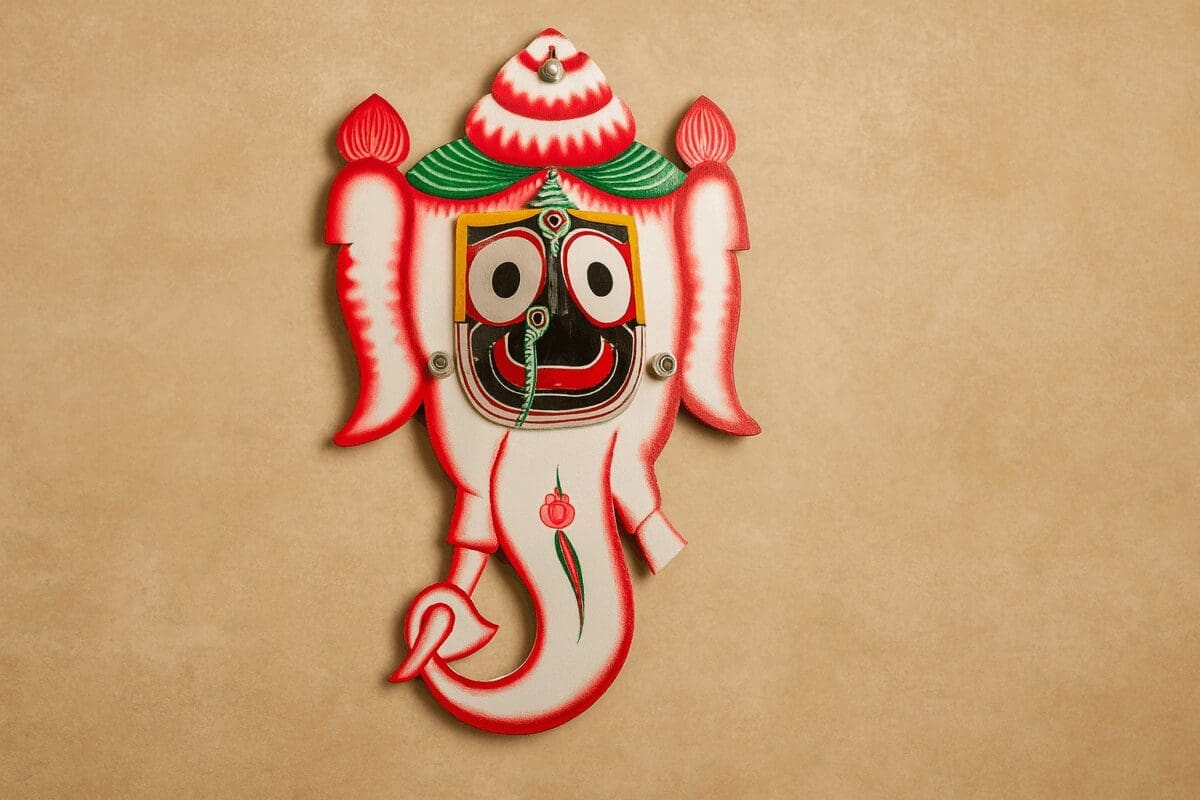
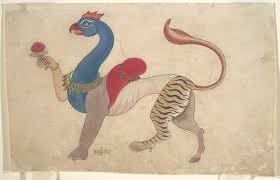
That form was as strange as it was beautiful and intriguing. His one body was a combination of nine beings. He had the head of a rooster, the hump of a bull, the neck of a peacock, and a serpent for a tail. His waist was that of a lion. Of his four legs, three were those of a tiger, an elephant, and a horse, and the front limb was a human hand. In that hand, a lotus flower was held gracefully.
The first poet, Sarala Das, has beautifully described this wondrous Nabagunjara (nine-part creature) form of Sri Krishna in the Madhya Parva of his Mahabharata. He wrote:
Listen, O son of Vaivasvata Manu, as Agastya speaks,
The Lord took nine forms in a single body.
The head of a rooster, looking very beautiful,
The hump of a bull, and the neck of a peacock adorned it.
The tail of a great serpent, the waist like that of a lion,
One foot of a tiger, looking exceedingly graceful.
A leg of a horse, appearing beautiful,
And another foot was that of a great elephant.
The front limb was that of a human hand,
And in that hand, the Lord of emotions held a lotus flower.
In this Nabagunjara form, he appeared near the Manibhadra mountain where Arjuna was staying.
At that time, Arjuna was sitting on a slab of emerald rock on the Manibhadra mountain, polishing his bowstring. Sri Krishna, in the guise of ‘Nabagunjara’, began to jump and leap in front of him. Arjuna was not only enchanted but also astonished to see such a strange creature. He thought, “I have seen so many forests before, but I have never seen such a creature anywhere!” In the next moment, it occurred to him, “No, this extraordinary creature must surely be an illusion.” He realized that this must be the Lord Himself. Therefore, he bowed to the Nabagunjara and began to offer praises. He said, “You are imperishable, undecaying. You are formless, yet you can take any form. You are the avatar without beginning, the wish-fulfilling tree. Even the three-eyed Lord (Shiva) was once deluded by your illusion. I am but a mere mortal! Therefore, shed this illusory form and appear in your true form.”
In response to Arjuna’s praise, Sri Krishna shed his illusory Nabagunjara form and appeared in his own form. Arjuna was overjoyed to see his dear friend, Sri Krishna. Sri Krishna asked about Arjuna’s well-being and said, “You have been in exile for a long time. Come, let’s go to Hastinapura now. Without you, Hastinapura feels empty.”
But Arjuna replied, “I cannot break my vow. My exile has only been for four years, six months, and thirteen days. Only after another seven years, five months, and seventeen days will the twelve years be complete. Only then will I return to Hastinapura.”
Hearing Arjuna’s words, Sri Krishna felt sad. But he was also delighted to see Arjuna’s commitment to his word.
Arjuna said, “Your Nabagunjara form has captivated me. By coming to me in such a form, you have demonstrated your greatness. Along with that, it also contains the message that every creature and human in creation should live together in harmony. Therefore, from now on, this Nabagunjara form of yours will be worshipped by all to awaken this unprecedented spirit of coexistence.”
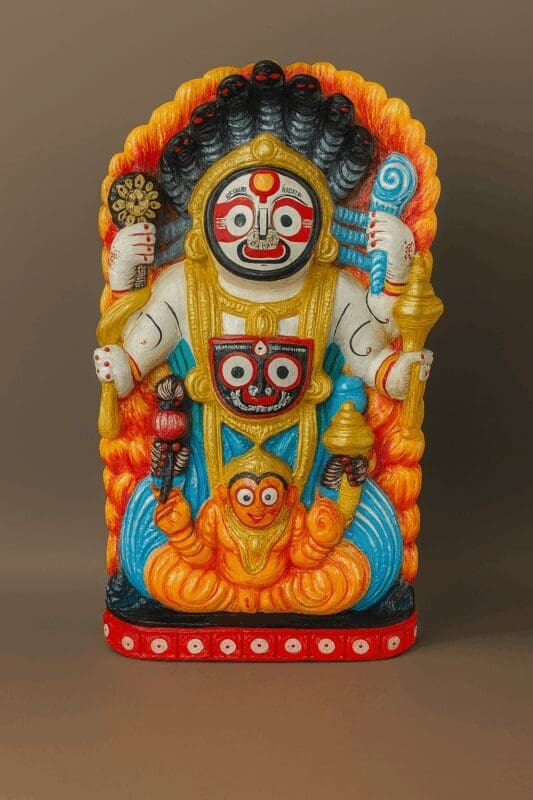
Discover Krishna’s Nabagunjara form, a symbol of coexistence.


 Dakhinabarti sankha (Small Size)
₹ 3,747.00
Dakhinabarti sankha (Small Size)
₹ 3,747.00 Snan Darpan: for Shri Jagannath mahaprabhu's bathing rituals
₹ 9,498.00
Snan Darpan: for Shri Jagannath mahaprabhu's bathing rituals
₹ 9,498.00 Snan Darpan: for Shri Jagannath mahaprabhu's bathing rituals