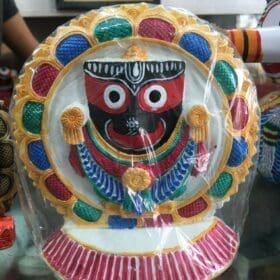
Today is Bhadraba Purnima, celebrated as Bhagavata Janma (the birth of the Bhagavata). According to mythological accounts, to save King Parikshit from the fear of death, the sage Shukamuni narrated the nectar-like story of Lord Sri Krishna to him over seven days. This narration is known as the “Srimad Bhagavatam”. As per commentators and popular tradition, Shukamuni began narrating this divine story on Bhadraba Shukla Navami (the ninth day of the bright fortnight of the month of Bhadraba) and completed it on Bhadraba Purnima. This is likely why Bhadraba Purnima has been celebrated as the holy occasion of the Bhagavata’s birth.
The great sage Vyasadeva sits under a banyan tree looking dejecte

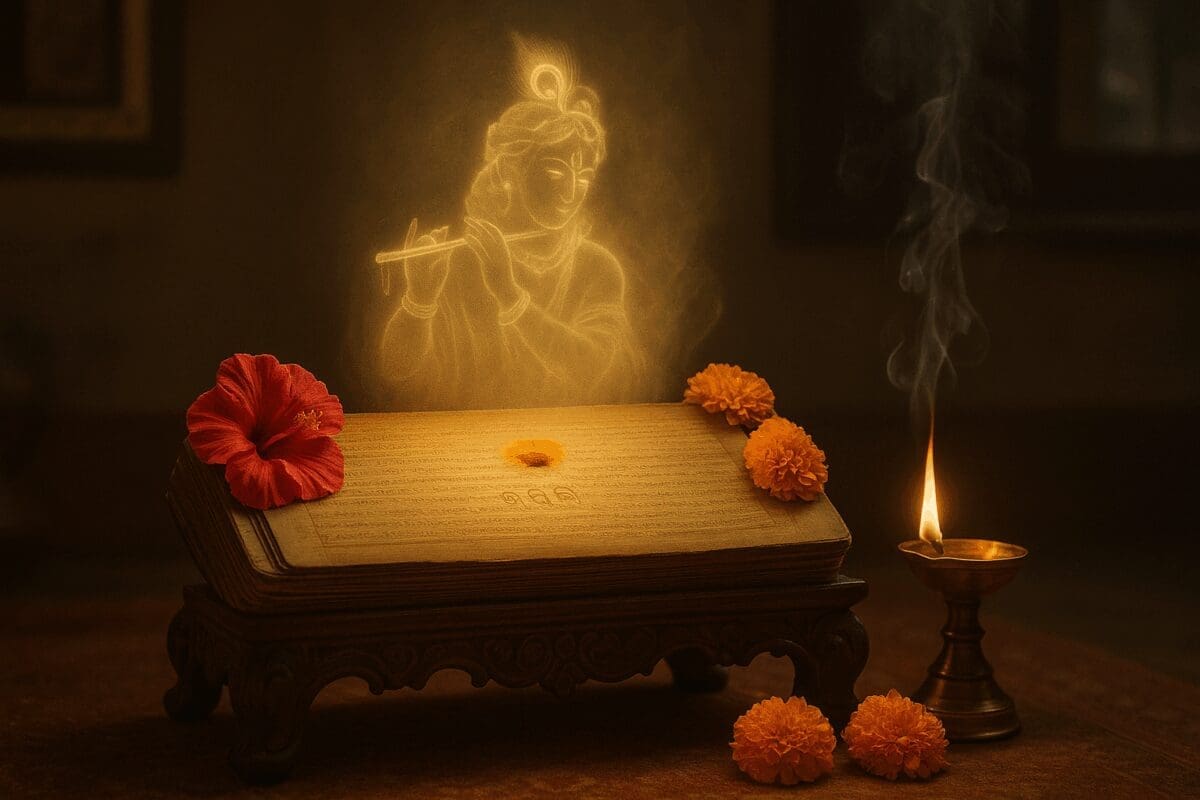
The Srimad Bhagavatam is universally accepted as the divine word emanating from the mouth of the Lord. It is believed that reading the Bhagavata removes all sins and sorrows. It describes the Lord’s divine plays (leela), forms (rupa), abodes (dhama), and glories (mahatmya). The Lord takes many forms and performs various divine acts. By listening to the story of the Bhagavata, all kinds of misfortunes, sorrows, and various obstacles are removed. Maharshi Vyasadeva’s original Srimad Bhagavatam in Sanskrit is considered a supreme culmination among the religious Upanishads. Its spiritual and poetic value, along with its teachings on devotion (bhakti), knowledge (jnana), renunciation (vairagya), and principles of social formation, are immensely beneficial for the entire world. It would not be wrong to say that Krishna Dwaipayana Vyasadeva composed this text for the ultimate welfare of humankind. In this light, the scripture of Srimad Bhagavatam is considered the very auspicious form (murti) of the Lord Himself.
Regarding the composition of the Bhagavata, it is said that one day, as Vyasadeva sat feeling dejected, the sage Narada Muni approached him. Seeing Vyasadeva’s face, Narada asked, “Your face suggests you are in sorrow. Why would a great, wise, learned sage like you, a revered Rishi, be sad? Who is greater than the one who has composed great scriptures like the Vedas, Puranas, and the Mahabharata?” Hearing Narada’s words, Vyasadeva replied, “Yes, sage, as you say, I have composed much. But for some reason, a sense of dissatisfaction remains in my mind. I wish to create something more. Although I have composed the Vedas, Mahabharata, etc., I want to compose a scripture that common people can read, understand, and by singing the glories of Krishna, live happily.” Then, through their discussion, Narada Muni and Vyasadeva decided upon the creation of the great scripture, the Bhagavata. Thereafter, Vyasadeva began composing the Bhagavata and also completed it swiftly.
The Bhagavata Mahapurana speaks of the cycle of birth and death. Freedom from this cycle is called nirvana, moksha, or attaining heaven. The Bhagavata Mahapurana beautifully describes that one gets the rare human birth after passing through 8.4 million (chaurasi lakh) forms of life (yonis). For example:
-
900,000 species of aquatic creatures
-
2,000,000 species of trees and plants
-
1,100,000 species of insects and worms
-
1,000,000 species of birds
-
3,000,000 species of animals
-
400,000 species of human-like beings
According to the meaning of the word “Bhagavata”: “Bha” means Bhava (devotion/emotion), “Ga” means Jnana (knowledge), “Ba” means Vairagya (renunciation), and “Ta” means Tattva (essence/truth). However, according to grammatical principles, Bhagavata kritam Bhagavatam, meaning, “that which is created by Bhagavan (the Lord) is the Bhagavata.” This Bhagavata describes the glory and greatness of the Lord. The Bhagavata is like a wish-fulfilling tree (Kalpa Vriksha) whose seed is the Supreme Soul (Paramatma) Himself, devotion (bhakti) is the basin for its roots, and Omkara is the sprout. It is comprised of twelve cantos (skandhas). The number of branches and sub-branches of this tree is 332, which is the total number of chapters in the Bhagavata. The number of leaves on this tree is 18,000, which is the total number of verses (shlokas) in the Bhagavata.
The Bhagavata is directly compared to the body of Sri Krishna. The first and second cantos are the Lord’s two lotus feet. The third and fourth cantos are the Lord’s two thighs. The fifth canto is the navel region. The sixth canto is the Lord’s chest. The seventh and eighth cantos are His two arms. The ninth canto is the Lord’s throat. The tenth canto is His beautiful face with lovely lips. The eleventh canto is the forehead. The twelfth canto is the Lord’s head. One can never say enough about the glory of this great scripture.
Among the great saints of the 16th century who created streams of devotion in society by basing their devotional works on the Srimad Bhagavatam in regional languages, the great saint of Odisha, Atibadi Jagannath Das, is one of the foremost. His rendition, the Odia Bhagavata, has become a formidable part of Utkaliya (Odia) life and culture.
History says that Vyasadeva’s Sanskrit Bhagavata was not widely accessible to the Odia-speaking people. Jagannath Das’s father, Bhagaban Das, was a Puranapanda (temple scholar who recites Puranas) at the great temple. After him, Jagannath Das became the Puranapanda. He would explain the Sanskrit Bhagavata in simple language. Jagannath’s mother expressed a desire to hear it in the form of Odia poetry. To fulfill the wish of his widowed mother, who was eager to accumulate merit in her old age by listening to the life of Krishna, Jagannath Das began to compose and recite the poetic translation chapter by chapter. That poetic translation took the form of the Bhagavata scripture. He translated it into the Odia language using the Nabakshari chhanda (a nine-syllable meter). The Bhagavata was recited daily in the premises of the Jagannath temple, and devotees would come to listen. Its popularity in the villages and homes of Odisha is universally known. The people and devout souls of Odisha consider this scripture as the living embodiment of the Lord Himself and worship it in their homes even today. This itself is proof of the greatness of this text. In the Bhagavata, Atibadi Jagannath Das has praised the human birth, as follows:
Aneka janma tapa phale
(After the penance of many births,)
Manushya janma mahitale
(One gets a human birth on this earth.)
Durlabha manushya janama
(This rare human birth,)
Pai kimpai heu bhrama
(Having attained it, why are you deluded?)
Sarba sharira madhye saara
(Among all bodies, the essence)
Durlabha nara kalebara
(Is the rare human form.)
Durlabha manushya sharira
(The rare human body)
Naraka nistarana dwara
(Is the gateway to escape from hell.)
The great saint Atibadi Jagannath Das is seated on the floor
Lord Jagannath possesses sixteen kalas (divine attributes), and Sri Krishna is an avatar of just one of these kalas. That single kala was then expanded into sixteen, from which one was given to Arjuna, while with the remaining fifteen, He Himself performed His eternal divine plays (leelas) in places like Gopa, Mathura, and Dwarika. The Odia Bhagavata by Jagannath Das is divided into twelve cantos, and each canto is divided into ten to thirty chapters. It is structured in such a way that if one chapter is read each day, it will be completed in exactly one year, or 365 days. In every Odia home, the Bhagavata is read in the delivery room when a child is born and beside the bed of a dying person. In the past, the Bhagavata was recited to ward off the fear of smallpox, epidemics, cholera, and other village calamities. The original Sanskrit invocation (Mangalacharana) of the Srimad Bhagavatam is also found in Jagannath Das’s Bhagavata.
|| Mangalacharana (Invocatory Verses) ||
Bāgīśā yasya vadane lakṣmīryasya ca vakṣasi |
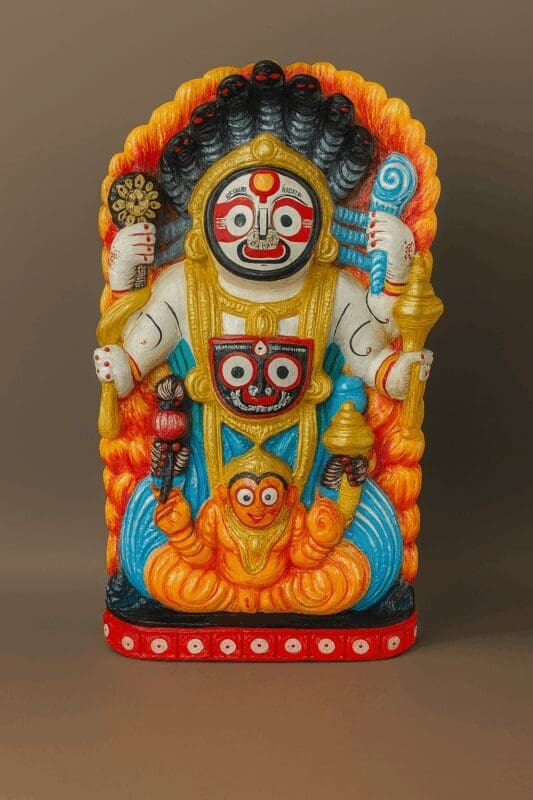
Yasyāste hṛdaye saṁvit taṁ nṛsiṁhamahaṁ bhaje || 1 ||
Meaning: I worship that Lord Nrusimha, in whose mouth resides Saraswati (the Goddess of Speech), on whose chest resides Lakshmi (the Goddess of Fortune), and in whose heart resides knowledge itself.
Viśvasargavisargādinavalakṣaṇalakṣitam |
Śrīkṛṣṇākhyaṁ paraṁdhāma jagaddhāma namāmi tat || 2 ||
Meaning: We bow to the Srimad Bhagavatam, which is the very form of Sri Krishna, the ultimate refuge of the universe and the supreme effulgence that destroys the world’s darkness. It is characterized by nine attributes: creation of the universe (sarga), secondary creation (visarga), sustenance (sthana), nourishment (poshana), impetus for action (uti), the reign of Manus (manvantara), narrations of the Lord’s pastimes (ishanukatha), dissolution (nirodha), and liberation (mukti).
Mādhavomādhavāvīśau sarvasiddhi vidhāyinau |
Vande parasparātmānau parasparanutipriyo || 3 ||
Meaning: We bow to Madhava (Lord Vishnu, the husband of Lakshmi) and Umadhava (Lord Shiva, the husband of Uma), who are the bestowers of all perfections, who are one soul in two forms, and who are pleased by each other’s praise.
Mūkaṁ karoti vācālaṁ paṅguṁ laṅghayate girim |
Yat kṛpā tamahaṁ vande paramānandamādhavam || 4 ||
Meaning: I offer my obeisance to that Madhava, the embodiment of supreme bliss, whose grace can make a mute person eloquent and enable a lame person to cross mountains.
Yaṁ brahmāvaruṇendrarudramarutaḥ stunvanti divaiḥ stavai-
rvedaiḥ sāṅgapadakramopaniṣadairgāyanti yaṁ sāmagāḥ |
Dhyānāvatsitatadgatena manasā paśaṁnti yaṁ yogino
yasyāntaṁ na viduḥ surāsuragaṇā devāya tasmai namaḥ || 5 ||
Meaning: I bow to that Supreme Lord whom Brahma, Varuna, Indra, Rudra, and the Maruts praise with divine hymns; whom the chanters of the Sama Veda glorify with the Vedas and their अंगs (ancillaries), Pada-pathas, Krama-pathas, and Upanishads; whom the yogis see with their minds absorbed in meditation; and whose limits neither the gods nor the demons can ever fathom.
Nārāyaṇaṁ namaskṛtṁya naraṁ caiva narottamam |
Devīṁ sarasvatīṁ vyāsaṁ tato jayamudīrayet || 6 ||
Meaning: After offering obeisances to Lord Narayana, to Nara-Narayana Rishi (the best of men), to Mother Saraswati (the Goddess of Learning), and to Srila Vyasadeva, one should recite this Srimad Bhagavatam, which is the very means of conquering the evils of the world and the heart.
“Govinda Govinda Govinda |
Padu gaḍuchi makaranda ||
Se makaranda pāna kari |
Hele tarile brajanārī ||
Se brajanārīnka payare |
Mana mo rahu nirantare ||
Mana mo nirantare thāu |
Hā kṛṣṇa boli jība yāu ||”
—Jagannath Das, Bhagavata Vani
(Govinda, Govinda, Govinda.
From your lotus feet, flows the nectar.
By drinking that nectar,
The women of Braja were easily delivered.
At the feet of those women of Braja,
May my mind forever remain.
May my mind forever stay there,
And may my life depart while uttering “Ha Krishna!”)
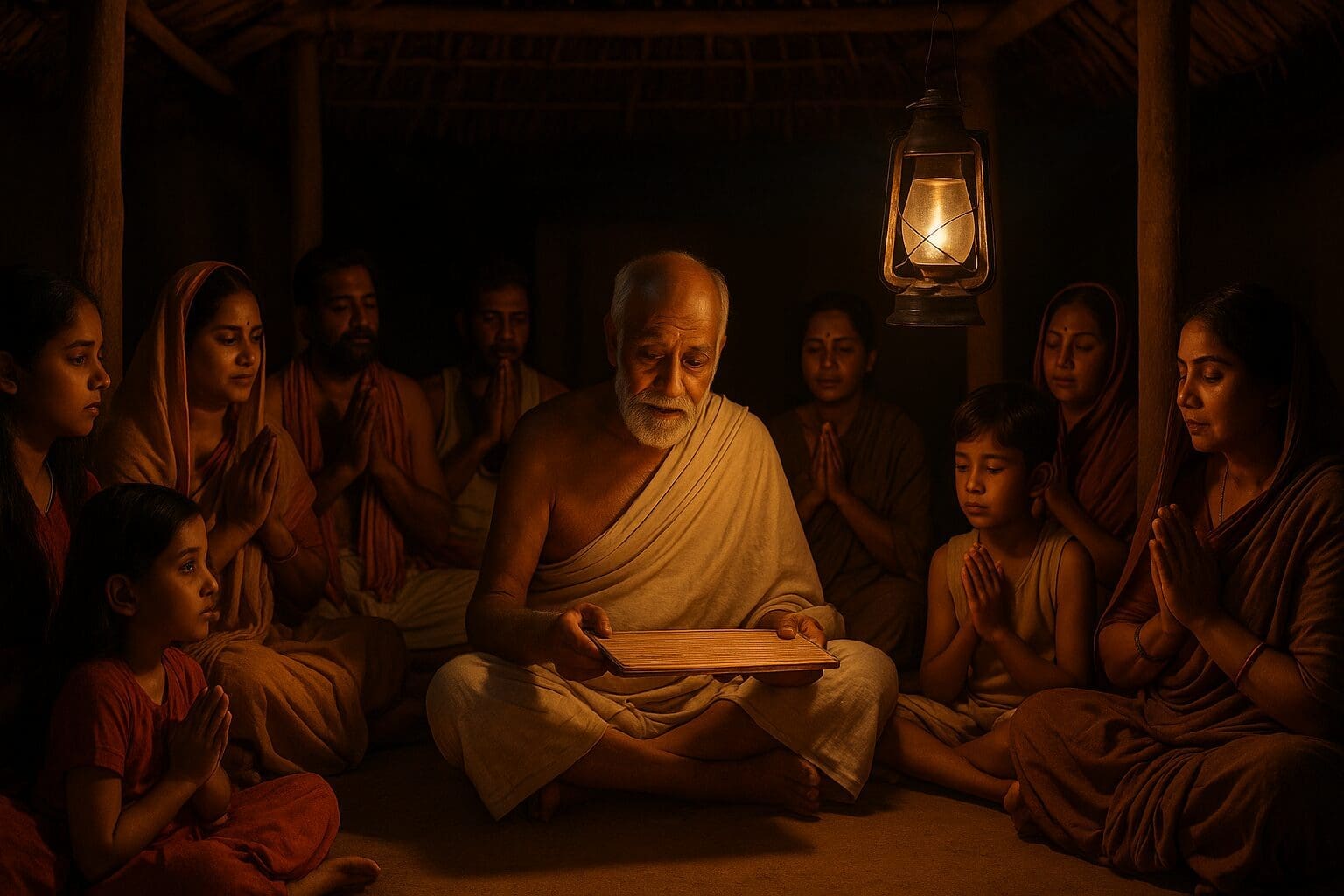
A ‘Bhagavata Tungi’ (a small, open hut) is lit by a single lantern.
Today is the birthday of that great and holy scripture. In the villages and towns of Odisha, this day is famously known as Bhagavata Janma. On this occasion, let us all take a vow to read the Odia Bhagavata daily.
🙏🙏🙏🙏🙏


 Natural Light Filters
₹ 1,147.32
Natural Light Filters
₹ 1,147.32 Goddes Laxmi Annd God Vishu Koudi
  Jagannath mahaprabhus Jhulana Palinki
  Chandan lagi seva(sandal wood)
  Beutiful shri jagannath Mahaprabhu Car/wall hanging
  Dakhinabarti sankha (Small Size)
  Radha Krishna Tasar Painting
  Justkalinga.com Traditional Jodo (Dhoti + Uttariya)
  The origin story of Shri Jagannath
  Mahaprabhu Marbles Art Idol
  Niladrinath Gift Hamper
  Shri Jagannath's Locket(Silver)
  Lord shri Jagannath Mahaprabhu Marble Art
  Natural Light Filters
  Sambhu Jagannath Locket