“Devashilpi Mahabhaga Devanam Karyasadhaka |
Vishwakarmannamastubhyam Sarvabhistha Pradayaka ||”
(O great divine architect, the accomplisher of the tasks of the gods. O Vishwakarma, salutations to you, the granter of all desired boons.)
According to the Hindu calendar (Panchang), when the Sun transits from the Leo (Simha) zodiac to the Virgo (Kanya) zodiac, it is known as Kanya Sankranti. The special significance of this Sankranti is that this day is celebrated with great fanfare as the birthday of the divine architect Vishwakarma in countries like India and Nepal.
‘Vishva Svasya Karman’ iti Vishwakarma (He whose creation is the universe is Vishwakarma)
The divine architect Vishwakarma is the patron deity of all crafts and artisans. According to the Puranas, he was born from the womb of Yogasiddha, sired by Prabhasa, the eighth Vasu deity. According to another belief, the divine architect Vishwakarma was born from the navel lotus of Prajapita Brahma. The four-armed Vishwakarma is depicted holding a chisel (batalia) in his upper left hand and a mallet (martuli) in his lower left hand, a discus (chakra) in his upper right hand, and bestowing blessings with his lower right hand. Adorned in divine garments, a jeweled necklace on his throat, embellished with unparalleled gems and ornaments, and wearing crocodile-shaped earrings (Makara Kundala). Although he is rich in knowledge and stature, he appears youthful. He is extremely handsome and radiant, with a lustre like that of Kamadeva (the god of love). Vishwakarma is the father of all arts and crafts. At Brahma’s command, Vishwakarma created the entire universe. All the weapons, celestial vehicles (vimanas), etc., of the gods were built by him. Amaravati, the capital of heaven, is the finest example of his craftsmanship. Just as castes are created based on the difference in human work, so is God imagined in various forms. When He creates, He is Brahma; when He preserves, He is Vishnu; when He destroys, He is Rudra. Similarly, when He is the artist, He is known as Vishwakarma.
In another sense, Vishwakarma is the creator of the universe. Brahma, the seer of all three time periods (past, present, future) who emerged from the navel lotus of the eternally resting Narayana, is the creator. Hence, Vishwakarma is imagined and worshipped as a form of Brahma. The scriptures describe five avatars of Vishwakarma. These five avatars are Virat Vishwakarma, Dharmavanshi Vishwakarma, Agnivanshi Vishwakarma, Sudhanva Vishwakarma, and Bhruguvanshi Vishwakarma. According to the Skanda Purana, Lord Vishwakarma, a form of Brahma, has five faces. The names of Vishwakarma’s five faces and his five sons are Manu, Maya, Tvashta, Shilpi, and Devagnya. Each of them is a powerful and divine sage who worked for the welfare of society. According to the names of these five faces, the five sons of Lord Vishwakarma created mechanical weapons and other materials for the benefit of the world. Rishi Manu, the eldest son of Vishwakarma, was married to Sampa, the daughter of Rishi Angira. The second son, Rishi Maya, was married to Saumya, the daughter of Rishi Parashara. The third son, Rishi Tvashta, was married to Jayanti, the daughter of Rishi Kaushika. The fourth son, Rishi Shilpi, was married to Karuna, the daughter of Rishi Bhrigu. The fifth son, Rishi Devagnya, was married to Chandrika, the daughter of Rishi Jaimini. Hindus believe that by his grace, new things are invented using various skills and knowledge.
The divine architect Vishwakarma appeared on Earth during Kanya Sankranti. ‘Vishva Svasya Karman’ iti Vishwakarma. Vishwakarma is also known as Tvashta. He was the father of Chitrangada. “Chitrangadayah pitaram mam Tvashtaram tapodhane” (Vamana Purana – 65/102). The word Tvashta (from the root tvakṣ) means carpenter, builder, or artisan, and is especially used to mean Vishwakarma. The lineage of Vishwakarma is described in the Brahma Vaivarta Purana. Furthermore, from this Purana, it is known that Ghritachi, a celestial courtesan (Apsara), was Vishwakarma’s wife. According to the ‘Amarakosha’, Ghritachi was one of the prominent celestial courtesans.
“Ghritachi Menaka Rambha Urvashi cha Tilottama
Sukesi Manjughoshadya kathyante’psaraso budhaih.”
According to the Brahma Vaivarta Purana, once Ghritachi, beautifully adorned, was on her way to the Pushkar Tirtha for a romantic union with Kamadeva. At that time, the divine architect Vishwakarma was returning from heaven and met Ghritachi. Captivated by Ghritachi’s beauty, Vishwakarma became filled with desire. However, Ghritachi was on her way to unite with Kamadeva. Therefore, she advised Vishwakarma to refrain from his intentions, saying, “O divine architect, according to the rules of heaven, on the day a celestial courtesan desires a particular god, that specific god is her husband. Thus, Kamadeva is my husband for today. You, Vishwakarma, are also a disciple of Kamadeva. Therefore, it is improper to abduct your guru’s wife. Tomorrow, you will surely be my husband.” Due to Ghritachi’s strong refusal, Vishwakarma became extremely angry and cursed her to be born as a Shudra woman on Earth. Ghritachi, in turn, cursed Vishwakarma to be born as a human on Earth. Vishwakarma informed the creator Brahma about Ghritachi’s curse and asked for a remedy. However, Brahma informed Vishwakarma that despite Ghritachi’s profession, she held the status of a chaste and devoted wife (pativrata) in heaven, and thus her curse would not be in vain.
In a later period, Vishwakarma was born into a Brahmin family and, having memories of his past life (jatismara), he knew everything. By the king’s order, while he was constructing many temples for gods and goddesses at Prayag Tirtha, he one day saw an exquisitely beautiful maiden bathing in the Ganga and realized that she was Ghritachi. Ghritachi also recognized Vishwakarma. As per Brahma’s words, they married in the Malaya forest on the banks of the Ganga and spent twelve years together. They had nine children. The sons were Malakara (garland-maker), Karmakara (blacksmith), Kansari (bronzesmith), Shankhari (conch-shell artisan), Kumbhakara (potter), Kundabika (turner/lathe-worker), Sutradhara (carpenter), Swarnakara (goldsmith), and Chitrakara (painter). Vishwakarma educated his sons by teaching them their respective crafts: floral art to the Malakara, ironwork to the Karmakara, bronze work to the Kamsyakara, woodwork to the Sutradhara, weaving to the weaver (Tanti), pottery to the Kumbhakara, jewelry making to the Swarnakara, and painting to the Chitrakara. His daughter Chitrangada also learned the art of tailoring from her father.
Furthermore, according to the same Purana, one of the sons, the Swarnakara, was considered fallen (patita) after stealing gold from a Brahmin. Similarly, the Sutradhara was also considered fallen for delaying the supply of wood during a yajna (Vedic sacrifice). (The use of wood cut by a carpenter’s adze in Vedic sacrifices is still in practice). The Chitrakara became infatuated with a Shudra courtesan and manifested as a mason/architect (Attalika). Thus, artisans and craftsmen of all classes are descendants of Vishwakarma. According to the ‘Vamana Purana’, the divine architect Vishwakarma was cursed and took the form of a demon. After receiving a boon from Rishi Ritadhwaja, he had a relationship with Ghritachi and was freed from the curse after fathering ‘Nala’.
“Tasmin Godavari tirthe prasuta tanayam Nalam
Jatoddhapatya kapitwat cha vishwakarmanyapyapyutwat.”
(Vamana Purana – 65/154)
Nala, the monkey commander, had the ability to make any stone he touched float on water. After Nala touched the stones, Lord Ramachandra built a bridge (Setubandha) across the ocean with those floating stones, crossed the sea, and reached the fortress of Lanka. Vishwakarma had a daughter named Chitrangada who married King Suratha. According to Puranic tales, the divine architect Vishwakarma or Tvashta is also recognized as the fire god Agni, who had a son named Trishira and a daughter named Sanjna. He arranged Sanjna’s marriage to Surya (the Sun God). When Sanjna could not bear Surya’s intense radiance, Tvashta Vishwakarma pleased Surya by reciting 108 hymns to the Sun (Surya Stotras), as described in the Narasimha Purana.
“Tenaivamukto dina krit tatheti
Tvashtaramukta vivarama bhaskarah
Sanjnam vishankam ravimandala sthitam
Kritva jagamatha ravim prasadya.” (Narasimha Purana – 19/22)
By pleasing the Sun God, Vishwakarma was able to trim his fierce radiance. From that mass of energy, Vishnu’s discus (Sudarshana Chakra), Shiva’s trident (Trishula), and the weapons of other gods were created. This is also reflected in the great poet Kalidasa’s epic ‘Raghuvansham’.
“Aropya chakra bhramimushta tejostashteva yatnolikhito vibhati.” (Raghu – 6/32)
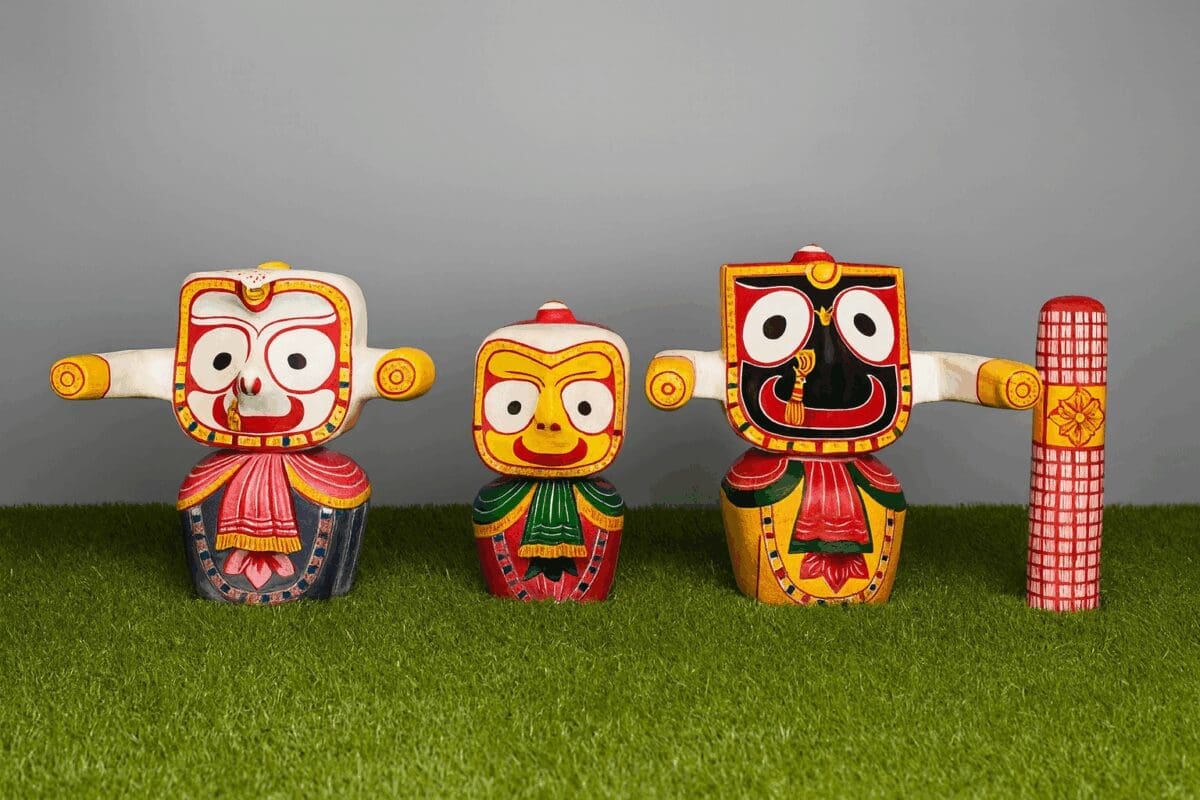
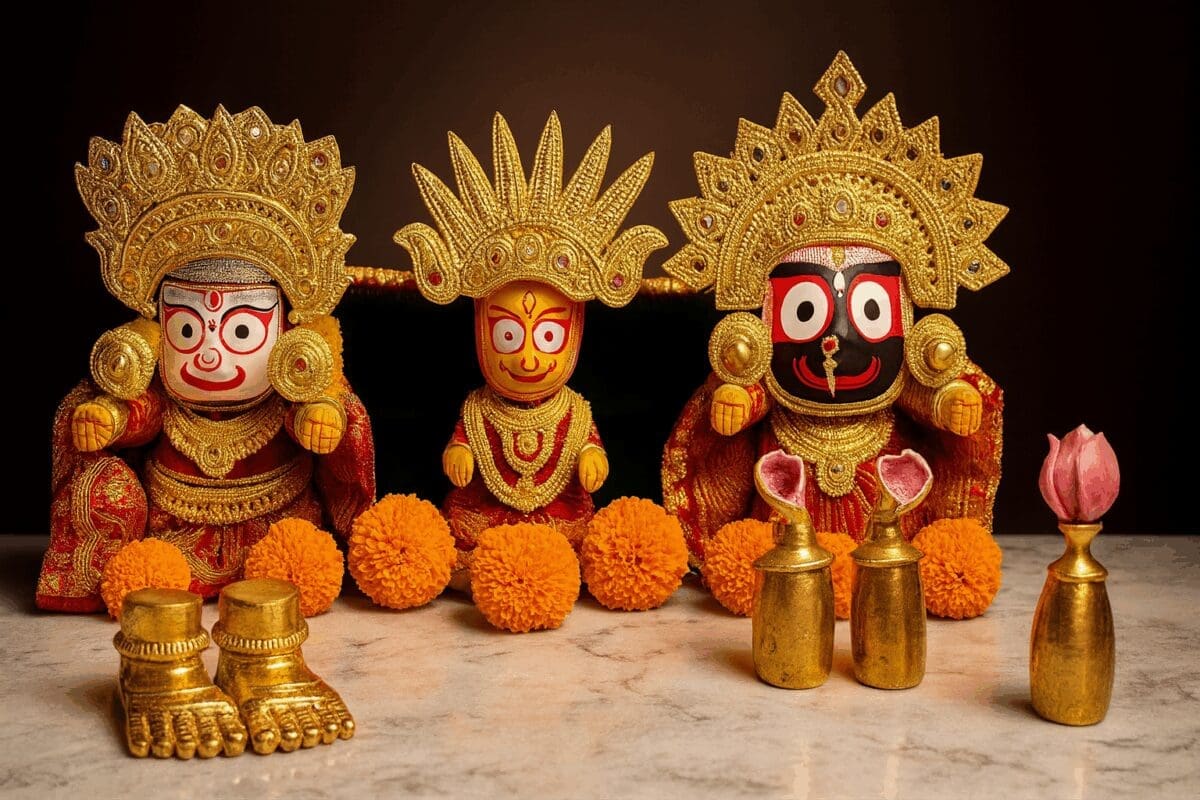
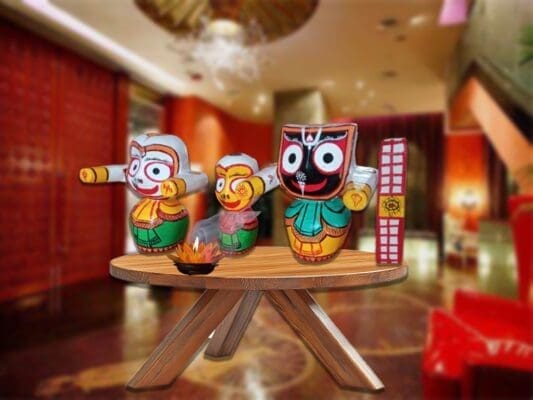
According to the Ramayana, Ravana’s golden city of Lanka; according to the Harivansha, the city of Dwarikadham; and according to the Skanda Purana, the sacred idols of Lord Jagannath were all crafted by Vishwakarma.
Vishwakarma’s daughter Sanjna and son Nala, the monkey.
Sanjna was Vishwakarma’s daughter. The Sun God married her. From Sanjna’s womb, sired by Surya, were born Vaivasvata Manu, Yama, Yamuna, and the Ashvini Kumar twins. Nala, the monkey commander, was born from the womb of the Apsara Ghritachi. Any stone he touched would become light and float on water. Because he touched the stones, Lord Ramachandra was able to build a bridge across the ocean with those floating stones, cross the sea, and reach the fortress of Lanka.
The Wooden Idols of Jagannath and Vishwakarma:-
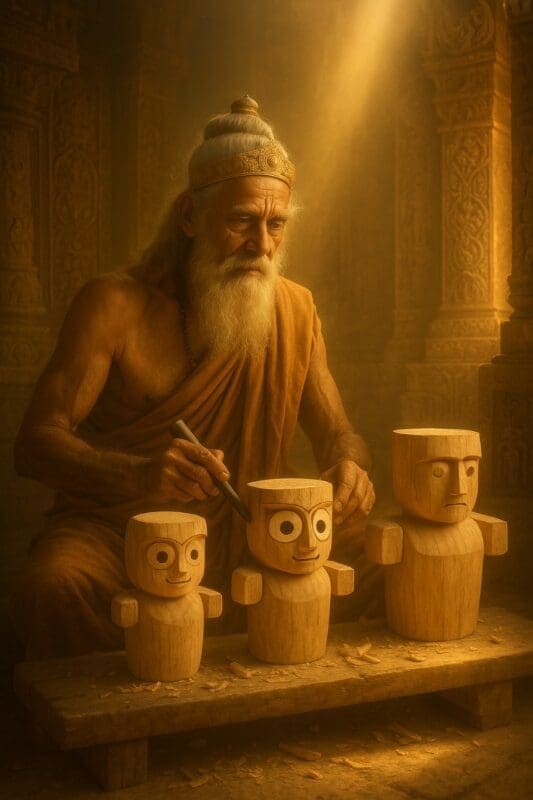
According to legend, the wooden idols of Jagannath were carved by Vishwakarma. King Indradyumna brought skilled artisans from various countries to carve the idols from the sacred log (daru) he had collected from Banki Muhana. However, their chisels could not carve the wood; instead, their edges were blunted. Failing to build the idols, everyone began to leave, and the king and queen grew increasingly worried day by day. After some days, an old carpenter arrived and expressed his desire to carve the idols. Finally, the responsibility of construction was given to the old carpenter. The old carpenter set a condition: the temple doors would not be opened for 21 days, during which he would fast and carve the idols. The king agreed and had the temple doors sealed. Every day, the king had arranged to listen to the “thak-thak” sounds from inside. After a few days, when the sounds stopped, Queen Gundicha could no longer remain patient. She thought the old carpenter had died of starvation and urged the king to open the doors. When the doors were opened, it was seen that the old carpenter had vanished, leaving behind only the half-finished idols. As the king and queen fell into deep despair, a divine voice from the heavens (Shunyavani) announced: “I have manifested in the form that I wished to appear in, so there is nothing to grieve about. This old carpenter was none other than the divine architect Vishwakarma himself.”
Because the Lord of devotees Himself came in the form of a carpenter to fulfill his devotee’s wish and carved His own idol, this form of the old carpenter is generally imagined as the form of Vishwakarma in Odisha.
The three chariots constructed for the Shri Gundicha Yatra, beginning from Akshaya Tritiya and ending before Netrotsava, are built according to scriptural methods. The previously mentioned ‘Sapta Rathakara’ or ‘Sapta Rathabindhani’ (seven master chariot-makers) carry out this construction work. The chariot paintings, coverings, flags, and other decorations are also part of this.
The method of chariot construction is documented in various Shilpa Shastra texts (treatises on arts and crafts). For the construction of the three chariots of the Shri Gundicha Yatra, texts like ‘Aparajita Pruchha’ and other Shilpa Shastras are generally referenced. Among these Shilpa Shastras, ‘Manasara Shilpashastra’ by Manasara, ‘Mayamatram’ by Maya, ‘Samarangana Sutradhara’ by Raja Bhoja, and ‘Shilparatna’ are prominent. ‘Vishwakarma Vastu Shastra’ by Vishwakarma is also mentioned in this context. These are all architectural or craft-related texts written in Sanskrit.
Some of these are also linked to the divine architect Vishwakarma described in the Puranas. According to Puranic context, this divine architect ‘Vishwakarma’ is the son of Brahma. In the original Sanskrit, he is ‘Vishvakarman’. Since ‘Vishva’ means all-pervading and ‘Karman’ means action, it refers to the lord of all-pervading action. There is also another Puranic view that Vishwakarma was born to Yogasiddha from the eighth Vasu deity, Prabhasa.
In the Vedas, however, Vishwakarma is known as ‘Tvashta’ or ‘Tvashtri’. He is also famous as the first promulgator of architectural science (Sthapatya Vijnana).
Vishwakarma is the divine architect of the entire universe, and it is described in the Puranas that he holds a water pot (kamandalu), a book, and tools like a chisel in his four hands.
Aparajita is known to be a rishi, but he is said to be the son of Vishwakarma, for which no definitive proof has been found to date. Although ‘Aparajita Pruchha’ is the Shilpa Shastra he authored, its original name is mentioned in many places as ‘Aparajita Prachha’ (Aparajita’s Questions). This suggests that the text may have been originally composed in a Prakrit language and later published in Sanskrit as ‘Aparajita Pucchā’.
In this text, the son Aparajita asks his father Vishwakarma various questions regarding architecture and craft-related constructions, and Vishwakarma answers them. The topic of chariot construction arises in this context. It is indicated that this work was composed by Bhuvanadeva.
The construction methods for the three chariots of Shri Jagannath’s Ratha Yatra in Shreekshetra are known to be determined according to the aforementioned Shilpa Shastras, including this ‘Aparajita Pucchā’. The part of the Vastu Shastra written by Vishwakarma that relates to chariot construction is called ‘Vishwakarmīya Ratha Lakṣaṇam’. However, ‘Vishwakarmīya Ratha Lakṣaṇam’ (edited by Raghunath Purushottam Kulkarni and published by Kanishka Publishers, New Delhi) mentions nine types of chariots. ‘Aparajita Pucchā’ (edited and translated by Dr. Shrikrishna Jugnu and Professor Bhanwar Sharma, published by Parimal Publications, Delhi) also describes nine types of chariots. According to ‘Vishwakarmīya Ratha Lakṣaṇam’, the nine chariots are: 1. Nanda, 2. Nandyavarta, 3. Nandighosha, 4. Paranjaya, 5. Pataka, 6. Padmaka, 7. Prithvijaya, 8. Mahodbhava, and 9. Shrimeru. Similarly, the nine chariots in ‘Aparajita Pucchā’ are: 1. Shreekara, 2. Vijaya, 3. Kanta, 4. Shreekesha, 5. Vishalaka, 6. Shreebhadra, 7. Shreevishala, 8. Bhadra, and 9. Bhadravishalaka. Among these, the name of Shri Jagannath’s ‘Nandighosha’ chariot and Devi Subhadra’s ‘Padmaka’ or ‘Padmadhwaja’ chariot are found in ‘Vishwakarmīya Ratha Lakṣaṇam’, but Shri Balabhadra’s ‘Taladhwaja’ chariot is not named. However, researchers and scholars have identified the ‘Shrimeru’ described therein as Shri Balabhadra’s chariot.


 Dakhinabarti sankha (Small Size)
₹ 1,249.00
Dakhinabarti sankha (Small Size)
₹ 1,249.00 Chandan lagi seva(sandal wood)
₹ 11,780.00
Chandan lagi seva(sandal wood)
₹ 11,780.00 Chandan lagi seva(sandal wood)
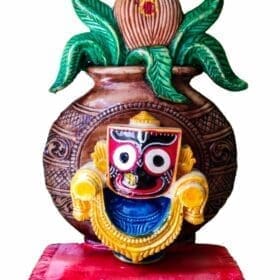
 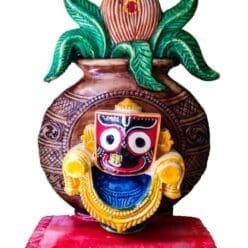 Mahaprabhu Marbles Art Idol
  The divine Tulasi Kanthi Mali
  Sambhu Jagannath Locket