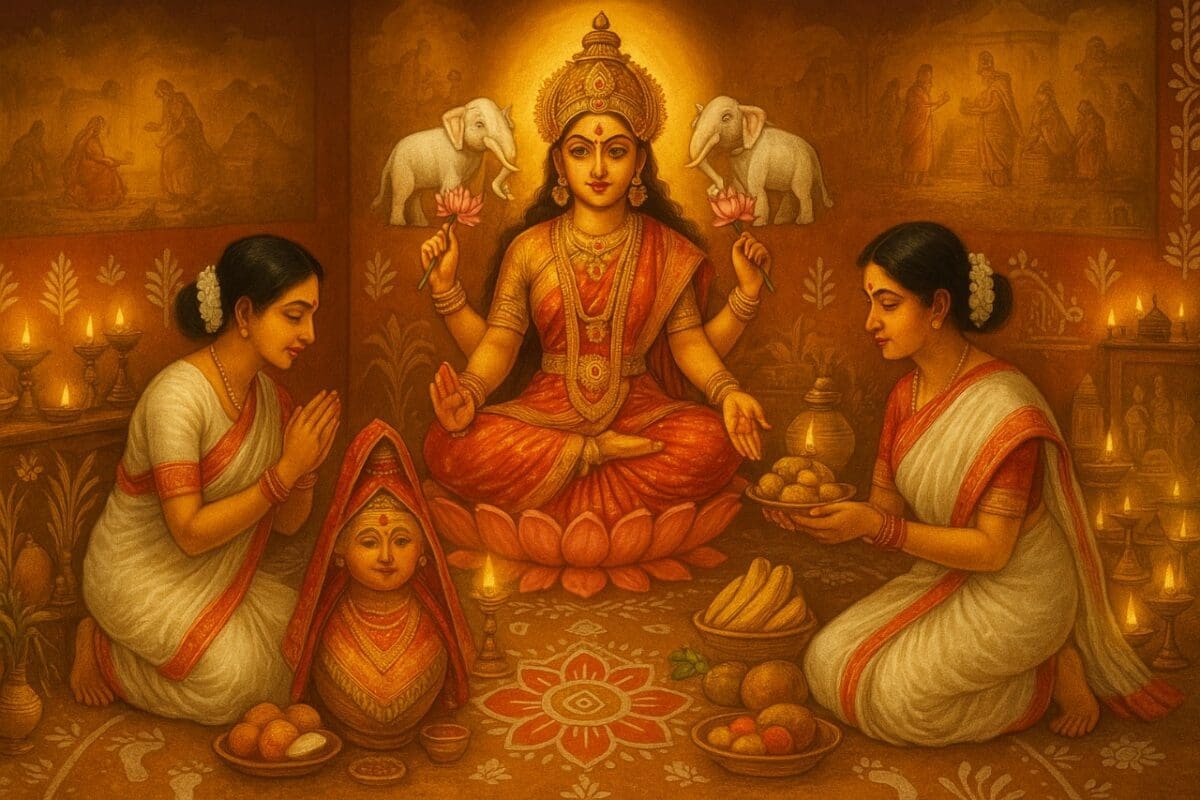
Kāntyā kāñcanasannibhāṁ himagiri prakhyai ścaturbhirgajai |
Hastōtkṣipta hiraṇmayāmr̥ta ghaṭai rāsicyamānāṁśriyam ||
Bibhrāṇāṁ baramabjayugmamabhayāṁ hastaiḥ kirīṭōjjvalāṁ |
Kṣōmābaddha nitambabimba lalitāṁ bandē’rabindasthitām ||
Meaning: Her radiance is like that of pure gold, and four majestic, snow-white elephants, as tall as the Himalayas, continuously anoint her with pots of immortal nectar held in their trunks. In her four hands, she holds the boons of blessing (Varada) and fearlessness (Abhaya), along with two lotuses. Her head is adorned with a magnificent, shining crown. Her waist is gracefully draped in silken robes. I offer my salutations to that Goddess Lakshmi, who is seated upon a blooming lotus.
Manabasa Osha is an agriculture-based festival celebrated in Odisha. Odia women observe this osha (vow/fast) in the month of Margashira. Manabasa Osha is also known as Lakshmi Puja. During this time, Goddess Lakshmi is envisioned as the embodiment of wealth, grain, affection, compassion, and forgiveness. Special attention is given to the prosperity, well-being, and cleanliness of the home. In the month of Margashira, the puja room is decorated with a “Dhana Menta” or “Dhanabeni,” which is a braid made by weaving sheaves of paddy.
The ‘Mana’ is a traditional measuring pot used for measuring grains like rice. Since this osha involves establishing and worshipping a ‘mana’ filled with paddy, it is known as Manabasa.
ll Legend ll
The legend of Manabasa Gurubar is described in Balaram Das’s Lakshmi Purana. According to this purana, one day, Goddess Lakshmi, surrounded by her attendants, took permission from her husband on a Manabasa Gurubar and, in the guise of a Brahmin woman, left the Great Temple (Bada Deula) to tour the land. She went from house to house to see who was worshipping her.
After observing that many wealthy and prominent people had forgotten that it was a Thursday, she arrived at the house of Shriya, a woman from the Chandal (a low-caste) community. Shriya had cleaned and plastered her house and had neatly arranged all the items for the puja, including the offerings. Mahalakshmi was pleased with her devotion and decided to stay there.
Seeing this, Lord Balabhadra became furious. Because Mahalakshmi had set foot in the house of a Chandaluni, who was considered untouchable in the society of that time, the doors of the Great Temple were closed to her. Feeling insulted, the Goddess left the Shri Mandir. As she left, she vowed to teach the two brothers, Kalia-Balia (Jagannath-Balabhadra), a proper lesson.
On Mahalakshmi’s command, Vishwakarma built another palace on the seashore. The Goddess summoned the spirits (Tala-Betala) and had them loot everything from the Great Temple, rendering the Shri Mandir devoid of all its wealth and splendor (Shri-hina). With nothing to eat, the two brothers wandered in hunger and finally arrived in front of her new palace. Impressed by the hospitality they received, they wished to meet the owner of the palace. When they discovered her identity, the two brothers felt deeply ashamed. Mahalakshmi agreed to return to the Shri Mandir only after they promised that there would be no prohibition on visiting the homes of the pure-hearted and that the discrimination of touchable and untouchable would be abolished.
ll Rituals ll
The first paddy harvest begins in the month of Margashira. The farmer brings bundles of paddy to his threshing floor (khala). Before bringing the harvest home, his wife selects the sheaves of white paddy. She weaves these paddy sheaves into a braid (beni) or a bunch (menta), dries it, and keeps it with great care and reverence.
The day before the Thursday osha, the house, courtyard, and surroundings are cleaned and plastered with a mixture of cow dung and mud. After the harvest, the piled-up paddy on the threshing floor is considered a blessing from Lakshmi, the goddess of food and wealth, and this osha is observed in her honor.
The night before Manabasa Gurubar, housewives clean the house and decorate it with Jhoti Chita (Alpana or Rangoli made with rice paste). On Thursday, women wake up early in the morning, complete their bathing and other chores, and begin the worship of Goddess Lakshmi.
In villages, women plaster their mud houses with cow dung and draw Jhoti and Lakshmi’s footprints with a paste made from newly harvested rice. Every doorway, courtyard, and wall is decorated with Jhoti Chita.
A new ‘mana’ is filled with white paddy and placed on a ‘khatuli’ (a small wooden stool). A paste of turmeric and guggul is applied to the top of the mana, shaping it like a face. Cowrie shells are used as eyes, and with creative skill, the mana is given the beautiful appearance of a face. The paddy braid (menta) is placed on top of it. It is then covered with a veil (odhani) made of a beautiful red-dotted silk cloth, making it resemble a new bride.
A divine, sixteen-petalled lotus is drawn around the stool of Goddess Lakshmi. From all around the house, the Goddess’s lotus footprints (chita) are drawn leading up to her seat. Some people also keep items like mango leaves, gayatulasi (a type of holy basil), a kalapati (black slate), a sindura farua (vermilion box), and brass idols. The threshing floor is also decorated with Jhoti Chita on this day.
A special place in the puja room is designated for establishing Mahalakshmi. A sixteen-petalled lotus flower is drawn at the puja spot using rice paste. Items prepared in advance for the puja include newly harvested white paddy, a ‘mana’, areca nuts, cowrie shells, coconut, duba grass, jujube leaves, vermilion, incense, lamps, and food offerings (naivedya). Before establishing the ‘mana’, it is washed with turmeric water, dried in the sun, and then smeared with vermilion.
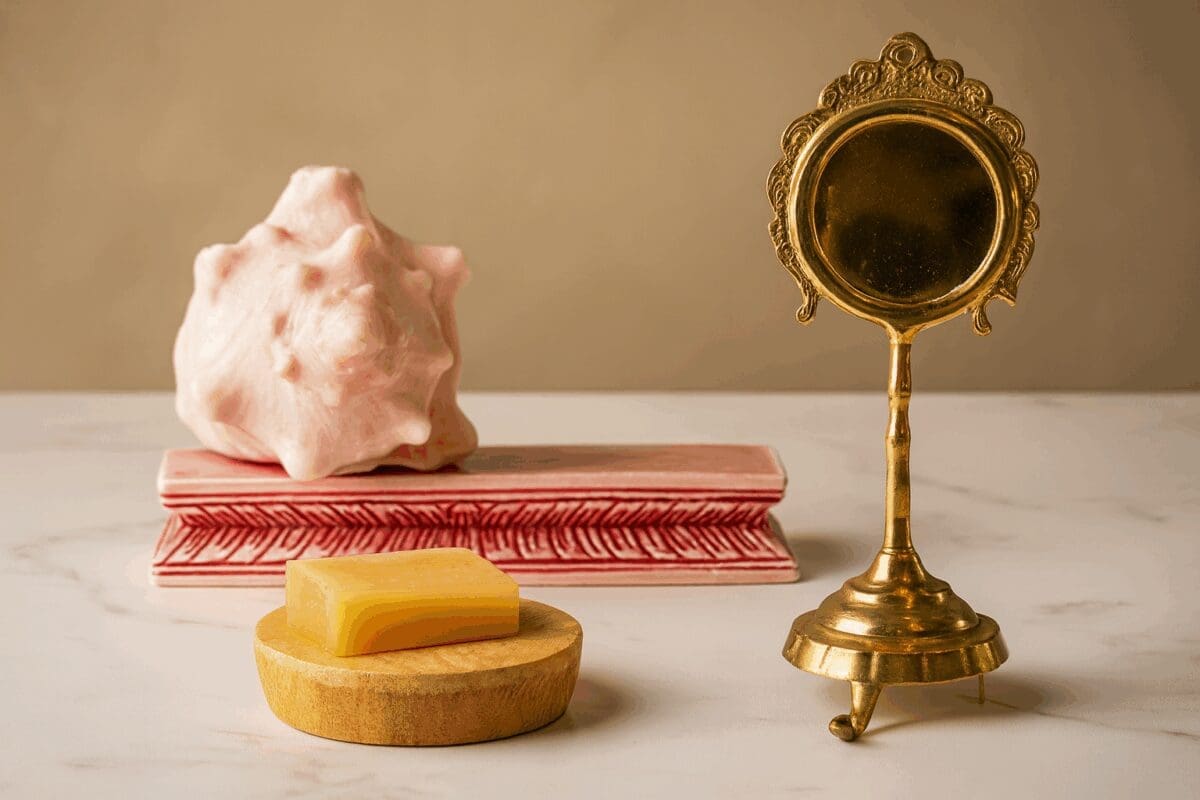
First, some new paddy is placed on a ‘khatuli’. The vermilion-smeared ‘mana’ or ‘gauni’, symbolizing Goddess Lakshmi, is filled with new white paddy, and an areca nut is placed on top. This ‘mana’ is placed on the ‘khatuli’, the paddy braid is placed on it, and it is covered with a new silk veil. Mahalakshmi is decorated like a newly-wed bride and established with offerings of sandalwood paste, vermilion, etc. According to the ritual, a wooden idol of Lakshmi, a comb, a mirror, and kohl are placed on the stool. Sugarcane and radish are placed nearby.
ll Offerings (Bhoga) ll
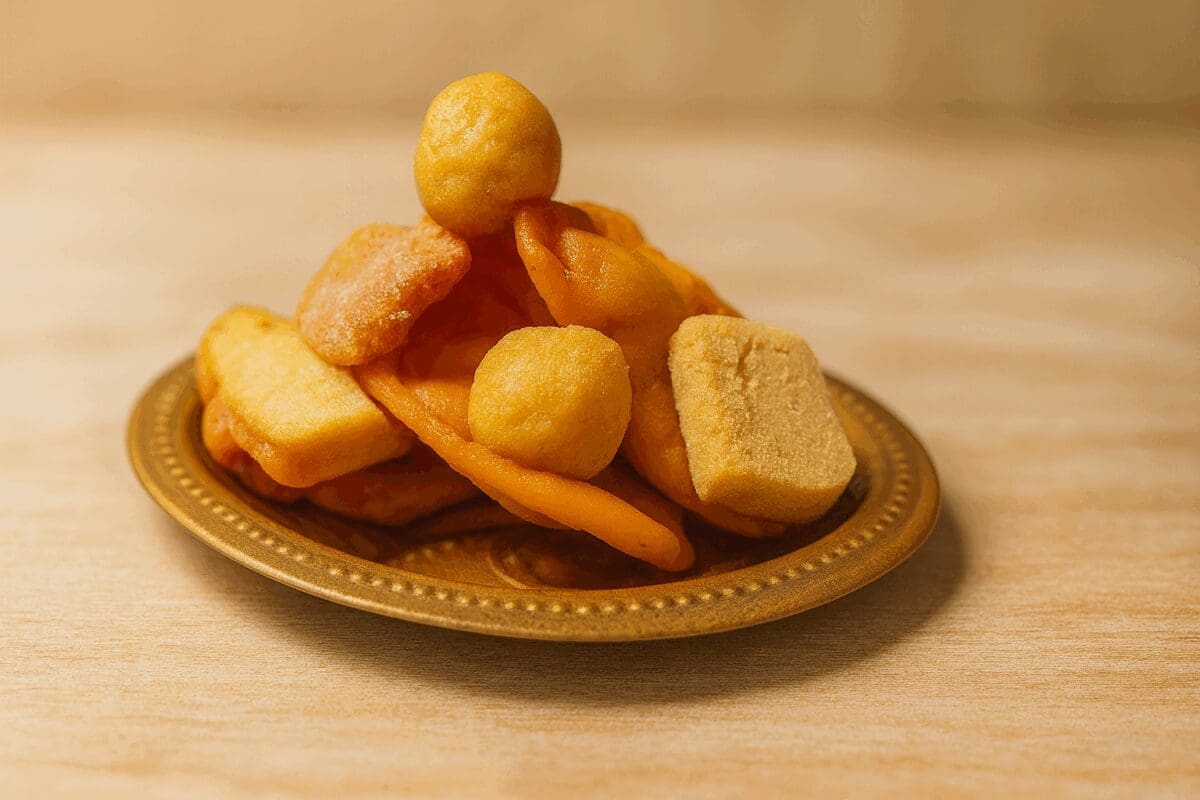
During the puja, incense, lamps, and various food offerings (naivedya) are offered to Goddess Lakshmi. Pithas (traditional cakes), fruits, and a special bhoga made from banana, chhena (cottage cheese), coconut, jaggery, and black pepper are offered. Additionally, ‘Manda Pitha’ is prepared and offered. Different types of pithas are prepared for each of the Thursdays.
Lakshmi is offered incense, lamps, and naivedya. The ‘Bala Bhoga’ (morning offering) consists of a mixture of mashed chhena, jaggery, coconut, and banana. Among the three main offerings (dhupa), this is called ‘Bala Dhupa’.
After this, preparations begin for the ‘Madhyahna Dhupa’ (midday offering). For the midday ‘sankhudi’ (cooked meal) offering, dishes like ‘khiri’ (rice pudding) or ‘tarana’, ‘chakuli pitha’ (rice pancake), curry, etc., are prepared and offered with devotion. After the midday offering, the Lakshmi Purana is recited before the Goddess. This bhoga is consumed only by the family members; it is a rule not to give it to anyone outside the family.
During twilight, for the ‘Sandhya Dhupa’ (evening offering), bhoga similar to the morning offering is offered again, and the evening puja is performed.
On the 2nd Thursday, ‘Chitau Pitha’ and ‘Dahikalua’ are offered; on the 3rd, ‘Khechedi-Dalma’; and on the 4th, ‘Manda Pitha’ is offered.
On the last Thursday of the Margashira month, the vow is concluded. On this day, the ‘mana’ is established following all the previous rituals, and ‘Manda Pitha’ and ‘Khiri’ are offered as bhoga. After the evening offering, the paddy inside the ‘mana’ is emptied into another container. All other puja items are respectfully immersed in a pond or other water body. The paddy used in the puja is husked, and the resulting rice is used to cook ‘khiri’ or ‘jau’ (porridge), which is consumed only by the family members.
In this way, from invoking the Goddess to her ceremonial immersion, all rituals are observed with the prayer for the all-around prosperity of the household.
🌷🌷🌷 Sri Mahalakshmi Stotram 🌷🌷🌷🌷
ll🌷ll Sarvadeva Krita Sri Lakshmi Stotram ll 🌷ll
(The Hymn to Sri Lakshmi Composed by All the Devas)
Oh Goddess Ambika, the embodiment of forgiveness, please forgive us! You are beyond the highest, the form of pure existence (sattva), and devoid of anger and other vices.
You are the standard for all virtuous women, the goddess worshipped by the gods. Without you, the entire world is like a dead and fruitless place.
You are the embodiment of all wealth and the divine form present in everyone. You are the presiding goddess of the Rasa dance (Raseshwari), and all women are but a part of you.
In Kailash, you are Parvati; in the ocean of milk, you are Sindhu Kanya (daughter of the ocean). In heaven, you are Swarga Lakshmi, and on Earth, you are Martya Lakshmi.
In Vaikuntha, you are Mahalakshmi; the goddess of gods, you are Saraswati. You are also Ganga and Tulasi, and in Brahmaloka, you are Savitri.
In Goloka, you yourself are Radhika, the goddess of Krishna’s life-breath. In the Rasa dance, you are Raseshwari, and in the forests of Vrindavan, you are Vrinda.
You are Krishna Priya in Bhandiravan, Chandra in Chandanvan. You are Viraja in the Champaka forest and Sundari on the Shata Shringa mountain.
You are Padmavati in the lotus forest and Malati in the Malati forest. You are Kunda Danti in the Kunda forest and Sushila in the Ketaki forest.
Oh Goddess, you are Kadamba Mala in the Kadamba forest. You are Rajalakshmi in the royal palace and Grihalakshmi in every home.
Saying this, all the gods, sages, and Manus cried, their faces bowed down, their throats, lips, and palates dry.
This is the sacred hymn to Lakshmi, auspiciously composed by all the gods. One who recites it after waking up in the morning will certainly attain everything.
A man without a wife will get a humble, virtuous wife who will bear good sons. She will be well-behaved, beautiful, charming, and very sweet-spoken.
She will be blessed with sons and grandsons, be pure, of noble lineage, gentle, and excellent. A childless man will be blessed with a Vaishnava son who will live a long life.
He will be endowed with supreme wealth, knowledge, and fame. A king who has lost his kingdom will regain it; one who has lost prosperity will regain it.
One who has lost relatives will regain them; one who has lost wealth will regain it. One who has lost fame will regain fame, and will certainly achieve prestige.
This hymn bestows all kinds of auspiciousness and destroys sorrow and suffering. It brings eternal joy and happiness and is a friend on the path to righteousness (dharma) and liberation (moksha).
॥ Thus completes the Lakshmi Stotram composed by all the Devas ॥🙏❤️


 Aguru : The natural Perfume for Mahaprabhu
₹ 799.00
Aguru : The natural Perfume for Mahaprabhu
₹ 799.00 Netra Utstav :The day of re-consecration (AUDIO & PDF FILES)
₹ 99.00
Netra Utstav :The day of re-consecration (AUDIO & PDF FILES)
₹ 99.00 Netra Utstav :The day of re-consecration (AUDIO & PDF FILES)
  Shri Jagannath Magnet
  Goddes Laxmi Annd God Vishu Koudi
  Krishna Kanth Mayoor Locket
  Handmade Bamboo Basket