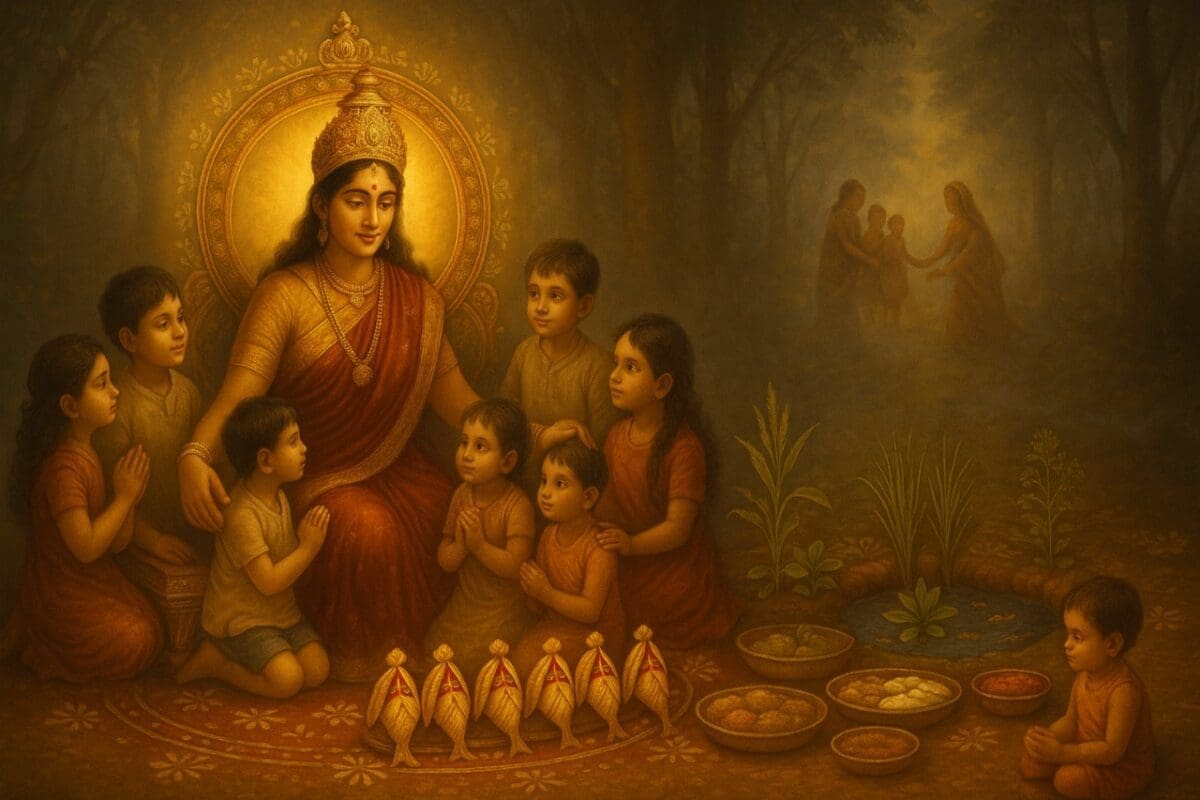
Today is Kanji Aonla Osha. This Osha (a ritualistic fast) is observed on the ninth day of the dark fortnight (Krushnapaksha Nabami) in the month of Margashira. The significance of this Osha is that it is performed by mothers for the well-being of their children, and by childless women with the desire to be blessed with a child. They offer their prayers and worship to Goddess Shathi Devi. Goddess Shathi Devi is a unique form of the divine who determines the destiny of children.
There is a beautiful story associated with this Osha. In a certain country, there lived a merchant (Sadhab). He had four sons and four daughters-in-law. All four sons were engaged in trade and commerce. His youngest daughter-in-law became pregnant for the first time. Hearing this, everyone in the family was overjoyed. In her fourth month of pregnancy, she had a strong craving to eat pumpkin. However, there was no pumpkin in the merchant’s household garden. Out of shame, the Sadhab’s daughter-in-law didn’t tell anyone and stole a pumpkin from the neighbor’s garden, which she then cooked into a sour curry (Ambila) and ate.
The next day, the neighbor, seeing the pumpkin missing from their garden, uttered a curse: “Whoever has stolen the pumpkin from my garden, may Shathi Devi steal their child as soon as it is born.” Goddess Shathi Devi came to know of this.
A few days later, the youngest daughter-in-law gave birth to a son. Overcome by the pain of labor, she fell into a deep sleep, and during this time, Goddess Shathi stole her child. When the daughter-in-law woke up and couldn’t find her child beside her, she began to cry. Everyone searched everywhere but couldn’t find the baby. In this manner, Shathi Devi stole five of the Sadhabani’s (merchant’s wife’s) sons.
Finally, the Sadhabani became pregnant once again. As her time of delivery neared, she experienced immense pain. Seeing this, her mother-in-law got angry and said, “You have already eaten five children. There is no place for you in this house anymore. Get out of this house right now.” She gave her a ball of thread and said, “Wherever this thread ends, you shall give birth to your child there.”
Having no other choice, the youngest daughter-in-law obeyed her mother-in-law and left, following the thread. Finally, the end of the thread came to a stop deep inside a dense, inaccessible forest. It was completely dark, and no one was around. The Sadhabani felt utterly alone and began to weep. Her labor pains started to increase, and right at that moment, she gave birth to another child. But it wasn’t a human child; it was a wooden doll.
Seeing this, the Sadhabani cried out in despair and started praying and calling upon Goddess Shathi Devi. Shathi Devi could no longer bear her cries. Finally, the goddess appeared before the Sadhabani with her five sons and asked, “Are you a witch or a demoness? From where have you come into this dense forest, and why are you crying?”
Hearing this, the Sadhabani recognized the goddess and narrated her entire past story, one detail at a time. The goddess then returned her five sons and said, “I had stolen your five sons. Take them now. Never again in your life steal anything that belongs to another, and observe a fast for ‘Kanji Aonla’ on the day after Ashtami in the month of Margashira. Your sons will be blessed with well-being.”
Hearing this, the Sadhabani said, “O Mother, I am ignorant. I do not know anything about the rituals of worship. Please kindly tell me the rules and procedures for this Osha.” The goddess then explained everything.
|| Rules and Rituals (Vidhi-Vidhana) ||
On the ninth day of the dark fortnight of the Margashira month, women take a bath in the morning and observe a fast for the entire day. In the evening, in their courtyard near the base of the Tulsi Chaura (a sacred basil altar), they dig a small, square-shaped pit resembling a pond and fill it with water. They bring small fish from a pond and release them into this pit. Around this pit, they plant stalks of Balunga paddy. A taro (Saru) plant is planted in the middle of the pit, and a small wooden seat (pidha) is placed at its base.
Seven pieces of dried bitter fish (Pita Sukhua) are brought, washed in turmeric water, wrapped in yellow cloth, and decorated like brides (bohu) with kohl (kajjala) and vermilion (sindoor). They are then placed on the wooden seat. Next to each decorated dried fish, a stalk of Malabar spinach (Poi) is placed. At home, rice (bhata), dal, kanji (a fermented rice-water dish), a curry made with taro, radish, and dried bitter fish, and two rice pancakes (Chakuli Pitha) are prepared. This worship is offered with devotion to Goddess “Shathi Dushain.”
After the offering (bhog), the food is given to the children for whose well-being the fast was observed. The remaining offerings are either immersed in a river or buried. The seven stalks of Poi and the dried fish “brides” are forbidden to be given to anyone. They are also immersed in a river. This ritual eloquently describes that one receives punishment for stealing others’ property out of greed.
|| The Story of Kanji Aonla Osha (in verse) ||
(This is a prose translation of the traditional poem recited during the ritual)
Listen, O good people, to the story of Kanji Aonla Osha. Worshipping removes all sorrow from the mind. It is about the youngest daughter-in-law of a Sadhab’s house. She was four months pregnant. Her heart desired a pumpkin curry, so she quickly brought a pumpkin from a neighbor’s garden. She took a watery pumpkin without asking and cooked and ate it.
The neighbor cursed, “Who ate my pumpkin? They took it without telling me. May their child be eaten in the same way, may their days not turn into months.”
After some days, her ten months were complete. A son was born. She laid her son down to sleep. Shathi Dushain came quickly and took the son away. When she looked, the son was not there. She became sad.
After two months, she became pregnant again and in ten months, another son was born. In the same way, she laid the son down to sleep as her eyes grew heavy with slumber. Shathi Dushain took that son as well. When she looked, he was gone. Again, after two months, she conceived and gave birth to a son in the tenth month.
Her mother-in-law said, “What is this? She has eaten all her children. She gives birth to fine sons and eats them.” She started to watch over her. In this way, five days were watched over. She ate five sons whom she had given birth to. Many days passed like this. Seeing the baby in the womb but not in the house, she became sad when she became pregnant again.
When the tenth month arrived, she told her mother-in-law about her stomach pain. The mother-in-law said, “You have eaten five. And you have become pregnant again.” She placed a ball of thread at the door and said, “Go where this thread ends. You will give birth there.” She went to a dense forest where not even a crow’s beak or an axe handle could move.
In that forest, she gave birth to a son, who was like a wooden doll. She laid him on a leaf and was crying all alone in the forest. “I have no friend in this forest,” she cried. Shathi Dushain appeared there, holding one son in her arms and leading the others. She said, “Are you a ghost or a witch, sitting and crying in this forest?”
“Which great person is asking me? I am the youngest daughter-in-law of the Sadhab’s house.”
The goddess replied, “It is because you stole and ate the pumpkin from the neighbor’s house. The curse was that your son should die, and so we were taking him. For that reason, we took your son. Now, take him. Take your five sons. Take all six sons and go home.”
Hearing this, she sat up. Shathi Dushain left in her palanquin. The daughter-in-law arrived with her six sons. The Sadhabani said, “How is this, my dear?” People said, “Your daughter-in-law is coming. She is bringing six grandsons.” Thinking this, she came, welcomed them, and took them into the house.
Shathi Dushain said, “Listen. After Kartik month comes Margashira. On the ninth day is Kanji Aonla. Your daughter-in-law will perform it, not you. There will be seven bitter dried fish. Bathe them and put vermilion on their heads. Dress them in yellow cloth and kohl. There will be curry with kanji and radish. The bitter dried fish and roasted poi will be made. Six pithas will be placed before them. Make a pond with care, release kia fish and plant balunga paddy. Place a taro plant there. Do not give the poi stalks to anyone. Feed the curry and rice to your son. Whatever he does not eat, bury it. Those who desire children will perform this. Whatever they wish for, they will receive it.”
The Sadhabani kept this in her mind. She seated Shathi Devi on a throne and offered her water, fragrances, flowers, and food. She fell at her feet and bid her farewell.
Kartik passed and Margashira arrived. On the ninth day, Kanji Aonla came. She made the pond with balunga paddy and taro. She prepared seven bitter dried fish, dressed them in yellow cloth, and applied vermilion and kohl. She worshipped Shathi Dushain there, offering her name in the puja. She offered ornaments and worshipped according to the rituals. She prepared pumpkin and kanji and made six pithas. She served the rice and performed the puja rituals, offering water, fragrances, flowers, and food. She told the story and made the offering, then fell at her feet and bid farewell.
Gradually, she acquired great wealth, sons, daughters, grandsons, and granddaughters. She built a home with her great-grandsons. Day by day, her wealth and family grew immeasurably. Good fortune dawned upon her. That is why Kanji Aonla is celebrated in the world. On that day, taking refuge in the goddess brings the fruits of this Osha.
The person who reads or listens to this, all their life’s goals will be fulfilled.
This Kanji Aonla Osha, celebrate a mother’s powerful devotion with a pure and complete ritual. The Sadhab’s daughter-in-law showed her faith to protect her children; now you can honor your own traditions.


 Key Chain
₹ 245.00
Key Chain
₹ 245.00 Shri Gita gobindam Book
₹ 1,998.00
Shri Gita gobindam Book
₹ 1,998.00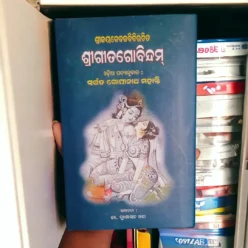 Shri Gita gobindam Book
  The divine Tulasi Kanthi Mali
  Shri Budha Stone Murti
  Ancient Tribal Art
  Natural Light Filters
  Niradrinath gift hamper
  Jagannath mahaprabhus Jhulana Palinki
  Chandan lagi seva(sandal wood)
  Shri Jagannath's Locket(Silver)
  Sambhu Jagannath Locket