

-
×
 Niladrinath Gift Hamper
₹ 8,899.00
Niladrinath Gift Hamper
₹ 8,899.00





Articles
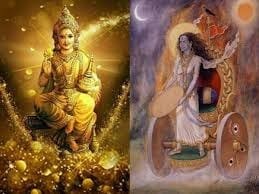
Goddess Lakshmi’s Sister, Alakshmi
17
Jul
Jul
================
In the Naimisharanya forest, amidst the great sages, Suta Muni was narrating the Sri Padma Purana. In the context of the Kartika Mahatmya (The Glory of the Month of Kartika), he explained how, due to a curse from Parvati, the three great gods (the Trideva) were born on earth as the Banyan, Peepal, and Palash trees, and he spoke of the sanctity of these three trees. When he mentioned certain faults associated with the Ashwattha (Peepal) tree, the sage Shaunaka asked:
“Why is it considered wrong to rest under the Ashwattha tree at night?
And why is one’s merit destroyed if one touches it on a Sunday?”
To explain this, Suta Muni told the beautiful story of Alakshmi.
In ancient times, the Devas (gods) and Asuras (demons) joined together to churn the ocean. Using Mount Mandara as the churning rod and the serpent Vasuki as the churning rope, they churned the ocean, from which emerged Lakshmi, the Kamadhenu cow, the Kaustubha gem, the eight Apsaras, the Airavata elephant, the Uchhaishravas horse, the eight great treasures (Ashtanidhi), and Amrita (the nectar of immortality). The gods divided all these treasures among themselves. Mahalakshmi herself chose Lord Vishnu as her consort and went to reside with him in Vaikuntha.
In that abode of Vaikuntha, which is filled with all prosperity and happiness, the daughter of the ocean, Goddess Lakshmi, one day folded her hands and pleaded with Vishnu, “O Lord! You are the beginning and the endless, the manifest and the unmanifest, the greatest of beings. I am your humble servant. I have a request at your divine feet. If you permit me, I shall speak.” When the Lord gave his permission, Goddess Lakshmi said, “During the churning of the ocean, along with me, my elder sister Alakshmi was also born. Seeing her unpleasant appearance, no one agreed to marry her. My father, Varuna, is greatly worried because, as you know, if a marriageable daughter is kept at home, all of one’s accumulated merits are destroyed. Moreover, he has made another mistake: without first marrying off the elder daughter, he offered me, the younger daughter, to you. I am also deeply saddened by my father’s sorrow. Therefore, I implore you to arrange for my sister Alakshmi’s marriage. You are the Lord of the universe. What task is impossible for you?”
Hearing these words from Lakshmi’s lips, the Lord, the repository of all cosmic thought, mounted Garuda and arrived at the ashram of the sage Uddalaka, an expert in the Vedas. (Uddalaka was the great Vedic rishi who had once donated his own son, Nachiketa, to Yama, the lord of death).
Knowing that Vishnu himself had set foot in his ashram, Maharshi Uddalaka’s joy knew no bounds. He venerated the Lord’s feet, seated him on an honorable seat, and worshipped Govinda with the sixteen traditional offerings. The Lord, an ocean of mercy, was extremely pleased and said, “O best of sages! I have come here with the hope that a task will be accomplished through you. It is this: if you have devotion for me, please marry my wife Kamala’s (Lakshmi’s) elder sister, Alakshmi. You are a supremely virtuous man, and you have my affection.” Hearing such dear words from the Lord’s divine mouth, the rishi Uddalaka said, “O Lord, life of the universe! Your command is my highest honor.”
Following Sri Vishnu’s command, all the resident sadhus of Uddalaka’s ashram went to the city of Varuna. Varuna’s daughter, Alakshmi, was brought to the wedding pavilion. The rishis gazed upon Alakshmi’s hideous and deformed appearance. They were shocked to see Alakshmi’s coarse tongue, tawny hair, long nose, long ears, long legs, tiny hands, and harsh speech. Nevertheless, following Vishnu’s order, the sage Uddalaka married Alakshmi.
Taking Alakshmi with him, the sage Uddalaka returned to his ashram. The female residents of the ashram welcomed the newlywed couple according to custom. None of these auspicious rituals pleased Alakshmi. Upon entering the sage’s ashram, Alakshmi heard the sound of Vedic chants. The scent of smoke from the sacred Homa fire became unbearable for her. Unable to control herself any longer, she went and sat on the street outside.
A mortified Uddalaka came to Alakshmi and said, “What is this you have done? Casting aside all shame, you have come to sit on the street. What problem is there in my home that you have come to sit outside and weep?” Alakshmi replied, “These Vedic chants, mantra recitations, Homa fires, and sacrifices are unbearable for me. I cannot stay here. My dwelling places are where there is constant quarreling, slander, gambling, deceit, violence, disputes, cruelty to animals, falsehood, blasphemy, and the like. I do not care for any perfumes, sandalwood paste, or flowers. I cannot stay where there is no smell of meat. And in your ashram:
‘The smell of ghee fills your home,
The smoke from the Homa fire is terrifying to me,
I cannot bear it,
And the words of the Vedas torment my body.’
O sage! This ashram of yours is not a suitable place for me to live.”
The sage Uddalaka fell into deep thought. He thought, “Keeping such a wicked woman in the house will only lead to disaster. She is truly a destroyer of Dharma.” As the scriptures say, “A wife who can slander and bind her husband should not be kept in the house.” The sage decided, “No, she cannot be kept in the home any longer. I will take her to some desolate place and leave her there.”
That day was a Saturday. The rishi Uddalaka, using deceptive words, took Alakshmi deep into a dense and frightening forest. Leading her to the base of an Ashwattha tree, he said, “Stay here for now. Later, I will certainly arrange for you to live wherever you wish. I am going now to bring all your favorite foods for you.”
Leaving Alakshmi there, the sage Uddalaka returned to his ashram and prayed to the Lord, “O Lord! Please rescue me from this crisis.”
Thinking her husband would surely return, Alakshmi sat there waiting. For three days, Alakshmi waited there, watching the path for her husband. Seeing that he was not returning, she began to wail horribly, like a madwoman. The fierce sound of her crying reached the ears of Goddess Lakshmi in Vaikuntha. The Goddess said to Narayana, “O Lord, my sister, having lost her husband, is crying pitifully in a dense forest. Please help her. Take her to some good place where she will not suffer.”
Hearing Lakshmi’s plea, Narayana mounted Garuda and, reaching Alakshmi, said, “Why are you sitting here? Your sister Lakshmi has sent me. Come with me to Vaikuntha. You will have no trouble there. Your younger sister Lakshmi is the queen of Vaikuntha. It is a place of great splendor. You can come there without any hesitation.”
Hearing Narayana’s words, Alakshmi said, “In the past, during the great deluge, all the impurities of the world settled as mud in the primordial waters. I was born from that very mud of impurity. Therefore, ‘Whatever is spoken of as righteous duty (Swadharma) causes me great pain.’ I cannot live in a good place. Moreover, Vaikuntha is my younger sister’s home; how can I go there? I have no need for her prosperity. You are the Lord of all realms. Why don’t you designate a place for me that suits my nature? I will live there on my own terms and rule my kingdom; I have no more need for a husband.”
Hearing this, Lord Vishnu assigned Alakshmi her dwelling places: in violence, greed, strife, alcohol, jealousy, gambling, impurity, and inauspiciousness. He said, “At night, you shall reside in this Peepal tree along with ghosts and ghouls.
But,” Narayana continued, “this Ashwattha tree is my own form. From today, every Saturday, people who worship this tree will receive the desired fruit of having worshipped me. Along with me, you too shall be worshipped. But for seven days, you will remain hungry. During the night, this tree will be your shelter. Any human who sits at the base of this tree at night, you will enter their body and take rest there, and they will be condemned to suffer for eternity.”
Having thus designated a dwelling place for Alakshmi, Lord Sri Vishnu departed.
Finishing the story, Suta Muni said, “Therefore, it is forbidden by custom to sit under the Ashwattha tree at night, and even during the day. Touching the Peepal tree on a Sunday is also forbidden by custom. This is the proof of the scriptures.”
Hearing Suta Muni’s explanation, all the assembled sages were satisfied and departed. At the end of the tale in the Kartika Mahatmya, Sri Mahadev Das wrote:
Thus spoke Suta, the greatly wise,
Hearing this, all the sages were satisfied.
Uncover Alakshmi’s ancient tale. Embrace divine wisdom for prosperity.