⚫❗⚫
Kharnang sthūlatanuṁ gajendravadanaṁ lambodaraṁ sundaram
prasyandan madhugandhalubdhamadhupavyālola gaṇḍasthalam |
dantāghāta vidāritāri rudhiraiḥ sindūraśobhākaram
vande śailasutāsutaṁ gaṇapatiṁ siddhipradaṁ kāmadam ||
(English Translation of the shloka: I bow to the son of the mountain’s daughter (Parvati), Lord Ganapati, the bestower of success and fulfiller of desires; who is short and stout, with the face of a majestic elephant, a large belly, and beautiful form. His cheeks are perfumed with the scent of honey (ichor), attracting buzzing bees. He is adorned with the beautiful color of sindoor (vermilion) from the blood of enemies torn apart by the blows of his tusk.)
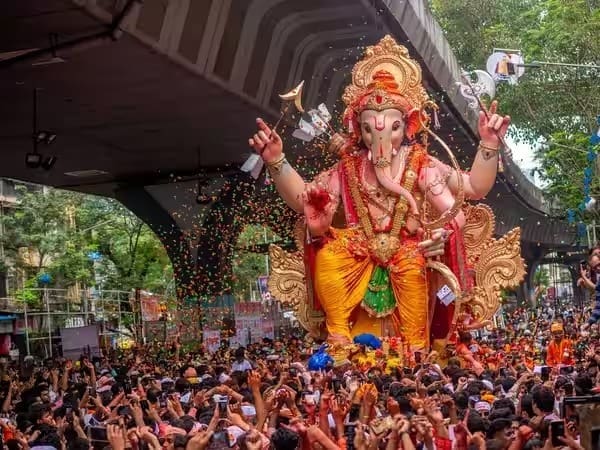
Today is the fourth day of the bright fortnight of the month of Bhadrava. It is the day of worship for the god of knowledge, the primordial deity, the first to be worshipped, Lord Shri Girijanandana (son of Parvati). The fourth day (Chaturthi) of the bright fortnight (Shukla Paksha) of the month of Bhadrava is celebrated as Ganesh Chaturthi.
To perform the Ganesh Puja, first, take a bath at dawn. Then, create an idol of Ganesha with wet clay and let it dry for some time. Decorate Ganesha with desi ghee, sindoor (vermilion), turmeric, and sandalwood paste. After this, adorn him with a sacred thread (paita) and install the idol in the northeast corner of the house. Light incense (dhoop) and a lamp (deepa) and offer flowers and fruits. Be sure to offer Ladoos as bhog (offering) to Ganesha. Light camphor and perform Ganesha’s Aarti. In this manner, worship Ganesha every day for 10 days, and on the day of Anant Chaturdashi, perform the immersion (visarjan) of Ganesha’s idol with all due rituals.
Mantras:
-
Ekadantāya vidmahe, Vakratuṇḍāya dhīmahi, tanno dantī prachodayāt ||
-
Mahākarṇāya vidmahe, Vakratuṇḍāya dhīmahi, tanno dantī prachodayāt ||
-
Gajananāya vidmahe, Vakratuṇḍāya dhīmahi, tanno dantī prachodayāt ||
(English Translation: We know the One-Tusked Lord, we meditate on the Lord with the Curved Trunk. May that Tusked One illuminate our minds and guide us.)
Ganesha is called “Agrapujya,” meaning the first to be worshipped. In any puja, Lord Ganapati is worshipped first before any other deity. He is also called “Vighnavinashaka,” the remover of obstacles, because Ganesha removes all impediments. Many stories about Ganesha’s birth and various divine plays (leelas) are found in scriptures like the Padma Purana, Linga Purana, Brahmavaivarta Purana, Skanda Purana, and Shiva Purana. Some of these stories differ from one another. The Ganesha Purana and Mudgala Purana provide detailed descriptions of Ganesha’s various avatars (incarnations). Just as Lord Vishnu took various avatars in different eras (yugas) to destroy evil and establish righteousness on Earth, the Ganesha Purana mentions that Ganesha also took avatars in different yugas to destroy evil and protect the world.
It is described that Ganesha’s first avatar was in the Satya (Krita) Yuga. He appeared as ‘Mahotkata Vinayaka’ from the womb of Devamata Aditi and annihilated मायावी (magical) demons like Dhumraksha, Jrmbha, Andhaka, Devantaka, and Narantaka. Mahotkata Vinayaka has ten arms. He holds a Parashu (axe) and a Kamandalu (water pot) in his hands, wears Kundala (earrings) in his ears, a Kasturi tilak on his forehead, a pearl necklace around his neck, a golden waistband, and a serpent adorns his navel.
Ganesha once again incarnated as Mayuresha in the Treta Yuga and as Gajanana in the Dvapara Yuga. In the Treta Yuga, as Mayuresha, he appeared as the son of Shiva and Parvati. Auspicious signs like a Chhatra (umbrella), Ankusha (goad), and a lotus with an upward-pointing line adorned him. In that avatar, he killed the demon Sindhu, who was empowered by a boon from the Sun God, and saved the Earth. He also destroyed the demon Kamalasura and his many Akshauhini (a battle formation) of soldiers. At the place where Kamalasura’s head fell after being struck by his trident, Ganesha established himself with the name Mayuresha, fulfilling the prayers of the gods and sages. In this avatar, his body was white in color. He had six arms, and his vehicle (vahana) was a peacock.
Similarly, in the Dvapara Yuga, Ganesha took the avatar of Gajanana and killed a demon named Sindura. When he appeared in this avatar, a moon adorned his head, and the Chintamani jewel graced his heart. With a large and prominent belly, small hands and feet, fan-like ears, and small eyes, Gajanana Ganesha’s form was very amusing. In this avatar, his vehicle was a mouse. Maharshi Parashara and his wife Vatsala raised him. In his Gajanana avatar during the Dvapara Yuga, he killed the evil demon Sindura and smeared the demon’s blood on his own body. After the death of Sindura, the three worlds—Svarga (heaven), Martya (earth), and Patala (the netherworld)—were saved from a terrible calamity. Since that day, he came to be known as Sindurapriya (lover of vermilion), Sinduraha (slayer of Sindura), and Sindura Vadana (vermilion-faced). Although he appeared as Parvati’s son, in this avatar, he was known as the son of Varenya and Pushpika. The valuable teachings he gave to his father Varenya are famous as the ‘Ganesha Gita’.
Just like Lord Vishnu’s Kalki avatar, a final avatar of Ganesha is envisioned in the Ganesha Purana. It describes that at the end of the Kali Yuga, Ganesha will appear as Dhumraketu. At that time, his body will be of a dark (shyam) color. Like the Kalki avatar, his vehicle will also be a horse. The two-armed Dhumraketu will destroy the evils of Kali with a sharp sword.
Apart from the four avatars described in the ‘Ganesha Purana’, the ‘Mudgala Purana’ also describes many avatars of Ganesha. Among them, eight are primary. These eight avatars are:
-
Vakratunda: His vehicle is a lion; he killed Matsaryasura (the demon of jealousy).
-
Ekadanta: His vehicle is a mouse, and he is the slayer of Madasura (the demon of arrogance).
-
Mahodara: His vehicle is a mouse, the destroyer of Mohasura (the demon of delusion), and the giver of knowledge.
-
Gajanana: His vehicle is a mouse, and he is the destroyer of Lobhasura (the demon of greed).
-
Lambodara: His vehicle is a mouse, and he is the destroyer of Krodhasura (the demon of anger).
-
Vikata: His vehicle is a peacock, and he is the slayer of Kamasura (the demon of lust).
-
Vighnaraja: His vehicle is the divine serpent Shesha, and he is the destroyer of Mamatasura (the demon of attachment).
-
Dhumravarna: His vehicle is a mouse, and he is the destroyer of Aham-asura (the demon of ego).
Thus, by destroying demons representing lust, anger, greed, delusion, arrogance, jealousy, attachment, and ego, Ganesha also destroys these evil tendencies from our minds. As a result, our character is elevated, and our minds become pure. Therefore, it should be the duty of everyone to worship Ganesha while trying to keep themselves away from these evil tendencies.
The descriptions and stories of Ganesha in the Puranas mentioned above have many differences among them. However, based on these descriptions, a universally accepted concept of Ganesha is formed. That is:
Ganesha is Ekadanta (one-tusked) and Chaturbhuja (four-armed). His four hands are adorned with a Pasha (noose), Ankusha (goad), and the Abhaya (fear-not) and Varada (boon-giving) mudras. His vehicle is a mouse. His body is red-colored. Red garments and flowers are dear to him.
Many other texts like the Shritattvanidhi, Mantra Mahodadhi, Mantra Ratnakara, Rupa Mandana, Shilpa Ratna, Mantramaharnava, Amshumadbhedagama, Uttara Kamikagama, and Suprabhedagama describe many more forms and qualities of Ganesha. In some places, he has 16 hands, in others 8, and yet in others 6. His body color also varies. Somewhere it is as brilliant as molten gold, elsewhere it is red like the morning sun, and in some places, it is white like the moon. The vehicle of Heramba Ganapati is a lion, Mayuresha Ganapati’s vehicle is a peacock, and in many places, the vehicle is a mouse. Furthermore, in the Kali Yuga, his vehicle will be a horse. In some forms, he is Panchamukha (five-faced, like Heramba Ganapati), and in others, he is Ekamukha (one-faced), Gajanana.
The description of Ganesha’s attire and ornaments is also beautifully mentioned in the Ganesha Purana. In the words of the creator Brahma, the Ganesha Purana describes his attire as:
Pearls and gems are studded in his crown. He anoints his entire body with red sandalwood paste. He wears a pearl necklace around his throat, the splendor of sindoor on his head, and a serpent-sacred thread across his chest. His arms are adorned with gem-studded armlets, and he wears a ring of emerald. A serpent-rope is tied around his waist. A moon rests on his forehead. His tusk is beautiful and white. His hand is in the boon-giving mudra. The Brahmavaivarta Purana mentions that he received these ornaments and adornments from deities like Surya, Chandra, Vayu, Lakshmi, Savitri, and Saraswati.
Why is Ganesha Lambodara (large-bellied), Ekadanta (one-tusked), and Modakapriya (fond of modaks)? Many stories regarding these are found in various Puranas. According to a description in the Brahma Purana, when Ganesha was young, he loved to breastfeed from his mother Parvati so much that he wouldn’t give his brother Kartikeya a chance. Seeing this, Shiva playfully called him ‘Lambodara’. Ganesha loves modaks. The Puranas describe him joyfully dancing after eating knowledge-enhancing modaks.
Similarly, there are stories about why Ganesha is one-tusked. One of these stories is that in the Krita (Satya) Yuga, when Ganesha took the Mahotkata Vinayaka avatar, he fought with the demon Devantaka. In that war, Devantaka was killed, but Ganesha was left with only one tusk.
Another story reveals that after the death of the Pandavas and Kauravas, Maharshi Vedavyasa was again in deep meditation. However, the sacred saga of the Mahabharata was playing in his mind. He was pondering how the fifth Veda—the Mahabharata—would be propagated. At that time, grandsire Brahma arrived at his ashram. Vedavyasa welcomed him with due respect. He prayed to Brahma to tell him how the epic Mahabharata, which contained the essence of all scriptures and the deep secrets of the Vedas and Vedangas, could be propagated on Earth. Hearing his prayer, Brahma said, “Ganesha is the repository of all intellect. Only he will be capable of listening and writing it down.” Therefore, he advised Vyasa to pray to Ganesha for the task of composing the Mahabharata. Following Brahma’s advice, Maharshi Vedavyasa requested Ganesha. Ganesha agreed to write but placed a condition. The condition was that Vyasa must dictate in such a way that Ganesha’s pen would not stop even for a moment. If it stopped, the writing would end there. Vyasa agreed but placed a counter-condition: Ganesha would only write what he had fully understood. He would not write anything without understanding it. This is how the Mahabharata was written. This story is mentioned in the Adiparva of the Mahabharata. It is said that Ganesha used one of his own tusks as a pen for this writing.
Ganesha is also called Ekadanta. There are a few more stories about why he has one tusk. One of them, from the Padma Purana, is that Parashurama once went to Kailash to meet Shiva. When he arrived, Shiva was resting. Ganesha was in charge of guarding the door. Therefore, he did not allow Parashurama to enter Shiva’s resting chamber. This angered Parashurama. A battle ensued between him and Ganesha. Ganesha wrapped Parashurama in his trunk, lifted him, and threw him down. Enraged by this, Parashurama threw the axe he had received from Shiva through penance at Ganesha. The axe struck Ganesha’s tusk and broke it.
There is another amusing story about this. Once, the moon god Chandra mocked Ganesha’s large belly, which angered Ganesha. He broke one of his tusks and threw it at the moon. Since that day, a mark has remained on the moon’s beautiful body, and Ganesha became one-tusked.
Like the stories of Ekadanta, there are many interesting tales in various Puranas about Ganesha’s birth and his acquiring of an elephant head (Gajanana). The most popular among these stories is: Once, Parvati created a conscious being from the turmeric paste from her own body. This conscious being was Shri Ganesha. One day, Parvati instructed Ganesha to guard the door while she bathed inside. At that moment, Shiva arrived and tried to go inside. But Ganesha, guarding the door, said that he would not let anyone in without his mother’s permission. For stopping Shiva at the door, Shiva became enraged. He severed Ganesha’s head with his trident (trishul) and bow (pinaka). Learning of this, Parvati became extremely furious. The gods, sages, and brahmins all feared that Parvati’s wrath would destroy the three worlds. They prayed to Parvati to calm her anger and also pleaded with Shiva to find a way to bring Ganesha back to life. Shiva said, “If you go north, the first living being you find whose mother is sleeping with her back turned towards it after giving birth—bring that creature’s head, and Ganesha can be revived.” Hearing this, the gods and Rudraganas went north and saw a mother elephant and her calf sleeping in that exact position. They cut off the baby elephant’s head and brought it back. Shiva attached the elephant calf’s head to Ganesha’s body and gave him life. Now, Ganesha became Gajanana. As per Parvati’s wish, this Ganesha became the first to be worshipped among all gods and goddesses. Later, he also became famous as the lord of the Ganas (attendants), thus earning the name Ganapati.
Another story regarding Ganesha’s elephant head is that his original head was destroyed due to the gaze of Shani (Saturn). Later, the head of a baby elephant was attached, bringing him back to life.
The story of Ganesha’s marriage is also quite fascinating. When Ganesha and Kartikeya, the two brothers, reached a marriageable age, Shiva and Parvati decided to get them married. But they couldn’t decide whose marriage should happen first. So, they set a condition for their two sons. The condition was: whoever among them could circumnavigate the entire Earth first would get married first. Hearing this, Kartikeya mounted his vehicle, the peacock, and set off to circle the Earth. Ganesha’s vehicle was a mouse. Even if he set out on it, he could not return before Kartikeya. So, he sat and thought of a solution. After some time, he mounted his mouse and went around Shiva and Parvati once. When asked, he explained, “The entire universe is contained within Shiva and Parvati. Therefore, circling them is greater than circling the Earth.” As a result, Ganesha won the competition. His marriage took place first. His two wives are named Siddhi (Success/Accomplishment) and Buddhi (Intellect). Hence, it is believed that worshipping Ganesha grants both success and wisdom.
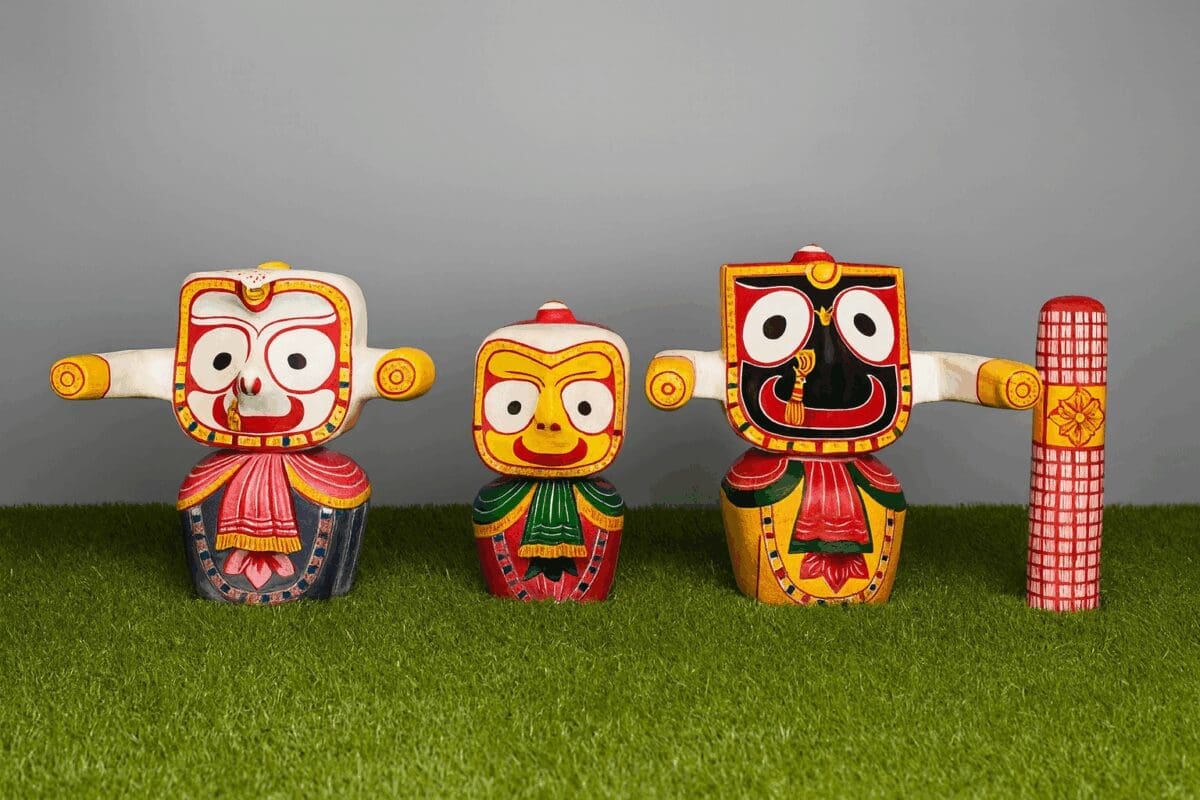
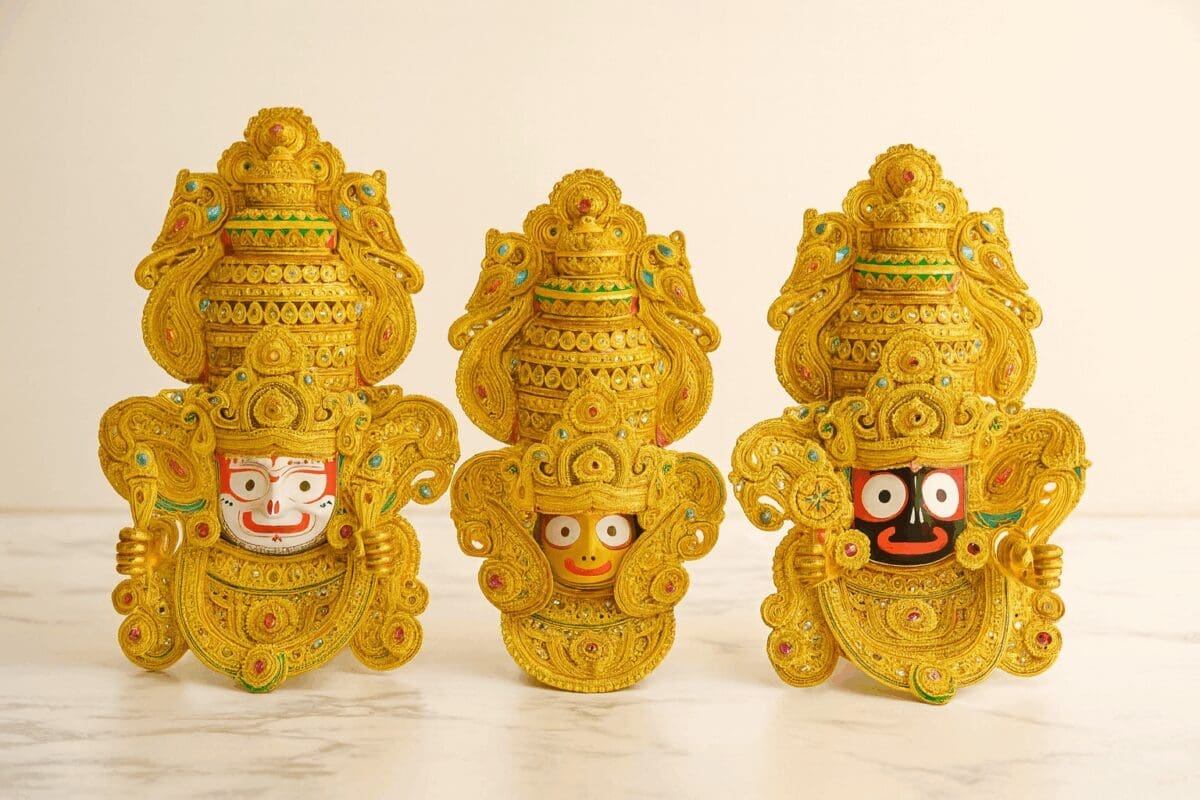
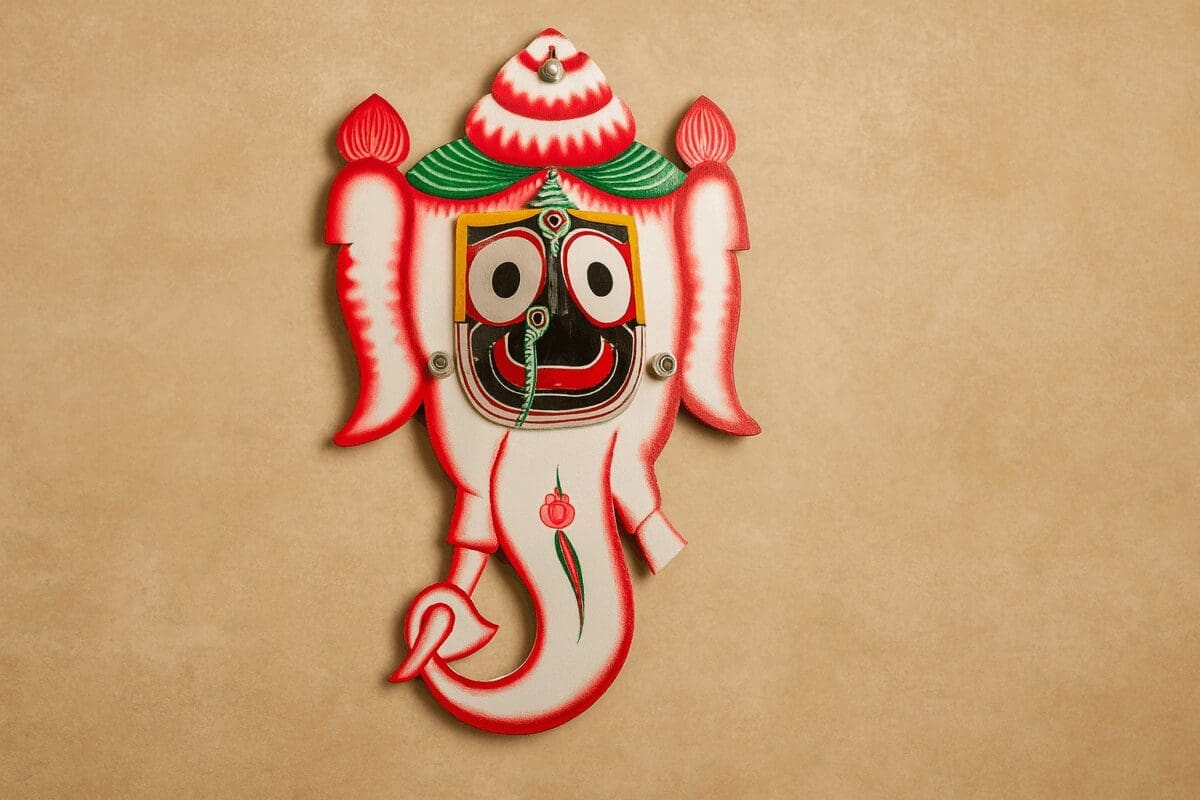
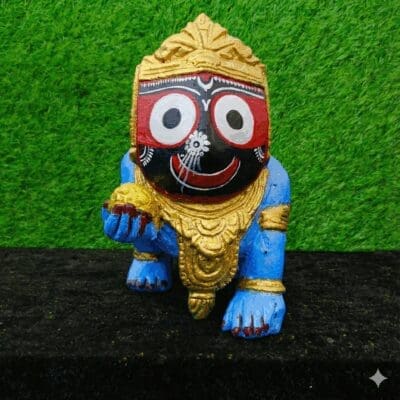
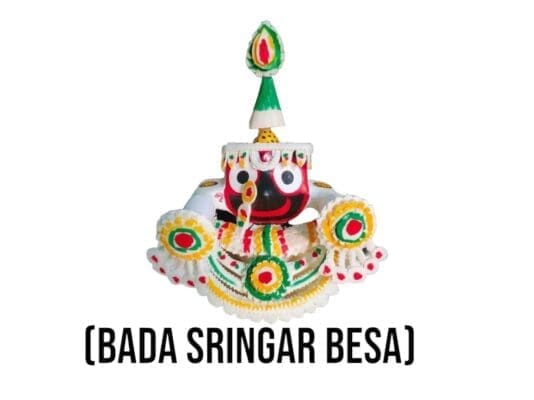
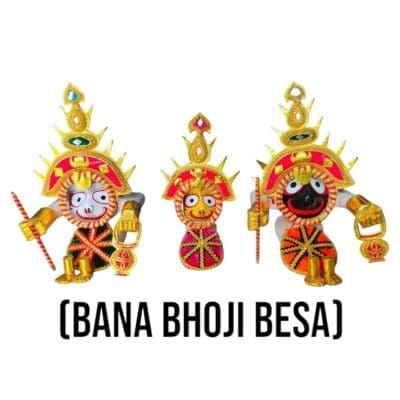
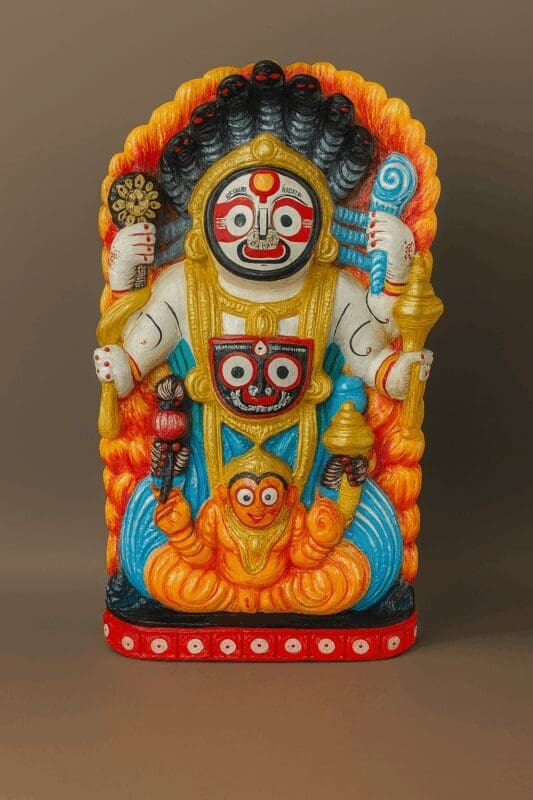
Our state deity, Lord Jagannath, also adorns the Gajanana or Hati Besha (Elephant Attire) once a year. It is mentioned in the ‘Dardhyata Bhakti Rasamrita’ written by Rama Dasa that Lord Jagannath takes on this form for his devotee, Ganapati Bhatta. Every year on the day of Snana Yatra, which falls on Jyeshtha Purnima, Lord Jagannath appears in this attire on the Snana Mandapa (bathing altar). In this form, devotees accept Jagannath as a form of Ganesha. 🙏❤️
Invite prosperity home with our sacred Ganesha puja collection.


 Shri Jagannath's Locket(Silver)
₹ 3,064.00
Shri Jagannath's Locket(Silver)
₹ 3,064.00 Dakhinabarti sankha (Small Size)
₹ 7,494.00
Dakhinabarti sankha (Small Size)
₹ 7,494.00 Dakhinabarti sankha (Small Size)
  Beutiful shri jagannath Mahaprabhu Car/wall hanging
 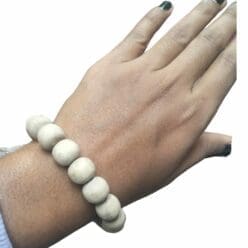 Beautiful Tulasi Wood Bracelet
 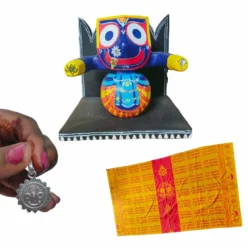 Niladrinath Gift Hamper
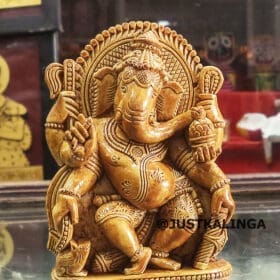
  Shri Ganesh Nrutyam Mutri
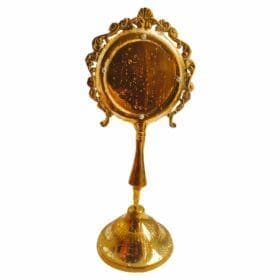
  Snan Darpan: for Shri Jagannath mahaprabhu's bathing rituals
 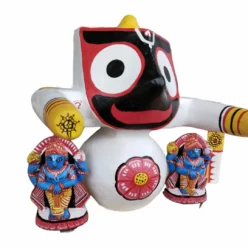 Nila Saila Combo
  The divine Tulasi Kanthi Mali