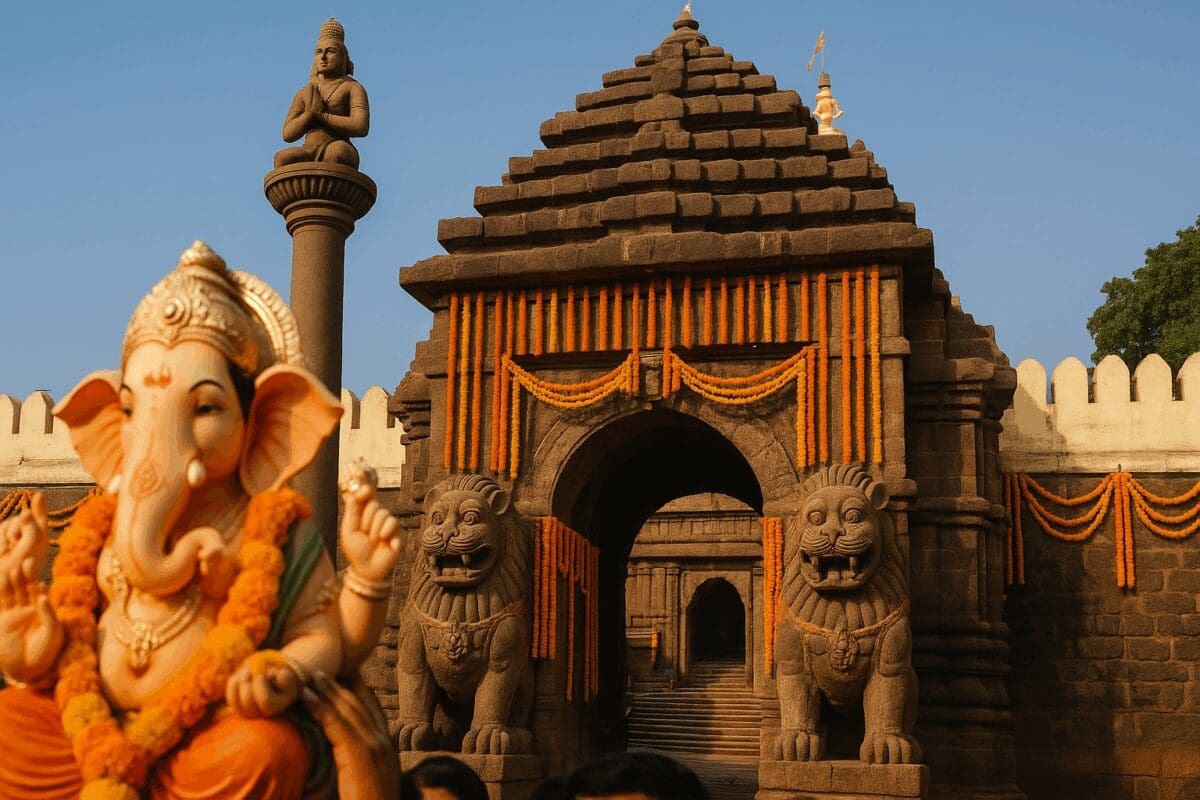
A joyous and blessed Ganesh Chaturthi to all! On this sacred day, as we welcome Lord Ganesha—the beloved remover of obstacles, the patron of arts and sciences, and the eternal guardian of all beginnings—into our homes and hearts, our minds turn to the concept of the threshold. Every new venture, every journey, and every prayer begins by crossing a threshold, a passage from the mundane to the sacred. And who better to guide us across these passages than Ganapati himself, the Dwarapalaka (Divine Doorkeeper) of the spiritual world.
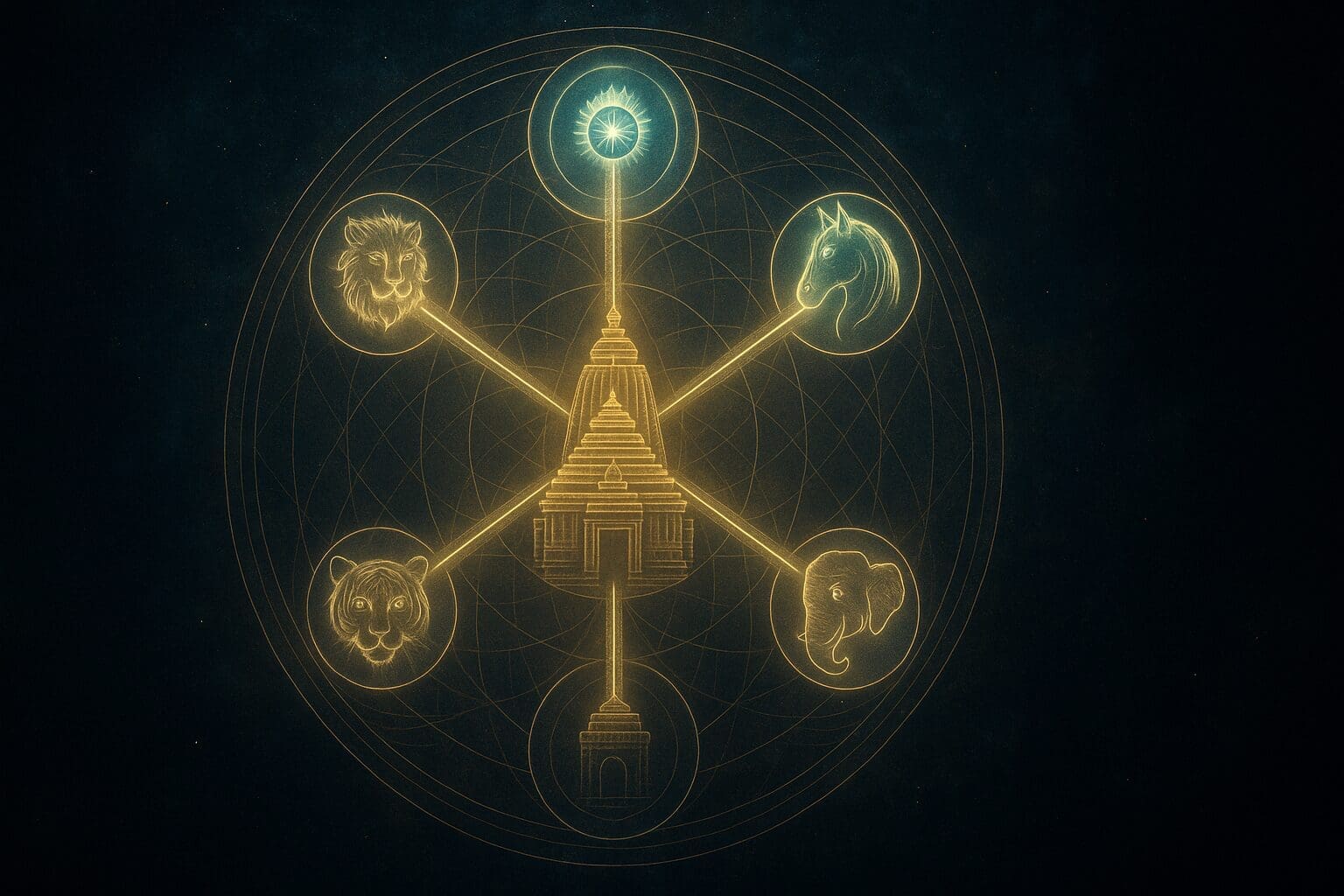
It is in this spirit of auspicious entry that we embark on a special pilgrimage today. We journey to the heart of Jagannath Dharma, the Srimandir in Puri, not just to behold the Lord, but to understand the profound spiritual science embedded in its very architecture. We will explore the Charidwara, the four magnificent gates of the Jagannath Temple. These are not mere entry points of brick and stone; they are cosmic portals, each aligned to a cardinal direction, guarded by a symbolic animal, and representing a fundamental pillar of human existence. Join us, on this day of Lord Ganesha, as we walk through these divine gates and uncover the spiritual map that leads to the Lord of the Universe.
The Sacred Geometry of Entry: Why Four Gates?
The architecture of a Hindu temple is never arbitrary. It is a manifestation of cosmic order, a microcosm of the universe itself. The Srimandir is a perfect example of the Vastu Purusha Mandala, a metaphysical plan where the structure is a living, breathing body of the divine. The presence of four primary gates is central to this design, reflecting a foundational principle of Sanatana Dharma: the number four.
We see this sacred number everywhere: the four Vedas (Rig, Yajur, Sama, Atharva), the four Yugas (Satya, Treta, Dvapara, Kali), the four arms of Lord Vishnu holding his divine instruments, and most importantly, the four Purusharthas—the four great aims of human life: Dharma (Righteousness), Artha (Prosperity), Kama (Desire), and Moksha (Liberation).
The Charidwara of the Srimandir are the physical representation of these four aims. Each gate is a school of philosophy, guiding a devotee through a different aspect of life before they can reach the central sanctum where the Lord resides, transcending all four. To understand the gates is to understand the journey of the soul.
1. East: The Singhadwara (Lion Gate) 🦁 – The Gate of Dharma & Salvation

Facing east, the direction of the rising sun and new beginnings, is the main and most frequented gate of the temple: the Singhadwara or Lion Gate. This is the grand entrance through which the deities make their ceremonial exit during Rath Yatra. Its very name invokes images of power, majesty, and courage.
Symbolism and Guardians: The gate is flanked by two colossal crouching lions, sculpted from a single piece of stone. They are not depicted in passive repose, but in a dynamic posture of alert protection, ready to vanquish any evil or ego that dares to approach the Lord’s abode. The lion (Simha) is the vahana (vehicle) of Goddess Durga, representing the victory of righteousness over unrighteousness. Thus, the Singhadwara is fundamentally the gate of Dharma. It tells the pilgrim that the path to God begins with a foundation of unwavering righteousness and courage. The celestial gatekeepers of Vaikuntha, Jaya and Vijaya, are the principal guardians here.
Key Features: Before one even reaches the lions, the first object of veneration is the magnificent Aruna Stambha, a sixteen-sided monolithic pillar dedicated to Aruna, the charioteer of the Sun God, Surya. Moved from the Konark Sun Temple centuries ago, its placement here is deeply significant. A devotee first pays respects to the eternal witness of all karma (Surya) before proceeding to the Lord.
Just inside this gate resides one of the most merciful forms of the Lord: Patitapabana, the “Savior of the Fallen.” This is a special icon of Lord Jagannath visible from the road, intended for those who, for various reasons, cannot enter the temple complex. It is a profound statement of the Lord’s boundless compassion, ensuring that salvation is available to all. Fittingly, a beautiful shrine to Lord Ganesha also graces this entrance, blessing every devotee’s entry.
2. South: The Ashwadwara (Horse Gate) 🐎 – The Gate of Kama & Conquest
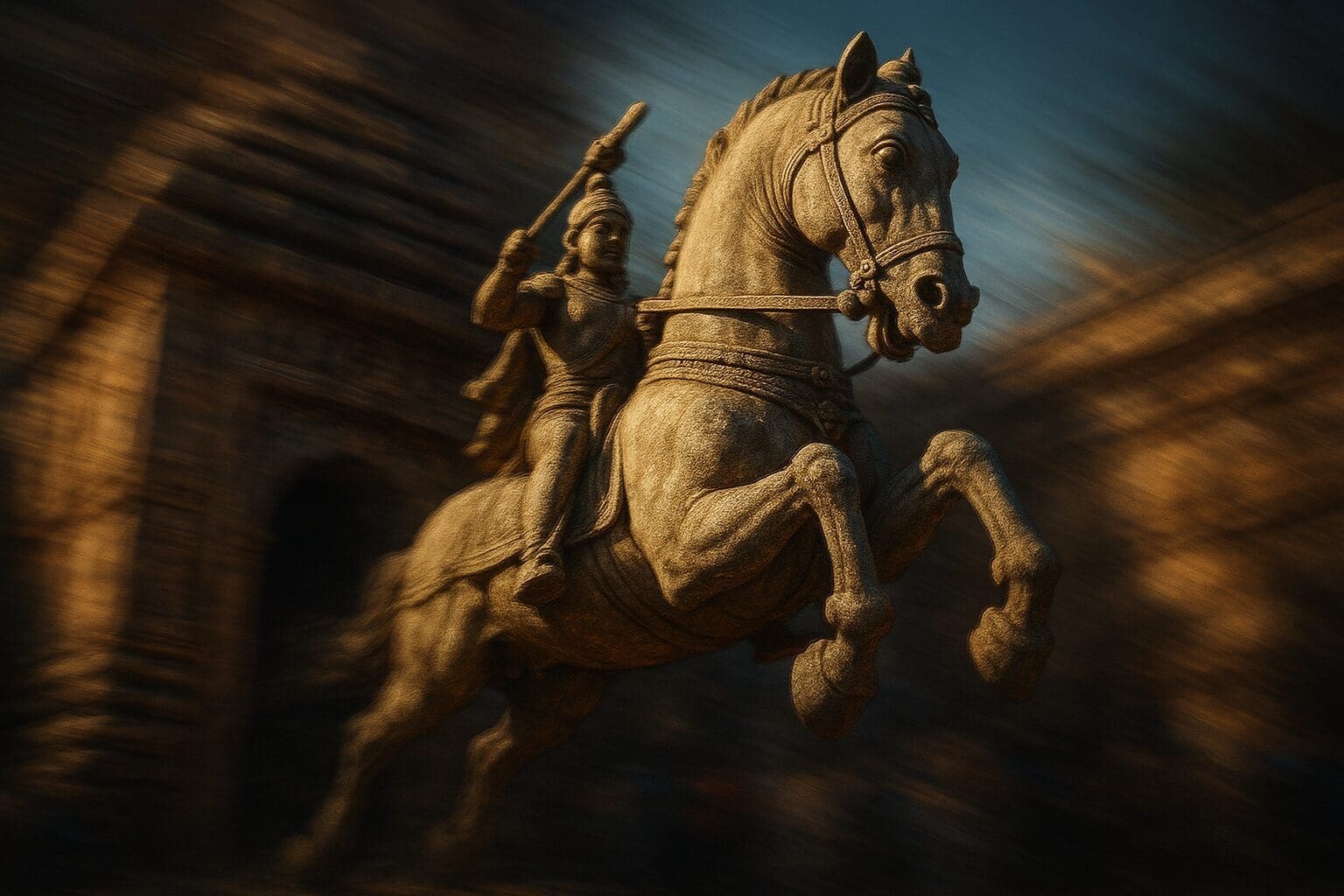
Turning south, we arrive at the Ashwadwara or Horse Gate. This gate is guarded by two triumphant, life-sized statues of horses, bridled and ready for action, trampling down a demonic figure. This entrance has historically been associated with royalty, warriors, and ceremonial processions of the Gajapati kings of Odisha.
Symbolism and Guardians: The horse (Ashwa) is a powerful symbol in Vedic thought. It represents speed, energy, power, and, most critically, the senses (indriyas). The Kathopanishad famously compares the human body to a chariot, the intellect to the charioteer, and the five senses to five wild horses. The imagery at the Ashwadwara—a warrior reining in a powerful horse—is a lesson in self-control. This gate, therefore, represents Kama, which in its highest sense means desire, ambition, and the pursuit of worldly objectives.
The Ashwadwara teaches that while power and ambition are necessary for worldly life (like that of a king), they must be controlled and conquered. The unbridled horses of sensory desire will lead one’s chariot to ruin. Only by mastering these energies can one achieve true victory—the victory over the self—which is a prerequisite for seeing the Lord. Entering through this gate is a reminder to harness one’s desires and channel them towards a higher purpose.
3. West: The Vyaghradwara (Tiger Gate) 🐅 – The Gate of Artha & Renunciation
The western gate, the Vyaghradwara or Tiger Gate, is perhaps the most esoteric of the four. Guarded by two imposing figures of tigers, it opens towards the hinterland and has traditionally been the entrance for sages, ascetics, and those engaged in deep spiritual practices.
Symbolism and Guardians: The tiger (Vyaghra) symbolizes the raw, untamed power of nature and the primal life force, or Shakti. Lord Shiva, the greatest of all ascetics, wears a tiger skin, signifying his mastery over this primal energy. The tiger represents power, but of a different kind than the horse—it is the inner energy that can be channeled through discipline and renunciation.
This gate represents Artha—wealth, substance, and material prosperity. This may seem contradictory for a gate used by renunciates, but the philosophy is profound. Artha is a necessary component of life, providing the means to sustain oneself and society. However, the pursuit of Artha, like a tiger, is fraught with danger. If one is not disciplined, this pursuit can become all-consuming and destructive. The sages who enter through this gate are those who have understood the nature of Artha, mastered its acquisition, and are no longer attached to its fruits. They have tamed the inner tiger of material desire and now seek the ultimate wealth of divine knowledge.
4. North: The Hastidwara (Elephant Gate) 🐘 – The Gate of Moksha & Wisdom
Finally, we arrive at the northern gate, the Hastidwara or Elephant Gate. Guarded by two majestic elephants, this gate is aligned with the direction of Kubera, the celestial treasurer, and is associated with wealth and prosperity. It is also fittingly close to the temple’s Maha Prasad kitchen (Rosaghara), the source of divine abundance.
Symbolism and Guardians: The elephant (Hasti) is a symbol of immense wisdom, stability, memory, and good fortune. It is inextricably linked with Goddess Lakshmi, who is often depicted in her Gaja Lakshmi form, being anointed by elephants. Crucially, the elephant form is sacred to Lord Ganesha himself. Thus, this gate carries the direct blessings of both the Goddess of spiritual wealth and the Lord of auspicious beginnings.
The Hastidwara represents the ultimate goal, Moksha or liberation. Having passed through the gates of Dharma (righteousness), Kama (controlled desire), and Artha (mastered prosperity), the devotee arrives at the gate of true wisdom. The elephant’s calm, majestic, and unshakable demeanor symbolizes the state of a liberated soul—stable, wise, and prosperous in spirit. It is the culmination of the pilgrim’s journey, where worldly pursuits are fulfilled and transcended, leading to the ultimate freedom in the Lord’s presence.
Conclusion: Four Paths to One Lord
The Charidwara of the Srimandir are a divine roadmap for the human experience. They teach us that the path to the Lord is not a single, narrow lane but a grand convergence of life’s essential pursuits. We must live a life of Dharma (Lion), control our Kama (Horse), master our Artha (Tiger), and finally, with wisdom, attain Moksha (Elephant).
On this auspicious day of Ganesh Chaturthi, as we celebrate the guardian of all gates, let us reflect on these four divine thresholds. Each time we begin a new task, cross into a new phase of life, or step into a temple, we are passing through a gate. May Lord Ganesha bless our every entry, removing all obstacles from our path. And may our life’s journey through the four great gates of experience lead us ultimately to the sanctum of our own hearts, where the Lord of the Universe, Jagannath, forever resides.
Jai Ganesha! Jai Jagannath! 🙏


 Sambhu Jagannath Locket
₹ 1,698.00
Sambhu Jagannath Locket
₹ 1,698.00 Dakhinabarti sankha (Small Size)
  Niradrinath gift hamper
  Niladrinath Gift Hamper
  Key Chain
  Chandan lagi seva(sandal wood)
  The origin story of Shri Jagannath
  The divine Tulasi Kanthi Mali