Articles
|| The Ritual of Observing Panchaka ||
Nov
The last five days of the Kartika month (from Kartika Shukla Ekadashi to Purnima) are observed as the holy Panchaka. It is also known as Maha Panchaka, Baka Panchaka, Bhishma Panchaka, or Vishnu Panchaka. Those who are unable to observe ‘Habishya’ (a restricted, pure vegetarian diet) for the entire month of Kartika, follow it during these five days. Many observe ‘Habishya’ for seven days starting from Anla Nabami, the day of Radha’s feet darshan. During these five days, Hindus abstain from non-vegetarian food and consume pure, sattvic meals. It is said that even cranes (Baka) refrain from eating non-vegetarian food during this period, which is why it is called ‘Baka Panchaka’.
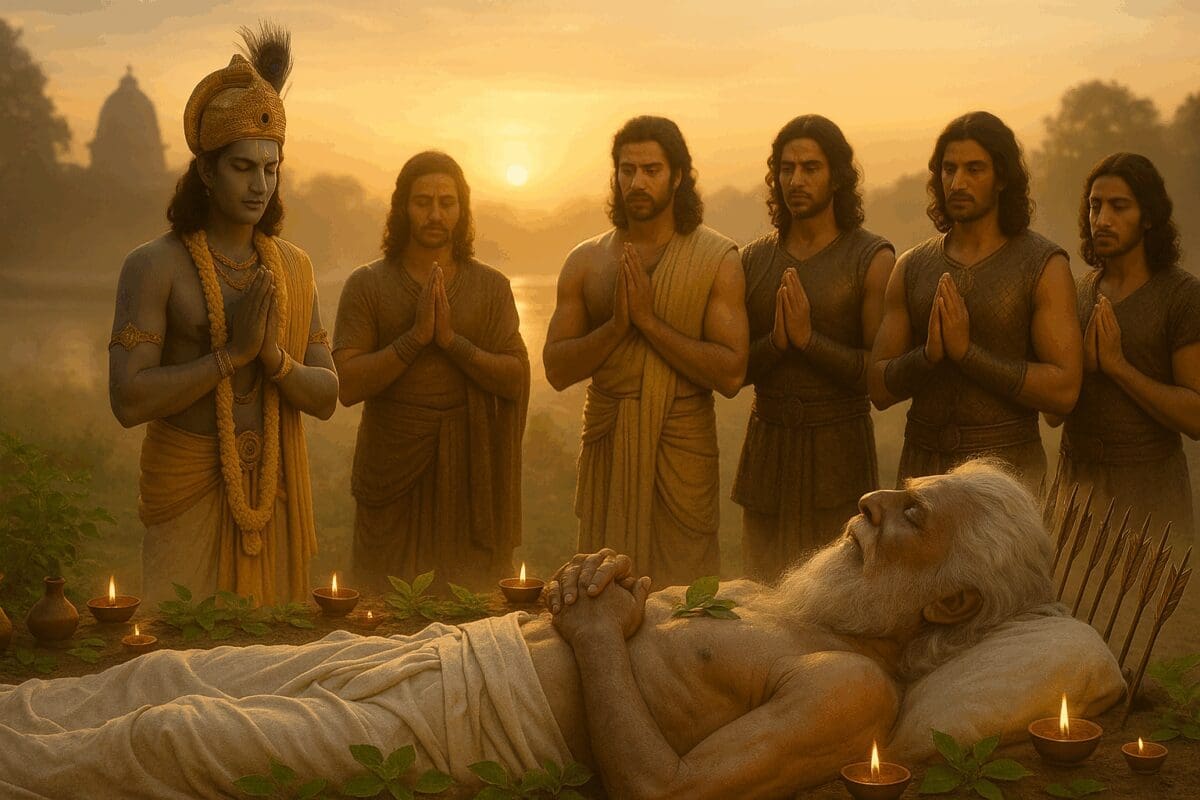
Lying on a bed of arrows, the great patriarch Bhishma described Rajadharma (the duty of a king), Mokshadharma (the path to liberation), and Danadharma (the virtue of charity), which was heard by the Pandavas along with Lord Krishna. Pleased by this, Shree Vasudeva said, “You are blessed. You have described the profound secrets of dharma. On the day of Kartika Ekadashi, you wished for water. Arjuna created a stream of Ganga water with his arrow, which satisfied your body, mind, and soul. Therefore, for the five days from today until Purnima, those who offer you water oblations (arghya) will be satisfying me.” This is Bhishma Panchaka, to be observed every year. Generally, many people observe the Bhishma Panchaka vrata (vow) with the desire of having children.
The last five days of the Kartika month, from Kartika Shukla Ekadashi to Purnima, are extremely sacred. During this Panchaka, the thirty-three crore deities come closer to humankind. During this time, if one worships Lord Vishnu by offering one lakh Tulsi (holy basil) leaves, all the deities are pleased and grant boons. “Sarvadeva namaskarah Keshavam pratigachhati” (A salutation to any deity reaches Keshava [Vishnu]). Lord Vishnu grants the desired boons. Each Tulsi leaf becomes a pearl. Chanting the name of Govinda for five days bestows inexhaustible merit (akshaya punya). “Govinda Govinda Hare Murare, Govinda Govinda Mukunda Krishna / Govinda Govinda Rathanga Paane, Govinda Damodara Madhaveti.” Reading the Bhagavata and the Gita is also advised. During this time, a person can attain liberation even by reciting a single verse of the Gita every day.
Kartika masi viprendra yastugitam pathennarah
Tasya punyafalam vaktum mamashaktir na vidyate
Gitayastu samam shastram na bhutam na bhavishyati
Sarva papahara nityam gitaika mokshadayini
Shrimad Bhagavatasya’pi shravanam yah samacharet
Sarvapapa vinirmuktah param nirvanam mruchchhati I
~ Skanda Purana
(The Skanda Purana states: The merit of a person who reads the Gita in the month of Kartika is beyond my power to describe. There has never been, nor will there ever be, a scripture equal to the Gita. The Gita alone is the eternal remover of all sins and the bestower of salvation. One who listens to the Shrimad Bhagavata is freed from all sins and attains the ultimate liberation.)
The Puranic secret behind these five days being called Bhishma Panchaka is that while lying on the bed of arrows, the patriarch Bhishma described Rajadharma, Mokshadharma, and Danadharma, which was heard by the Pandavas along with Lord Krishna. Pleased by this, Shree Vasudeva said, “You are blessed. You have described the profound secrets of dharma. On Kartika Ekadashi, you asked for water. Arjuna, with the speed of his arrow, brought forth the Ganga water, which satisfied your body, mind, and soul. Therefore, for the five days from today until Purnima, those who offer you water oblations will be satisfying me.” This is Bhishma Panchaka—to be observed every year. The observer of the vow should perform ‘tarpana’ (libation) for the great soul Bhishma. People of all castes can perform this Bhishma Tarpana.
The mantra is:
Satyavrataya shuchiye gangeyaya mahatmane
Bhishmayaitad dadamyarghya majanma brahmacharine I
(I offer this oblation to Bhishma, the son of Ganga, the great soul, who was devoted to truth, pure, and a lifelong celibate.)
Many observe this Bhishma Panchaka vrata with the hope of begetting children. That the observance of Bhishma Panchaka is for childless individuals is made clear from the mantra for offering arghya.
The mantra for offering arghya is:
Vaiyaghrapada gotraya sankruta pravaraya cha
Aputraya dadamyeta dudakam bhishma varmane
Vatsanamavataraya shantano ratmajaya cha
Arghyam dadami bhishmaya ajanma brahmacharine I
(I offer this water to the childless Bhishma Varman, who belongs to the Vaiyaghrapada gotra and Sankruta pravara. I offer this arghya to Bhishma, who was an incarnation of the Vasus, the son of Shantanu, and a lifelong celibate.)
One should devotedly worship Shri Hari with Panchagavya, fragrant sandalwood paste, and kumkum. One should chant the eight-syllable mantra “Om Namo Vasudevaya” or the six-syllable mantra “Om Ramaya Namah” one hundred and eight times. Celibacy should be observed during the period of the vow. During Kartika or Pausha month, one should conclude the vrata by feeding at least five Brahmins.
Each of the five days of Panchaka is significant. The first day of Panchaka is Bada Ekadashi. On the Ekadashi of the bright fortnight of Ashadha, Lord Vishnu killed the demon Shankhasura. Thereafter, the Lord rests in the Ksheera Sagara (Ocean of Milk) for four months. After these four months (Chaturmasya), He awakens on Kartika Shukla Ekadashi. For this reason, Vaishnavas awaken the Lord by chanting the following mantra:
Uttishthottishtha govinda uttishtha garudadhwaja I
Uttishtha kamalakanta trailokya mangalam kuru II
(Awake, Awake, O Govinda! Awake, O one with the Garuda banner! Awake, O beloved of Kamala [Lakshmi]! and bring well-being to the three worlds.)
The great patriarch Brahma tells the divine sage Narada, “This Ekadashi is called ‘Prabodhini Ekadashi’. Fasting on this Ekadashi yields the fruit of a thousand Ashwamedha sacrifices and a hundred Rajasuya sacrifices.” The second day of Panchaka is Dwadashi. On this day, good and wise people feed their elderly parents according to rituals and then consume the prasad of Lord Vishnu with their spouses. Those who follow this ritual for the Dwadashi vrata enjoy great happiness and ultimately attain salvation.
The last three days of Panchaka—Trayodashi, Chaturdashi, and Purnima—are extremely meritorious tithis (lunar days). These five days before Purnima are Panchaka, Maha Panchaka, Baka Panchaka, and Bhishma Panchaka. During these five days, every Hindu avoids non-vegetarian food and consumes pure, sattvic meals. According to folklore, even the carnivorous crane (baka) does not touch non-vegetarian food during this period. Hence, it is called ‘Baka Panchaka’. There is a religiously accepted reason for not eating non-vegetarian food this month. During this season, fish are often afflicted with diseases. Therefore, our religious beliefs are not superstitions but are based on science and spirituality.
Taking a bath in the early morning is beneficial for the body. People, especially widows, observe the ‘Rai-Damodara’ vrata by bathing early in the morning throughout the month. If nothing else, they observe the vrata for these five days of Maha Panchaka. There is no other vrata as meritorious as this one. Hence it is said, “One who observes this Maha Panchaka vrata is blessed and worthy of worship.” All the sins residing in their body are destroyed instantly. Those who selflessly worship Radha and Shri Krishna (Rai-Damodara) by placing their idols at the base of a Tulsi plant during this holy month attain liberation in this life. Those who, with two ‘ghadis’ of the night remaining, apply soil from the base of a Tulsi plant, take clothes and a kalash (pot) to a water body, and stand in navel-deep water, remembering sacred rivers like the Ganga and deities like Vishnu and Shiva, recite this mantra:
Kartike’ham karishyami pratah snanam janardana
Prityartham tava devesha damodara maya saha I
(O Janardana! O Lord of Gods, Damodara! For your pleasure, along with Maya [Lakshmi], I am taking this Kartika morning bath.)
While offering arghya, they say:
Grihanarghyam mayadattam radhaya sahita hare
Namah kamalanabhaya namaste jalashayine
Namaste’stu hrishikesha grihanarghyam namo’stute I
(O Lord Hari! Please accept this arghya offered by me, along with Shri Radha. Salutations to you, O lotus-naveled one! Salutations to you, O one who rests on water! Salutations to you, O Hrishikesha, please accept this arghya. I bow to you.)
To guide the souls of the departed and ancestors and to illuminate their dark and difficult path, ‘Akashadipa’ (sky lamps) are installed in every village. Every day of this holy month is a day of festival.
Once in the Dandakaranya forest, the sages and saints were captivated by the sight of Lord Rama’s form. Lord Rama granted them a boon: “In the Dwapara Yuga, all of you will be born as Gopis and attain me in my form as Krishna.”
Ballavi tumhe hoiba dwapare
Braje rahibu aambhe kansa dare
Brundabanare heba rasakeli
Ballavi eka e dehe maithili
Bahibu gopinathara namaku
Bele upendra bodhile tanku I
(A verse by poet Upendra Bhanja describing Rama’s promise: “You shall become Gopis in the Dwapara age. We shall live in Braja for fear of Kamsa. The Rasa Leela will take place in Vrindavan. In this body, I am with Maithili [Sita], but then I will be known as Gopinatha.”)
In the hope of attaining Krishna, these Gopis would observe the Kartika vrata for the entire month. They would bathe at dawn, install an idol of Krishna made of sand on the banks of a river, sea, pond, or stream, and worship it with flowers, sandalwood paste, and ululations, with the desire to get a husband like Krishna. That tradition is still followed today.