Articles
The Neta Pila
Oct
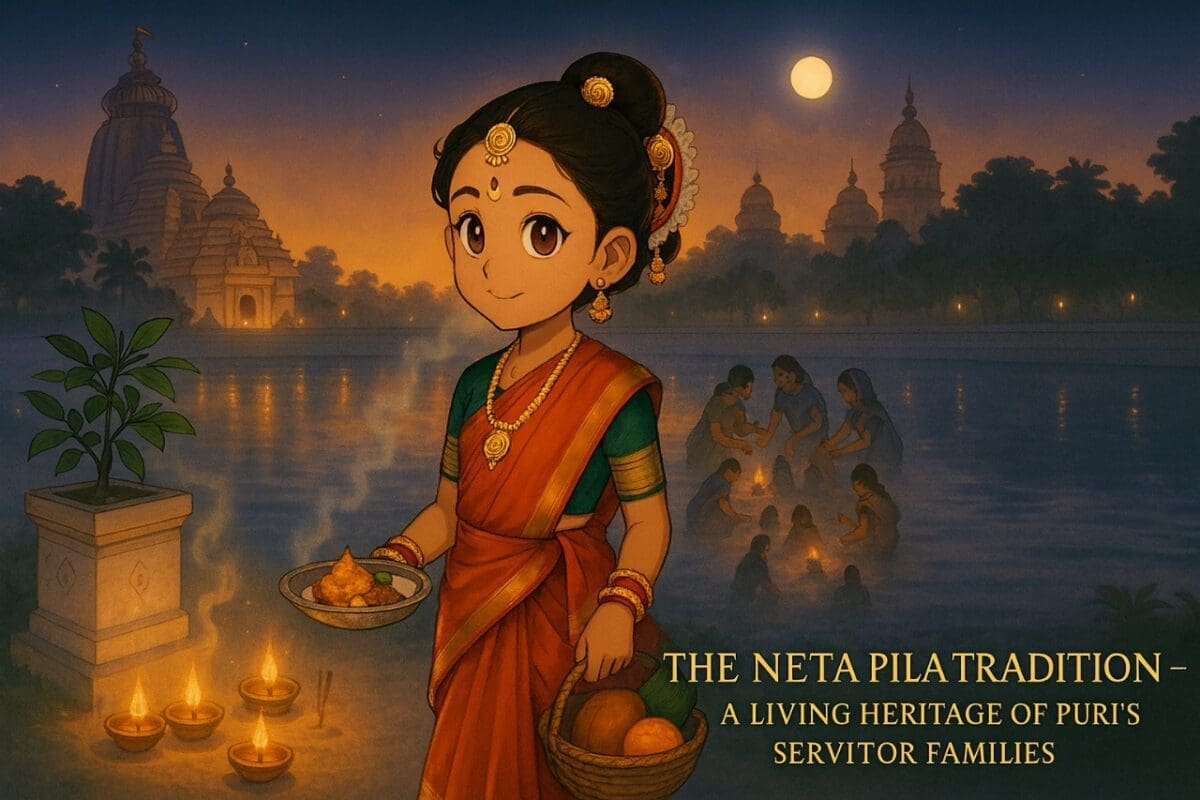
This is a unique tradition of the Sebāyat (servitor) community, also known as Balipuja or Janhi Osha. Unmarried girls observe this vrat (ritual observance) to be blessed with a good husband in the future. From Ashwina Shukla Panchami to Ashtami (the fifth to the eighth day of the bright fortnight in the month of Ashwina), they go to the Markandeshwar pond to worship the sages. In the evening, after performing the ‘Balipuja’ with ridge gourd (janhi) flowers and fruits, they see the moon and then consume Mahaprasad to complete their observance for the day.
The Neta Pila Tradition:-
“O Bali, O Bali, do not quarrel,
Tomorrow I will bring you small Sarucha berries.
The small berries are topped with ghee,
When the incense burns out, you’ll be the king’s daughter-in-law.
The king’s daughter-in-law is very skilled,
She held up the seven-headed serpent (ornament).
Whether by rule or by rite she did it,
She bowed her head and took her ritual bath.”
Every year, on the fifth day (Panchami) of the Sharadiya Durga Puja, this folk song can be heard from the voices of little children on the banks of the Markandeshwar pond in Srikhetra (Puri). The day of Ashwina Shukla Panchami is also called Neta Panchami. This “Neta” tradition is observed among the young girls from the families of the servitors of Mahaprabhu (Lord Jagannath).
A girl can become a ‘Neta Pila’ when she is two and a half, five, seven, or nine years old. These girls observe this vrat from Bhadraba Purnima to Ashwina Shukla Ashtami, for a period of 21 days. During this time, these little girls perform ‘Balipuja’ every evening at the base of the Tulasi Chaura (holy basil altar) at home. They place one betel nut (gua) and 7 cowrie shells (kaudi) in a small container (pharua) and worship them as a form of Lord Shiva. Every day, they bow down and offer Pushpanjali (a floral offering) with two handfuls of flowers.
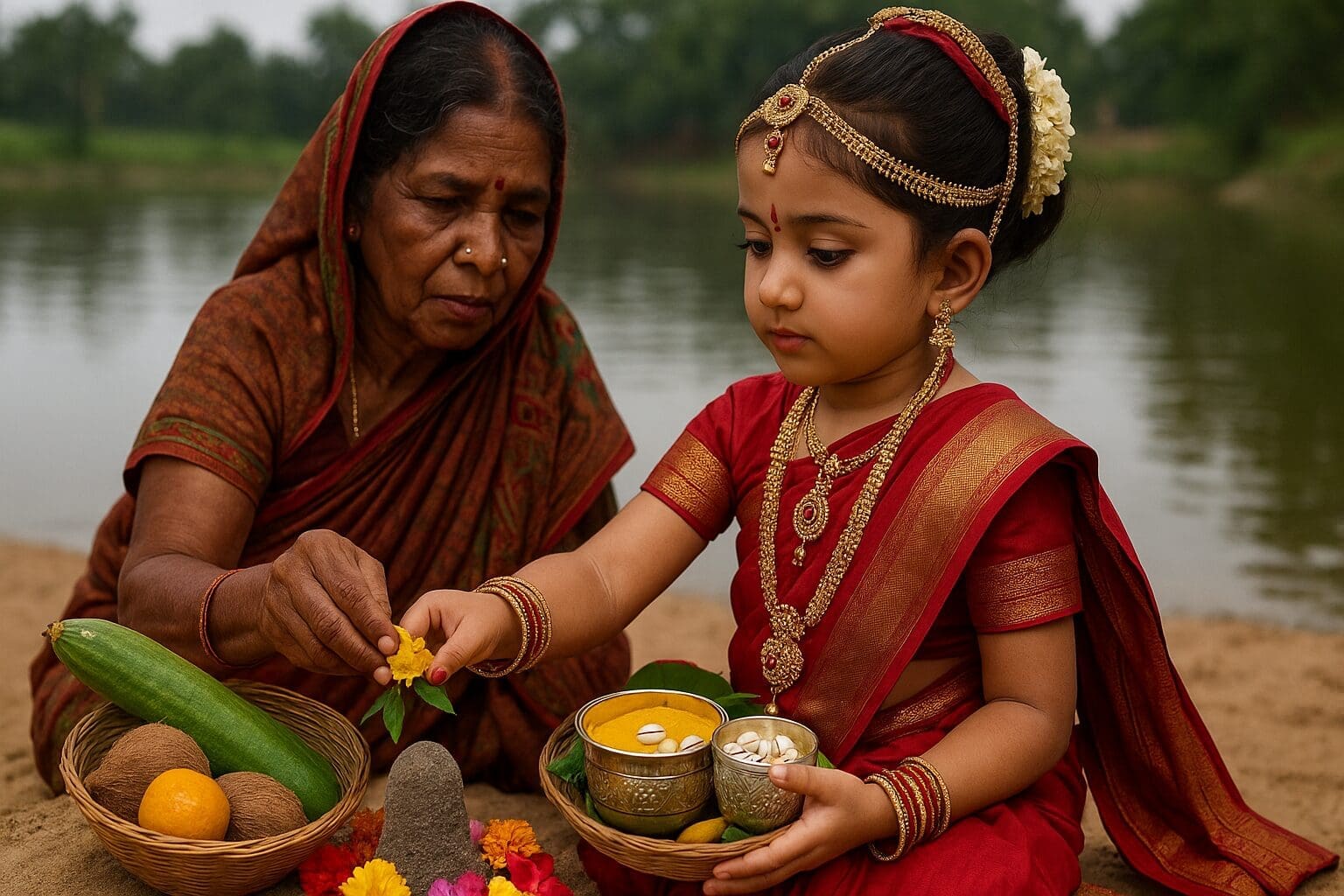
From Ashwina Shukla Panchami to Ashtami, these little girls become ‘Neta’. They dress up in traditional attire. They wear a silk saree (Pata Luga) in the ‘Kachha’ style and adorn themselves with various traditional ornaments. In one hand, they hold a silver box (karata) containing turmeric powder, cowrie shells, and a betel nut for the Balipuja. In another basket (tokai), they carry items like ridge gourd (janhi), orange, cucumber, coconut, sacred thread (paita), and turmeric. Accompanied by an elder female relative like a grandmother or an aunt, they proceed to the Markandeshwar pond. There, they make a Shivalinga from sand and worship Hara-Gauri (Shiva and Parvati).
The Neta Pila
Ornaments Worn by the Neta Pila:-
-
Head: Alaka, Ketakirekha Panapatra, Ragidi (a crescent moon-shaped ornament) on the right side, Purnachandra (full moon ornament) on the left, Suna Kakara for the braid, and a silver Rupa Phuli at the end of the braid.
-
Ear: Kaanaphula Pendi, Malakadhi, Bauli, Phiriphira, Phasia.
-
Nose: Notha on the left nostril, Guna on the right, and Dandi in the center (septum).
-
Neck: Chapasari, Sorisia Mali, Dhanua Mali, Gini Mali, Dangi Mali, Kurujataka, Chapuani Mala, Mauda Mali.
-
Arm: Balaa, Kathi Deunria, Suna Rasunia, Taada, Baju Bandha (armlet).
-
Waist: Anta Mala (waist chain), Paunji Bichha, Chandra Haara.
-
Feet: Goda Mudi (toe rings), Shikuli laga Padapadma (anklet with a chain attached to a toe ring), Paunji (anklets), Benga Patia Ghagudi, Magara Mundia Godakhadu, Pahuda, Jali Banki.
All these are traditional Utkaliya (Odishan) ornaments. 🙏❤️