Articles
|| The Kalki Avatar from Kala Pani ||
Dec
Abandoning all forms of luxury and comfort, the King is imprisoned inside a dark dungeon. Whips strike his back, followed by cane thrashings. Salt is rubbed into the open wounds on his body. Oh, the unbearable pain! He is no ordinary man; he is a King. What was his mistake? Why is a King imprisoned? Did another King defeat him and take him captive? What is the reason?
Time: The latter part of the 19th Century — 1877 AD.
Gajapati Divyasingha Deva III (1859–1882) was the Gajapati King of Puri. He was very powerful in valor and strength. However, he was a staunch opponent of the British. He believed that foreign rule (Firangi rule) could not exist in his kingdom, for this was the land of the “Thakura Raja” (The Lord’s King). Lord Jagannath Himself is the ruler here. Yes, because of this attitude, the Gajapati became an eyesore to the British administration. It was natural, for how else could their burning desire to bring all of India under British rule be fulfilled?
As a result, the Gajapati received the unbearable, unspeakable punishment of Kala Pani (Black Water exile). Convicted on false charges brought by the British government, Gajapati Divyasingha Deva III was imprisoned. He was exiled to the dungeons of the distant Andaman and Nicobar Islands. Not for one or two years, but for ten long years, the Gajapati spent his time in torture.
Finally, the time for freedom arrived. The British did not release him out of mercy; rather, the Gajapati attained freedom through his own efforts. Escaping the tight security ring of Kala Pani, he finally reached Puri. He met the Queen Mother, Patta Mahadei. After many years, the mother and son were reunited. The Queen Mother’s eyes were flooded with tears. Out of motherly affection, she hugged the Gajapati and wept. Her son’s emaciated body caused her even more grief.
But the time for this meeting was short. Keeping the future in mind, the Queen Mother herself pushed her son away. She told him, “You must escape from here immediately in disguise to another place. The British are keeping a sharp watch on us; they could arrive here at any moment and arrest you again.”
Obeying his mother’s advice and command, the Gajapati immediately left the royal palace. Accompanying him was Mahanta Raghubara Dasa of the Badachhata Matha in Puri. He was the Gajapati’s close childhood friend. The Gajapati, assuming a disguise, reached Jaguleipatana with his friend. This place is located on the southern side, just 5 kilometers on the road from Khordha to Nayagarh (State Highway). At that time, this area was surrounded by dense forest. The two friends arrived here and established a Matha (monastery). Gajapati Divyasingha Deva became known as Babaji Dayanidhi Das. Some people called him “Raja Babaji” (King Ascetic). Time passed, and the British could not find any trace of him.
The Gajapati was a supreme devotee of Lord Jagannath. However, he was deprived of seeing the Chaturdhamurti (the four deities) in the Srimandira. Since he could not gain the proximity of the ‘Black Deity’ (Jagannath) in the temple to save his life, the Raja Babaji would see and remember the Lord through the eyes of his devotion.
One day, he saw a dream where Lord Jagannath, Balabhadra, and Subhadra were giving him darshan, adorned with the Conch, Discus, Club, and Lotus. He woke up immediately after the dream. He thought, “I have never seen such a dream before. How did Lord Jagannath, Balabhadra, and Subhadra have full bodies? They are usually half-formed deities.” The next moment, he realized this was the Lord’s command. Idols of Jagannath, Balabhadra, and Subhadra would be built here, but they would be full-bodied idols with hands and feet.
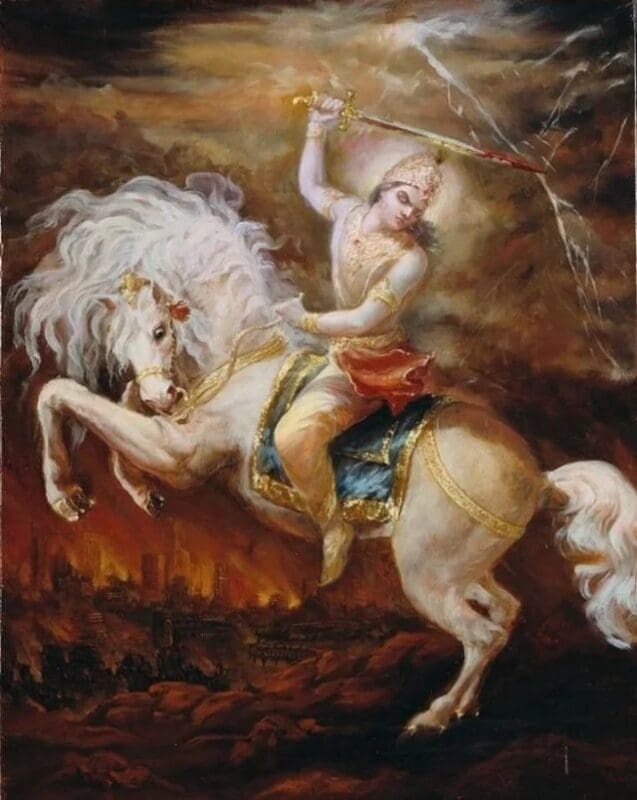
And so it happened. Wood (Daru) was brought from the backyard of a washerman in the nearby village of Beruha, and the idols were constructed. Because they possess full bodies (hands and feet), the Lord became famous here as the Kalki Avatar. Although it is said that Lord Jagannath will appear as the Kalki Avatar at Chhatia at the end of the Kali Yuga, referring to the Jagannath at Jaguleipatana as the Kalki Avatar increases the significance of this place. It is said that the Lord assumed the Kalki Avatar here to destroy the Mlechhas (referring to the British).
It is noteworthy that the red soil of Khordha is the soil of revolution. The last independent fort was Khordha Garh. It is said that the British could not enter the fort because Goddesses Barunei and Karunei themselves were in charge of its protection. For these reasons, many opine that Lord Jagannath assumed the Kalki Avatar at Jaguleipatana, near Khordha. Prana Raula of Puri performed the life-infusion ceremony (Prana Pratistha) of the idols here.
Gradually, devotees started coming to this place. A large number of sadhus and saints also resided here. Among the six disciples of Sadhu Raghubara Das, Atmaram Siddhachari was the first servitor of the Deity. Following this, the Rath Yatra (Chariot Festival) began here. It is heard from local legends that the ‘Thakura Raja’ started the Rath Yatra here after 1887. Some say the Rath Yatra was first held here between 1910 and 1915. If this is true, the credit goes to Gajapati Mukunda Deva III (1882–1961).
The three Deities used to sit on three chariots. Babaji Dayanidhi Das performed the Chhera Pahanra (sweeping of the chariots). People from neighboring villages also came to pull the chariots. However, around 1915–20, the Rath Yatra stopped due to a lack of patronage. It restarted in 1930–31. While the festival stopped intermittently for various reasons, it has been celebrated continuously since 1981.
Yes, a miraculous event occurred here in 1980. At that time, the head of the Matha was Baba Akhileshwar Das. One day, during the evening Alati, due to carelessness, the fire from the lamp caught the black curtain in front of the Deity. The fire then spread to the thatched roof of the Matha. The Matha was completely burnt down. However, miraculously, the idols of Lord Jagannath, Balabhadra, and Subhadra, along with Jaya, Vijaya, and Sudarshan, remained unharmed. Not even a trace of fire touched them. This news spread across the region. Following this, the people of Jaguleipatana and surrounding villages became active. With everyone’s cooperation, a temple was built here. Although the Matha has been transformed into a temple, many people still call it a Matha.
Within the temple premises, there is the shrine of Kundaleshwar Mahadev and the Samadhi (tomb) of Sadhu Raghubara Das. The government has provided 4 acres of land from this point up to the Mausi Maa Temple. Two hundred meters north of the highway, at the village entrance, is the seat of Goddess Jagulei Thakurani. That place is famous as the Mausi Maa Temple. Former MP Dr. Prasanna Patasani performs the Chhera Pahanra on the chariot. All activities are carried out through the joint cooperation of the Temple Trust, the villagers, and the Khordha District Administration.
Snana Yatra and Rath Yatra are the two major festivals of the Lord here. Another unique feature of this place is that the chariots are not built with new wood every year, nor is the Nabakalebara (New Body ceremony) of the Deities performed.
The village is named Jaguleipatana after Goddess Jagulei. ‘Ja’ for Jagulei and ‘Ja’ for Jagannath. In this village lies the abode of Jagannath, Balabhadra, and Subhadra with hands and feet. This Jagannath temple is unique compared to all other Jagannath temples in the world. Known as Sri Sri Ananta Purushottama Kshetra, this site is extremely important from both religious and tourism perspectives.