Articles
Mahashivratri: The Cosmic Alchemy of Stillness and Awakening
Feb
The velvet canopy of the pre-spring sky holds a secret that ancient sages decoded millennia ago. While most civilizations celebrate the sun, the Vedic tradition carves out a sacred space for the darkest night of the year: Mahashivratri. It is not merely a date on a lunar calendar; it is a celestial phenomenon, a spiritual portal, and a deep psychological reset.
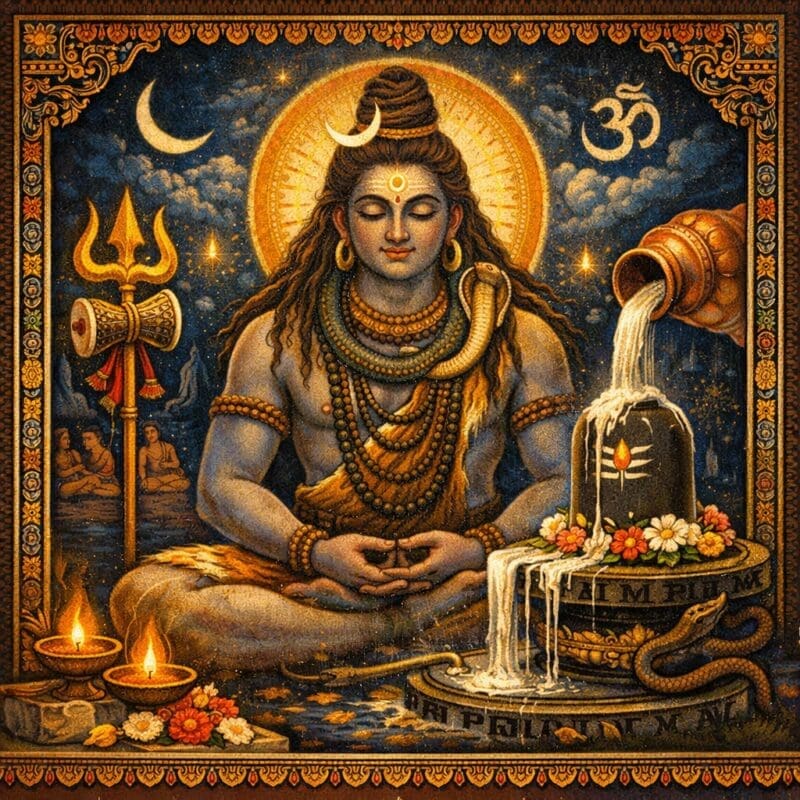
To understand Mahashivratri is to move beyond the bronze idols and the spilling of milk over stone. It is to enter the “Great Night of Shiva”—a time when the physical laws of the universe seem to nudge the human consciousness toward its source.
1. The Anatomy of Darkness: Why the Night?
In our modern world, darkness is often equated with fear, ignorance, or the “unseen.” However, in Shaiva philosophy, darkness is the Prakriti (the primordial womb) from which all light is born.
The Womb of Creation
Before the Big Bang, there was stillness. Before a thought arises, there is a gap of silence. Mahashivratri embraces the 14th night of the dark fortnight (Krishna Paksha) because it represents the state of the universe before manifestation. By worshipping in the dark, we are not celebrating “evil”; we are celebrating the Unmanifest.
The Biological Edge
Spiritually, the human spine is seen as the antenna of consciousness. On this specific night, the planetary positions are such that there is a natural upsurge of energy in the human system. By staying awake and keeping the spine vertical, a seeker assists this natural flow of energy from the Muladhara (base) to the Sahasrara (crown). The night provides the quietude necessary for the senses to retract from the “noise” of the material world and dive into the “music” of the inner self.
2. The Shiva Linga: The Science of Formless Form
The Shiva Linga is perhaps the most misunderstood symbol in global theology. Stripped of its ritualistic layers, it is a mathematical and metaphysical masterpiece.
The Ellipsoid: Modern science confirms that the universe is an expanding ellipsoid. The Linga represents this cosmic shape—the first form taken by creation before it diversified into galaxies and atoms.
The Union of Opposites: The Linga stands upon the Yoni (the base). This represents the inseparable nature of Shiva (Pure Consciousness) and Shakti (Dynamic Energy). Consciousness without energy is dormant; energy without consciousness is chaotic. Their union is the balance of life.
The Axis Mundi: It represents the Stambha—the pillar of fire that has no beginning and no end. It reminds the seeker that their true identity is not the limited body, but the infinite pillar of awareness.
3. The Discipline of the Soul: Fasting and Vigil
On Mahashivratri, millions fast (Upavasa) and stay awake (Jagaran). These are not acts of penance to please a demanding deity; they are sophisticated tools for self-transformation.
Upavasa: Moving Closer
The word Upavasa literally means “to sit near.” By abstaining from heavy food, the body’s metabolic energy—usually consumed by digestion—is redirected. The “digestive fire” becomes “spiritual fire.” This makes the body light and the mind sharp. When you are not preoccupied with the tongue, you begin to hear the heart. It is a declaration: “I am more than my hunger.”
Jagaran: The War Against Ignorance
Sleep is often a metaphor for Avidya (spiritual slumber). Most of us go through life “asleep” even when our eyes are open—driven by habits, biases, and ego. Jagaran is a practice of conscious alertness. To stay awake all night is to tell the ego, “I am the witness. I am awake to my own existence.”
4. The Tandava: The Rhythm of Existence
Shiva is Nataraja, the Lord of the Dance. His Tandava is the rhythmic play of the cosmos.
Srishti (Creation): The vibration that brings matter to life.
Sthiti (Preservation): The balance that keeps the planets in orbit.
Samhara (Dissolution): The necessary recycling of the old to make way for the new.
Tirobhava (Concealment): The veil of illusion (Maya).
Anugraha (Liberation): The grace that reveals the truth.
Mahashivratri is the night we tune our internal frequency to this dance. We realize that our joys and sorrows are just “steps” in a much larger, divine choreography.
5. From “I” to “Shiva”: The Path to Moksha
The ultimate realization of this night is the dissolution of the “small self.” The ego is a heavy burden we carry daily—our titles, our possessions, our grievances. Mahashivratri acts as a solvent.
In the presence of Mahakala (the Lord of Time), our personal histories shrink. We realize that the stillness we find in deep meditation is the same stillness that occupies the heart of Lord Shiva. As the ancient chant goes: Shivoham, Shivoham—”I am Shiva.”
This is not arrogance; it is the ultimate humility. It is the recognition that the spark within you is the same fire that powers the suns.