Articles
ll Vijaya Ekadashi or Pankoddhara Ekadashi ll
Feb
⚫❗⚫
“O Vishwanatha, Shiva, Shankara, God of Gods,
Holder of the Ganges, Leader of the Pramathas, Lord of Nandi.
Enemy of Bana and Andhaka, Hara, Lokanatha,
Savior from the deep wilderness of worldly sorrows, O Lord of the Universe, protect me.”
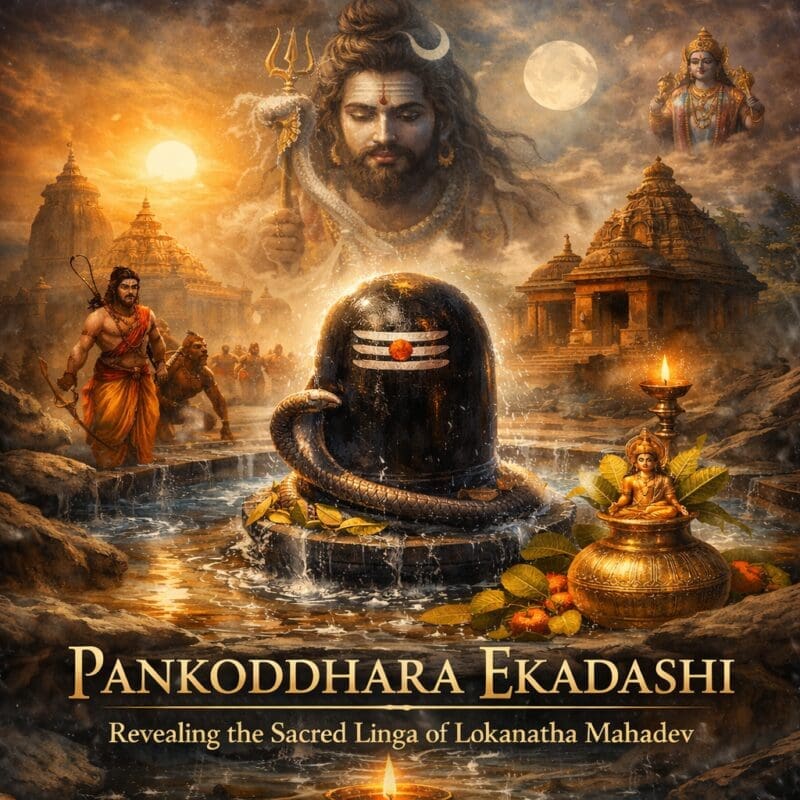
To the west of the Srimandir (Jagannath Temple), Lord Sri Lokanatha Mahadev resides. This is an ancient temple. In Puranas and folklore, He is known as Alabukeshwara. ‘Alabu’ means Gourd (Lau), so according to some opinions, He is also worshipped as Laukeshwara. The specialty of this Mahadev temple is that the main Shiva Linga worshipped here always remains submerged in spring water. Throughout the year, the Chalanti Pratima (representative idol) is worshipped here.
Every year, on the Ekadashi day preceding Shivaratri, the Bel leaves and water that have accumulated throughout the year are bailed out (removed). This is called Pankoddhara or Pankaujhula Ekadashi (Raising of the Mud/Slush Ekadashi). Only on this specific day of the year can devotees view the actual form of the main Linga of Sri Lokanatha and feel blessed.
The five Mahadevs of Srikshetra (Puri) are referred to as the Pancha Pandavas. Sri Lokanatha is regarded as the second Pandava, Bhima. Furthermore, Sri Lokanatha is the Guardian of the Treasury (Bhandara Rakshaka) of the Srimandir; hence He is known as Bhandara Lokanatha. Sri Lokanatha is also considered the Minister (Mantri) of Mahaprabhu Sri Jagannath.
“Lokanatha Deva Sadananda holds the post of Minister,
He ensures the safety and wealth of the assembly.”
It is believed that if one takes refuge in Sri Lokanatha Mahadev, the childless attain sons, and those suffering from debilitating diseases are cured.
The Ekadashi of the Krishna Paksha (waning phase of the moon) in the month of Phalguna is called Pankoddhara Ekadashi or Vijaya Ekadashi. By observing this Vijaya Ekadashi vow (Vrata), a human can conquer enemies. According to Puranic legend, during the abduction of Sita, when Ramachandra reached the northern shore of the ocean with the Vanara (monkey) army, He became worried about the mighty enemy Ravana and the depth of the ocean. While seeking a way to cross the ocean, on the advice of a sage, He observed this Vijaya Ekadashi vow. It is believed that due to the influence of this vow, He was able to cross the ocean and slay Ravana.
ll The Puranic Story ll
Yudhisthira asked: “O Vasudeva! Which Ekadashi falls during the Krishna Paksha of the month of Phalguna, and what is the ritual for this vow? Please tell me.”
Lord Srikrishna said: “Yudhisthira! Once, when Narada asked Brahma about the merit gained by the ‘Vijaya (Pankoddhara) Ekadashi’ vow of the Phalguna Krishna Paksha, hear what Brahma told him regarding the greatness and rituals of this vow.”
Brahma said: “Narada! This vow is very ancient, holy, and a destroyer of sins. This Ekadashi grants victory to kings; there is not even an iota of doubt about this.
In the Treta Yuga, when Maryada Purushottam Sri Ramachandra reached the seashore to attack Lanka, He could see no way to cross the ocean. He asked Lakshmana: ‘O Son of Sumitra! By what means can this ocean be crossed? It is extremely deep and filled with terrifying aquatic creatures. I see no simple way to cross it easily.’
Lakshmana said: ‘O Lord! You are the Primal God and the Supreme Being (Purushottam). What is unknown to you? Sage Bakadalabhya resides on Kumari Island, half a yojana away from here. You should go to that ancient sage and ask for a solution.’
Sri Ramachandra arrived at the ashram of the great sage Bakadalabhya and bowed to him. The Maharishi was pleased and asked the reason for Sri Rama’s arrival.
Sri Rama said: ‘O Brahmin! I have come here with my army to attack Lanka. O Great Sage! Please tell me the way to cross the ocean now.’
Sage Bakadalabhya said: ‘O Sri Rama! There is an Ekadashi named “Vijaya” that falls in the Krishna Paksha of Phalguna. If you observe this vow, you will be victorious. You will certainly be able to cross the ocean with your Vanara army. O King! Now listen to the fruitful ritual of this vow.
On the day of Dashami (the 10th day), establish a pitcher (Kalash) made of gold, silver, copper, or clay, fill it with water, and place fresh leaves (mango leaves) on it. Place a golden idol of Lord Narayana upon it. Then, on the morning of Ekadashi, after bathing, re-establish the Kalash. Worship it specially with garlands, sandalwood paste, betel nut, and coconut. Place seven types of grains (Saptadhanya) and barley on the Kalash and worship it with incense, lamps, and various offerings (Naivedya). Light a ghee lamp for the uninterrupted success of the vow.
Then, on the day of Dwadashi (the 12th day), after sunrise, place this Kalash on the bank of a river, waterfall, or pond and worship it. Donate that Kalash along with the idol of the deity to a Vedic Brahmin. Along with the Kalash, other significant donations should also be made. O Sri Rama! Along with your commanders, observe this “Vijaya” Ekadashi vow with great effort following these rituals. Through this, you will achieve victory.’
Brahma said: ‘Narada! Hearing this, Sri Ramachandra observed the ‘Vijaya Ekadashi’ vow at that time as per the sage’s instructions. By observing that vow, Sri Ramachandra became victorious. He killed Ravana in battle, conquered Lanka, and rescued Mother Sita. Son! Humans who observe this vow according to the prescribed rituals attain victory in this world, and their afterlife also remains secure.’
Lord Srikrishna said: ‘Yudhisthira! For this reason, one should observe the “Vijaya Ekadashi” vow. Reading and listening to this narrative yields the merit of performing the Vajapeya Yajna (Sacrifice).’ “
🙏❤️