 Shri Jagannath's Locket(Silver)
  Shri Balaji Jagannath Digital photo For Framing
 Articles
ll Makara Sankranti and the Makara Chaurashi Besha of the Lord ll
Jan
⚫❗⚫
“Byanjanannani dibyani pupanscha bibidhanapi |
Chatuh sankhyadhikasiti prakaram bibidham bahum ||”
— Bamadeba Samhita
(Translation: Various divine cooked dishes and multiple types of cakes, numbering eighty-four varieties, are offered.)
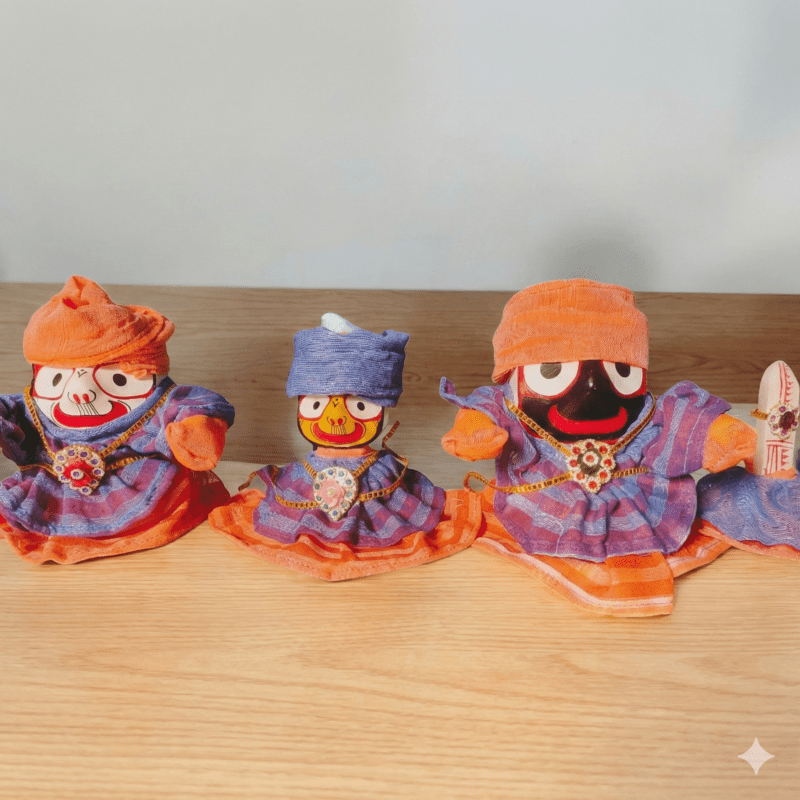
Among the twelve major festivals (Dwadasa Jatra) of Lord Shri Jagannath, the Uttarayana Jatra, celebrated on the Sankranti of the month of Pausha, is known as Makara Sankranti. On this day, special rituals are conducted in the Shri Mandir (Jagannath Temple) according to ancient traditions. After the completion of Mangala Alati and Abakasha rituals, the deities are adorned with Futa Paharana (garments) and a special Makara Chula (crest/turban) is placed on their heads, followed by the application of camphor (Karpura Lagi). Subsequently, the Gopal Ballav and Sakala Dhupa (morning offerings) are completed. After the morning offerings, rituals like Mailama, Jatrangi Mahasnan (grand bath), Sarbanga, and the wearing of new clothes and gold ornaments (Chha Murti Alankara) are performed.
Following this, a procession featuring the Ghanta (gong), Chata (umbrella), and Kahali (trumpet) accompanies the Talichha and Pradhani servitors as the offerings are brought to the sanctum. After the Mudirasta performs the Prasada Lagi, the Pujapanda priests of the three deities sit for the Madhyanha Dhupa (mid-day meal) rituals with sixteen types of worship (Shodasha Upachara). During the Tera (curtain) period, the Pujapanda, Rosha Paika, Patribadu, and Suarabadu go outside to perform the Asta Digbali (offerings to the eight directions) before the food offering is concluded.
Next, preparations begin for the Makara Bhoga, which was consecrated the previous day in the Bhoga Mandapa. Notably, the Shuddha Suara prepares the Makara Chaula (special rice dish) using coconut, ghee, sugar, spices, and milk cream. The Pantibadu servitors, wearing Baghamuha (tiger-faced masks), carry the Makara Chaula around the temple premises three times (Bedha) in a grand procession before placing it before the Lord. Other offerings such as milk from the Mahabhoi, sweets from the Gudiya, and betel nuts/leaves from the Hadapa Nayaka are also presented. Finally, the Pujapanda performs the offering with five-fold rituals (Panchopachara), followed by the Bandapana (lamp ceremony) performed by the Pujapanda, Patimahapatra, and Mudirasta.
On the occasion of Makara Sankranti, 84 varieties of offerings are made to the Lord, prepared with great devotion by the Suara (cooks). This is known as the Makara Chaurashi Bhoga. Once these rituals are completed, lakhs of devotees gather in the Nata Mandapa to catch a glimpse of the deities. This Uttarayana Jatra creates a profound sense of spiritual bliss in the hearts of devotees.
Today is the holy Makara Sankranti. The entire nation is in a festive mood for this occasion. The festival is celebrated based on the northward movement (Uttarayana) of the Sun God (Surya Narayana). Here in Odisha, we worship Lord Jagannath by performing the Uttarayana Bandapana and offering the Makara Chaurashi Besha and Bhoga.
While the Sun is considered the source of all energy and the protector of the 8.4 million species (Chaurashi Laksha Yoni), in Jagannath culture, Lord Jagannath Himself is the Adi Surya (The Primordial Sun). Proof of this can be found within the temple. In the Navagraha temple located near the Lakshmi temple, the “reverse” positioning of the Sun proves that Jagannath is the source of the Sun. In most temples, we worship planets starting from the Sun to Ketu, but here, they are installed in the reverse order because the Lord’s manifestation (Prakatya Leela) takes place in Koili Baikuntha, located nearby.
Adorned in Makara Chaurashi Besha, my Jaga looks divine,
On Makara Sankranti, His beauty truly shines.
By witnessing this form, oh friend, the scriptures say,
One attains liberation from the 8.4 million cycles of birth today.
Lord Jagannath, like the Sun, is the source of all power and the nourisher of 8.4 million species. Therefore, for the welfare of all living beings, 84 types of dishes are offered to Him on Makara Sankranti. This is called the Makara Chaurashi Bhoga. Makara Chaula (uncooked raw rice mixed with delicacies) is offered as Annabali to the guardian deities of the directions (Digpalas).
The 84 types of offerings include:
Jagannath Ballabh, Khaja, Gaja, Shukla Pheni, Meetha Pheni, Luni Khuruma, Meetha Khuruma, Badapuri, Sanapuri, Kakatua Jhilli, Badanadi, Sananadi, Kakara, Hansakeli, Chandrakanti, Bada, Nanamana, Basanta Arisa, Paga Arisa, Maricha Ladu, Bada Khirisa, Kadamba, Mendha Mundia Khechudi, Netrapuri, Magaja Ladu, Amalu, Dalimba, Manohara, Sarabhaja, Parijataka, Mandua, Ballabh Kora, Gopala Ballabh, Amruta Rasabali, Suari, Chadheinada, Badakanti, Mathapuli, Gagudi, Nadia Khuri, Bundia Khiri, Takua, Pana, Mahadei Khechudi, Mohanbhoga, Jenamani, Sujigaja, Balibamana Muga, Suara Pitha/Poda Pitha, Makhana, Khali Ruti, Kanika, Sadha Anna (Plain rice), Dali, Besara, Payas, Puranduri, Adapakan, Khua Manda, Khairachula, Lakshmi Bilas, Ghianna (Ghee rice), Anna Rasabali, Ladu, Nadia Keli, Khaira Chulia, Motichula, Dhanu Sankranti Pitha, Panasua Ladu, Sarakumpa, Arakhaphula, Kadamba, Kheimanda, Chenapitha, Shrihastakora, Radhaballabhi, Sadha Enduri, Chuliakupada, Gaintha, Jeuta, Kanaphuli, Mendhasingia, Khandamanda, and Kanti.
ll Makara Sankranti Bhoga ll
By the time Makara Sankranti arrives, new crops like paddy and sugarcane are harvested in Odisha. Therefore, on this day, a delicious offering called ‘Makara Chaula’—prepared with fresh uncooked raw rice, new jaggery, chenna (cheese), coconut, ripe bananas, ghee, and milk—is offered to the household deities and in the threshing floors (Khala). People share this Bhoga and establish “Makara” (a formal bond of friendship). In some regions, Poda Pitha made from new rice is also offered. Since the Sun is responsible for the harvest, farmers offer the new grains to the Sun God during the auspicious time of Makara Sankranti. 🙏❤️