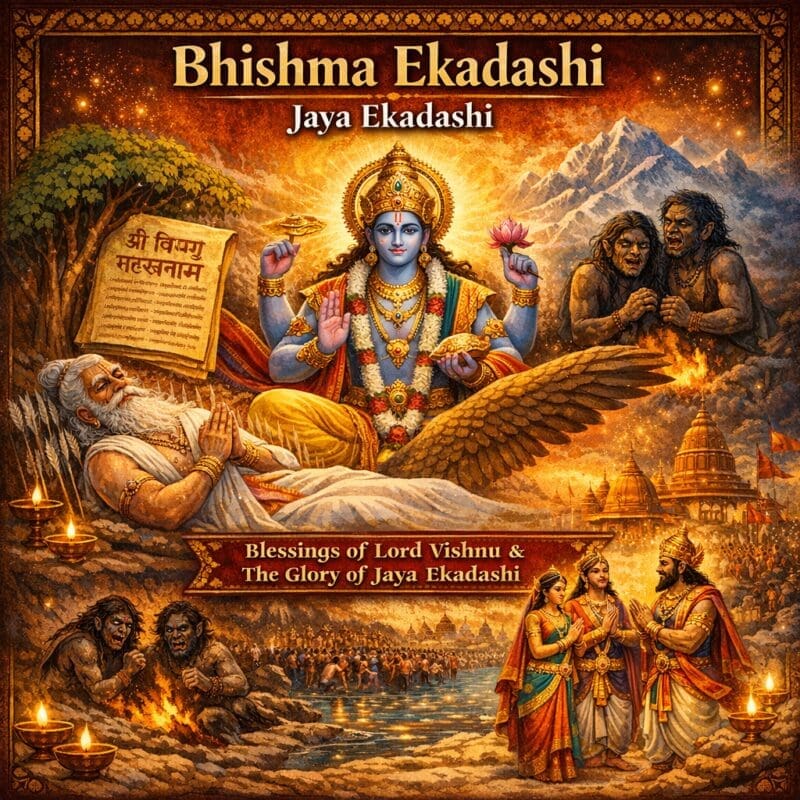
The Ekadashi falling in the bright fortnight (Shukla Paksha) of the month of Magha is celebrated as Bhishma Ekadashi. It is also known as Jaya Ekadashi or Bhaimi Ekadashi. It is said that the Vishnu Sahasranama Stotram (the thousand names of Lord Vishnu) was born on this very day. By fasting on this day, remembering Bhishma Pitamah, and chanting the Vishnu Sahasranama throughout the day, one receives the blessings of the Almighty. Lord Vishnu is worshipped and offered prayers on this occasion. Among the many auspicious bathing days of the “Maha Kumbha” period—such as Makara Sankranti, Magha Purnima, and Maha Shivaratri—Bhishma Ekadashi is considered a holy day for the Kumbha Snana (sacred bath).
In Odisha:
On this Ekadashi, the Gaja Uddharana Besha (the attire depicting the liberation of the elephant) of Shri Gopaljiu is held at Sakshigopal. In Yajpur, the Vyasa Sarovar Mela takes place, and at the Nilamadhab Peetha in Kantilo, the Bhaimi Ekadashi Jatra commences.
ll The Legend ll
According to Hindu belief, this Ekadashi is named Jaya, and observing this fast destroys “Pishachatwa” (the state of being a demon or a ghost). This means that by fasting with a pure heart and worshipping Vishnu, the evil tendencies within a human mind are dissolved. There is a famous legend regarding this:
According to the Padma Purana, there once lived a Gandharva maiden named Pushpavati and a Gandharva youth named Malyavan in the heavenly realm of Indra. They were deeply infatuated with each other. Blinded by passion, they lost their sense of time and place. While performing music and dance in the court of Lord Indra, they became so distracted by each other that Malyavan forgot the lyrics of his song and Pushpavati lost the rhythm of her dance.
Seeing this disrespectful behavior in the full assembly, Lord Indra became furious and cursed them to become Pishachas (flesh-eating demons). He cast them out of heaven. The duo landed in the Himalayas near Badrinath. They suffered immensely due to the extreme cold and their wretched state. Fortunately, on the day of this Ekadashi, they were so miserable that they did not kill any living being for food, touched neither water nor grain, and remained awake all night due to the cold.
Unbeknownst to them, they had observed the Bhaimi or Jaya Ekadashi fast. As a result, their sins were washed away. The following day, they regained their divine bodies and returned to heaven.
ll The Greatness of Jaya Ekadashi as told in Padma Purana ll
Yudhishthira said: “O Lord Krishna, the Primordial Deity! You are the creator, sustainer, and destroyer of all four types of living beings. Please graciously provide me with the details of the Shukla Ekadashi of the month of Magha.”
Shri Krishna replied: “O King! The Ekadashi of the bright fortnight of Magha is famous as ‘Jaya’. This date is the destroyer of all sins, the most supreme, holy, and the granter of desires and salvation. Furthermore, by observing this fast, even the sin of Brahmahatya (killing a Brahmin) and the state of being a Pishacha are destroyed. A human who observes this never attains the state of a ghost (Pretatwa).”
He then narrated the story:
“Once, while Indra was ruling heaven, the gods were living in great bliss, enjoying the Parijata flowers in the Nandankanan forest. One day, Indra organized a grand dance performance. Among the Gandharvas present were Pushpadatta, Chitrasena, and his son. Chitrasena’s wife was Malini, and their daughter was Pushpavati. Pushpadatta’s son was Malyavan. Malyavan was enchanted by Pushpavati’s beauty, and she too was captivated by him.
During their performance for Indra, they became so lost in their mutual attraction that their singing and dancing faltered. Perceiving this as an insult to his court, Indra cursed them: ‘Fie upon you, you foolish violators of my command! Go to the mortal world, take the form of Pishachas, and suffer the fruits of your bad deeds.’
They fell onto the Himalayan mountains and suffered terribly. They even forgot their past identities due to the misery. One day, Malyavan said to Pushpavati, ‘We must have committed terrible sins to suffer this hell-like demonic existence. From now on, I shall not commit any sinful act.’
By great stroke of luck, it was the day of Jaya Ekadashi. They spent the day and night under a Peepal tree without food or water. Due to the biting cold, they could not sleep. This unintentional fasting and vigil were accepted as an act of devotion.
O King! On the day of Dwadashi, by the grace of Lord Vishnu, their demonic form vanished. Pushpavati and Malyavan regained their original forms and returned to heaven. When they appeared before Indra, he was astonished and asked, ‘By what merit was your curse lifted?’
Malyavan replied, ‘O Lord! By the grace of Lord Vasudeva and the merit of the Jaya fast, we have been liberated.’ Hearing this, Indra said, ‘O Malyavan! From now on, you may consume nectar again. Those who are devoted to the fast of Hari (Ekadashi) and Lord Krishna are worthy of our worship as well.’
Shri Krishna concluded: “O Yudhishthira! This ‘Jaya’ fast destroys even the most heinous sins. It grants the benefits of all charities and the fruits of all sacrifices (Yajnas). One who observes it resides in Vaikuntha in bliss for millions of ages. O King! Even reading or hearing the glory of Jaya Ekadashi provides the merit equivalent to performing the Agnishtoma Yajna.”
🍁🍁🍁🍁🍁🍁🍁🍁🍁🍁🍁🍁

 Panchatrirth Water
₹ 1,078
Panchatrirth Water
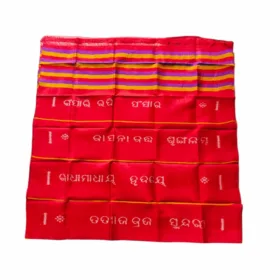
₹ 1,078 Grace Shawl for Pooja/festival moments and Temple Visit
From ₹ 729/-
Grace Shawl for Pooja/festival moments and Temple Visit
From ₹ 729/-