Articles
|| Dhanu Sankranti and Pahili Bhoga Rituals ||
Dec
Dhanu Sankranti is another major festival for Odia people. It has been observed since time immemorial. The transition of the Sun into the Sagittarius zodiac (Dhanu Rashi) is called Dhanu Sankranti. The period from this Sankranti up to Makara Sankranti constitutes the time of intense winter. During this time, it is natural for people to become lethargic and wake up late. However, in our temple tradition, the opposite is true. throughout this month, the rituals of the Supreme Lord (Mahaprabhu) are performed well before sunrise.
At a time when people do not even wish to get out of bed, the Lord’s bathing rituals (Snana Abakasha) are completed, and the morning breakfast (Bala Bhoga) is already offered. This Pahili Bhoga ritual teaches us not to be lazy during winter but to be active and diligent. Furthermore, this is the season for harvesting crops. This ritual inspires us to be dutiful and engage in harvesting activities during this month. One month of harvesting provides food for the entire year.
|| Pahili Bhoga Ritual is observed from Dhanu Sankranti to Makara Sankranti ||
In the world-famous Sri Jagannath Temple, various rituals, festivals, and celebrations are observed throughout the year, and many types of food offerings are presented to the Lord seated on the Ratnasimhasana. According to mythology, among the four Dhamas (holy abodes) of India, ‘Srikshetra’ (Puri) is renowned as the ‘Bhojana Dhama’ (Dining Abode) of the Supreme Being. Food holds great significance in this holy place. There are arrangements for special food offerings during various festivals. Therefore, it is rightly said:
“Bada Deula re lagichhi nata,
Niiti punia niiti hata.”
(Festivities never cease in the Great Temple; every day is a festival, every day is a fair.)
The service of Sri Jagannath encompasses all emotional flavors (Rasas) such as Romantic Love (Shringara), Heroism (Vira), and Parental Love (Vatsalya). Among these, the period from Dhanu Sankranti to Makara Sankranti is the time for worshipping with Vatsalya Rasa (Parental Affection). The Pahili Bhoga rituals begin in the Sri Mandira from Dhanu Sankranti. Very early in the morning—before the crow even caws (before dawn)—Pahili Bhoga is offered to the Lord.
Mother Yashoda used to feed the two brothers, Rama and Krishna. For this reason, the daily rituals of the Lord are performed very early in the temple. Pahili Bhoga is offered to the Deities for an entire month. The Lord eats food cooked by His mother. It is said that during this month, Goddess Mahalaxmi visits her father’s house. Therefore, the affectionate Mother Yashoda cooks early in the morning to serve Sri Jagannath rice and various dishes piping hot during the cold winter. Thus, this offering is a testament to Mother Yashoda’s motherly affection and natural love for her son. This is why the tradition of Pahili Bhoga has continued.
According to mythological legend, once in Dwaraka, Sri Krishna became overwhelmed with memories of Mother Yashoda and assumed the form of child Gopala. Narada arrived there and inquired about the mystery. Directed by Sri Krishna, Narada went to Gopapura. There, he saw the two brothers, Krishna and Balarama, sitting on Yashoda’s lap and happily eating various sweets. Sri Jagannath’s Pahili Bhoga is a memorial of this event.
There is no mention of Pahili Bhoga in the Skanda Purana, or in the Bamadeva Samhita and Niladri Mahodaya, which describe the various festivals of the temple. From this, it is inferred that the practice of Pahili Bhoga is a later addition, likely starting in the 16th century AD. Following this ritual, the morning incense offering (Sakala Dhupa) takes place, followed by the public viewing (Sahanamela Darshan). The ritual of retiring to sleep (Pahuda) happens by midnight. According to tradition, on Dhanu Sankranti, ‘Muan’ (sweetened puffed rice balls) comes from the Bada Odia Matha for the Deity’s offering.
In the Sri Mandira, from Dhanu Sankranti to Makara Sankranti, the ‘Pahili Bhoga’ ritual is performed alongside the morning Gopala Ballabha Bhoga. On these days, while two ghadis (approx. 48 minutes) of the night remain, the door opening ritual, Mangala Alati, and Abakasha take place. Afterward, the Deities are dressed in winter clothing (Ghoda) and ornaments. Then, after the purification of the inner and outer sanctuaries, the Gopala Ballabha Bhoga is served at the Anasara Pindi.
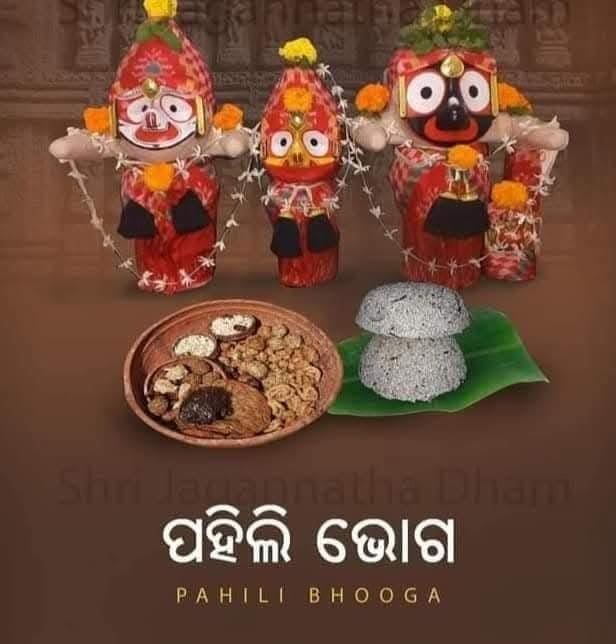
After the sprinkling of consecrated water, the call is made for the arrival of the Pahili Bhoga Chheka (baskets of offerings). In this offering, cakes made of black gram and wheat, fried in ghee, are brought and worshipped with five Upacharas.
The cakes offered in Pahili Bhoga include:
Bada Jhili, Darasua Badi, Darasua Jhili, Bada Bada, Kakeri, Sana Amalu, Nali, Kakera, Arisa, Mugei, Enduri, Ladu, Gaja, Khaira Chula, Manda, Chuda Pua, Badi, Kantei, etc. The quantities of these are also mentioned in the temple’s Record of Rights (Swattwalipi).
To facilitate the cooking of all these items, the Rosha Homa (kitchen fire sacrifice) is performed immediately after Mangala Alati on these days.
There is a folk belief that Mother Laxmi spends this month at her father’s house. In Odia households, there is a tradition of daughters-in-law visiting their father’s home during the month of Pausha. Therefore, the Mother (Yashoda), being anxious, feeds her children hot food early in the cold winter morning. This Pahili Bhoga evokes the memory of rice served by a mother. 🙏❤️