Articles
Chitalagi Amavasya: Jagannath’s Golden Forehead Adornment
Jul
-: Today is Mahaprabhu’s Chitalagi (Forehead Adornment) :-
Śrāvaṇasya ca darśe
Apihyaruṇodaya kālake |
Naivedyāmadhikaṁ dadyāt prātaḥ pūjanakālake ||
Suvarṇaracitaṁ divyaṁ nānāratnasamujjvalam |
Tilakaṁ tu kapāleṣu devānāṁ bhillajātayaḥ ||
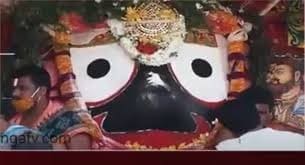
On the day of Shravana Amavasya (new moon), that is today, the Chitalagi Amavasya ritual will be observed in the Srimandir (Jagannath Temple, Puri). Today, the golden Chitas (forehead ornaments) of the Mahaprabhu are adorned. The Chaturdamurti (the four divine images) are decorated with diamonds, sapphires (nila), and rubies (manikya). These attractive Chitas, made with various types of precious ornaments, are placed on the foreheads of the holy idols. Among the many festivals, sub-festivals, and the thirteen major yatras (journeys/festivals) celebrated in the Srimandir, the Chitalagi Amavasya is one of the more than fifty important sub-festivals.
It is noteworthy that these gem-studded golden Chitas are removed from the foreheads of the deities on the night of Snana Purnima (the divine bathing festival). These Chitas are brought from the temple treasury (Bhandara), and in the presence of the Deulakarana, Tadhau Karana (temple scribes/officials), and officials of the Srimandir administration, they are cleaned by the Bania Sevaka (goldsmith servitors) and re-established. As the Chitalagi ritual is confidential, devotees are barred from entering the inner sanctum during this time.
The Nila Chita (Sapphire Forehead Ornament) of the elder lord, Sri Balabhadra, has a large central emerald (nayaka markata). It is surrounded by five concentric bands encrusted with small rubies, diamond chips, tiny emeralds, more diamond chips, and blue stones (nila).
The Hira Chita (Diamond Forehead Ornament) of Mahaprabhu Sri Jagannath has a central diamond (nayaka hira). In the seven bands of the Chita, there are diamond chips, rubies, diamonds, emeralds, and tiny emeralds. At the very top of the seventh band, there is a betel leaf-shaped diamond stone. This is known as the Brahmajyoti Hira (Diamond of Divine Effulgence).
The Manikya Chita (Ruby Forehead Ornament) of Devi Subhadra has a square central emerald (nayaka markata). In the three bands of the Chita, there are large rubies, small rubies, diamond chips, tiny diamonds and rubies, tiny emeralds, oily diamonds (telia hira), sapphires, and diamond necklaces (hira kanthi).
“Śrāvaṇe māsi saṁprāpte yoddharccayet kamalāpatim | Na sa garbhagṛhaṁ yāti yāvadābhūti saṁplavam ||”
—Skanda Purana
Meaning: A person who worships Kamalapati (Lord Vishnu) in the month of Shravana will not have to be reborn for all of eternity.
“Yoddharccayet śrīdharaṁ devaṁ śrāvaṇe bhaktipūrvataḥ | Na gacchenni rāyaṁ rājyaṁ kṛtvā pāpa śatānyapi || Śrāvaṇe māsi yo dadyāt lajānghata samanvitān | Haraye tasya viprarṣe na vipatti gṛhe bhavet ||”
—Skanda Purana
Meaning: In the month of Shravana, on Chitalagi Amavasya, if one worships Lord Shridhar, their sins are washed away and no calamity befalls their home.
“Śrāvaṇe piṣṭakaṁ yastu haraye mudgapūritaṁ | Dadāti tasya viprarṣe gṛhe śrīniścalā bhavet ||”
—Padma Purana
The 18th-century spiritual writer Balunki Pathi, in his treatise “Yatra Bhagavata,” has mentioned that the Chitalagi Amavasya holds a special place among the festivals celebrated in the Srimandir. On this day of Shravana Amavasya, the forehead ornament is offered to Lord Jagannath. He wrote:
“Śrāvaṇe kṛṣṇapakṣe tu darśaprāpte śubhadine | Lalāṭa-bhūṣaṇaṁ yātrāṁ jagannāthasya karāyet ||
Lalāṭabhūṣa-muttārya smānāntaṁ śayījagatprabhoḥ | Amāyāṁ śrāvaṇe caiva punargacchati vaiṣṇave ||
Nānāratna samāyuktaṁ kātarūpeṇa nirmitaṁ | Dadyāt viṣṇorlalāṭe ca sarvamaṅgala hetave ||
Lalāṭa bhūṣaṇaṁ yātrāṁ śrāvaṇe yo nakurbati | Tāvat varṣa puṇyaphalaṁ naśyatyāśu na saṁśayaḥ ||”
—Balunki Pathi, “Yatra Bhagavata”
Meaning: The forehead adornment festival of Lord Jagannath should be performed on the auspicious day of the new moon in the dark fortnight of Shravana. The forehead ornament, which is removed after the bathing festival, is placed back on the Lord of the Universe on the new moon day of Shravana. Made of gold and studded with various gems, it should be placed on Vishnu’s forehead for the well-being of all. He who does not perform this forehead adornment festival in Shravana will, without a doubt, lose all the pious merits of that year.
Today, during the Sakala Dhupa (morning food offering), the Bhandara Mekapa (treasury in-charge servitor) will bring the three sealed Hira Chitas and hand them over to the Tadhau, Deulakarana, and administrative officials at the Beharana (office). In their presence, the Srimandir Bania Sevaka (goldsmith servitor) will polish and clean the Chitas. After the Sakala Dhupa and Bhoga Mandapa rituals, the Puspalaka servitors will remove the ‘Jhobakanthi’ ornaments from the three deities and give them to the Palia Mekapa (servitor on duty), who will then hand them over to the Bhandara Mekapa. After this, the Puspalaka servitors will escort Sridevi and Bhudevi to the Khata Seja Ghara (divine bedchamber).
Then, the Palia Khuntia servitor will go to call the Daitapati servitors. The Palia Mekapa will accompany them. The Badagrahi Daita and Pati servitors will climb onto the throne for all three deities and perform the Chitalagi. For this, the Anasara Sudha Suara servitor provides the medicinal paste (oshua), and the Patara Bishoi provides the silk threads (paata dora). After the Chitalagi is complete, the Palia Mekapa washes the top of the throne. The Sudha Suara servitor prepares for the Mahasnana Puja (grand ablution ritual). Three Pujapanda servitors arrive and perform the Mahasnana Puja. Afterwards, the inner sanctum is washed and cleaned, and the Puspalaka servitors come to perform Mailama (change of attire). They bring Sridevi and Bhudevi from the Khata Seja Ghara and place them on the throne. After garlands and flowers are offered and the decorations are complete, the deities are adorned with the Chha Murti Alankara (six-form ornaments). Following this, the Madhyahna Dhupa (midday food offering) takes place. Later, after another cleaning, the Pujapanda, Pati Mahapatra, and Mudirastha servitors perform Bandapana (obeisance) at the three altars. On this tithi (lunar day), some servitor groups (Niyogas) also offer Aarati Bhoga, which includes delicacies like Chhena Tadia and Phala Sola.
From the pages of history, it is known that during the invasion of Raktavahu, the Chaturdhamurti were hidden underground (Patali) in Subarnapur (modern-day Sonepur). Under the supervision of Adi Shankaracharya, King Jajati Keshari brought the deities from there, reinstated them on the Ratnabedi (bejeweled pedestal) in the Srimandir, and performed their consecration ceremony, adorning them with these gem-studded golden Chitas. Since that day, the Shravana Amavasya has become known as Chitalagi Amavasya in the cities and villages of Odisha. On this day, a special Aarati Bhoga is also offered by the Pratihari Niyoga (a group of servitors).
Today is Chitalagi Amavasya! Witness the divine golden adornment of Lord Jagannath’s forehead.