Articles
Budhei Osha or Budhibaman Osha…
Aug
Among the many Oshas (ritual fasts) observed in the month of Bhadraba, one is ‘Budhei Osha’. It is also called ‘Budhibaman Osha’. The day Wednesday (Budhabara) is named after the planet Mercury (Budhagraha), who is known as the prince of the gods. The Budhei Osha is performed on this day. Generally, starting from the day after Shrabana Purnima (or Gahma Purnima) until Bhadraba Purnima (or Indu Purnima), married women observe this vrat (pious observance) by fasting on every Wednesday.
Buddhi or Budhei is Bhairavi or Bimala. Baman refers to Bhairava, who is Lord Jagannath himself. Therefore, the deities worshipped in this Osha are Shri Jagannath and Bimala. However, according to astrology, the female form of Budhi Bamangala is worshipped in this Osha, as they are considered the creators.
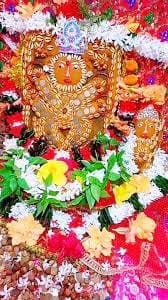
Married women observe this Osha. They worship the deities on a Shila (grinding stone) and Shilapua (pestle). For this vrat, a grinding stone and pestle are washed, wiped clean, and placed on a pidha (a low wooden seat). Amla (Indian gooseberry) is washed in Ganga water and then ground into a paste with turmeric and fenugreek. With this paste, two idols are prepared on the grinding stone and the pestle. The names of these two idols are ‘Budhei’ and ‘Sudhei’. Cowrie shells and small betel nuts are used to create their eyes, nose, ears, and mouth. Kajal (kohl) is applied to their eyes and sindoor (vermilion) on their foreheads. The idols are decorated with yellow flowers and bel leaves, draped in a small red saree, and given a veil. In some places, along with flower garlands, these turmeric-paste idols are also adorned with a garland of khai (puffed rice). A ‘pahada’ is laid out in front of the place of worship. The puja begins by placing five types of flowers, five types of fruits, five incense sticks, five strands of duba grass, and five grains of akshata (unbroken sacred rice), along with a sankalpa nadia (a coconut dedicated to the vow) near the altar. The Budhei Osha vrat katha (book of stories) is read.
Budhei Osha is an Osha celebrated in Odisha. It is observed on the four or five Wednesdays of the Bhadraba month. In some places, it is celebrated on all five Wednesdays. Typically, married women perform this Osha with the wish for a child and for the well-being of their children. This Osha is observed with a strict, waterless fast (nirjala). According to the tradition of Budhibaman Osha, the place of worship is purified by smearing it with cow dung. The deities are adorned with bel leaves, flower garlands, and garlands of puffed rice (khai). A coconut is established during the first observance (pali) and is broken and offered to the deity on the final pali. On the Wednesdays in between, offerings of various traditional cakes and sweets (pithapana) are made. However, on the final pali, at least five different kinds of pithapana are prepared. On each Wednesday, the women fast throughout the day and eat the bhog (sacred food offering) at night after the puja. The grinding stone and pestle serve as the deities.
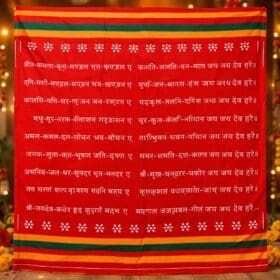
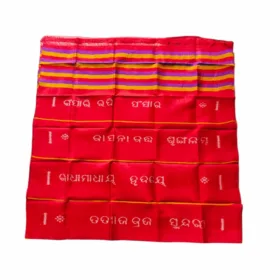
First, the grinding stone and pestle are bathed with water mixed with ground amla and Ganga water. They are then dressed as female figures by wrapping them in turmeric-dyed cloth and thread. Sindoor is applied to their foreheads and kajal to their eyes. There is a special book for the Budhibaman Osha, which is composed of five stories. These stories are: the merchant and his wife of Magadha, the liquor-seller couple of Jajatinagar, Bandhu Mohanty of Jajpur, the childless Brahmin woman, and an ordinary woman from Haripur. It is believed that if a childless woman lays a saree at the entrance of the puja room from the very first observance, she is blessed by the sacred touch of everyone’s feet and is graced with a child. This cloth is called a ‘pahada’.
🙏❤️❤️❤️
Jai Jagannath
Bring home divine blessings with authentic Budhei Osha essentials.