Articles
ll Gaja Uddharana Besha (The Attire of Elephant Liberation) ll

Feb
⚫❗⚫
“From a million leagues away, the elephant called out, O King of Gods!
With your four arms, You leaned in and heard his desperate cry.”
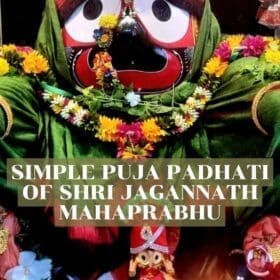
Today is the holy Magha Purnima. According to tradition, every year on Magha Purnima, the Gaja Uddharana Besha of the deities stationed on the Ratna Singhasana (the Golden Throne) is held in the Shri Mandir. On this day, after the completion of the Madhyanha Dhupa (Midday Offering) and Mailama (change of clothes), the Sarbanga ritual is performed. Following this, the deities are adorned in the Gaja Uddharana Besha on the three altars. This Besha is conducted with the assistance and cooperation of the Bhitarachha, Talichha, Puspalaka Nijoga, Khuntia, and Mekapa servitors.
In this attire, the Lords wear ornaments such as the Chula (crest), Kirita (crown), Karna Kundala (earrings), Surya Chandra (Sun and Moon emblems), Antapatti (waist belt), Hata (hands), Bajubandha (armlets), and weapons like the Shankha (conch), Chakra (discus), Gada (mace), Padma (lotus), Hala (plow), and Musala (pestle). These ornaments are crafted from Sola (pith), Jari (tinsel), Jambura, cloth, and wood-apple glue (Kaitha Atha). Skilled artisans begin preparing these items within the temple premises at least 15 days in advance.
List of Items for Gaja Uddharana Besha:
-
The Elephant (Gaja)
-
Chula (Crest) – 3 units
-
Kirita (Crown) – 3 units
-
Peta (Body armor) – 3 units
-
Shri Payara (Divine Feet) – 3 pairs
-
Divine Arms for Goddess Subhadra – 2
-
Divine Arms for Lord Balabhadra – 4
-
Divine Arms for Lord Jagannath – 4
-
Garuda – 1
-
Arms and Legs for Garuda – 4
-
Crocodile (Kumbhira) – 1
-
Shankha (Conch) – 2
-
Hara Musala (Pestle) – 1
-
Gada (Mace) – 2
-
Chakra (Discus) – 2
-
Puta – 2
-
Alaka – 3
-
Singhasana (Throne) – 1
-
Karna Kundala (Earrings) – 3 pairs
-
Antapatti (Waist belt) – 3 pairs
-
Pa Padma (Lotus feet base) – 3 pairs
-
Lotus Flowers – 4 (made fresh every year)
-
Hataphera (Hand coverings made of Sola/Jari) – 10
-
Nakuasi (Nose ring) – 3 (made fresh every year)
-
Surya Chandra (Sun & Moon) – 3 pairs (made fresh every year)
-
Kanotia (Ear ornaments) – 6 (made fresh every year)
-
Lotus Bud Garlands – 2
-
The Ocean (Samudra) – 1 (made fresh every year)
-
Phera – 2
-
Lotus Bud – 1
Under the supervision of the Shri Mandir Administration, this Besha has been held regularly since 1979. In this attire, both Lord Balabhadra and Lord Jagannath appear with four arms. Lord Jagannath holds the Shankha, Chakra, Gada, and Padma, and appears as if sitting upon Garuda. Notably, in this Besha, Goddess Lakshmi (Shridevi) sits on the lap of Lord Jagannath. Similarly, Lord Balabhadra holds the Shankha, Chakra, Hala, and Musala, appearing in his Vasudeva form. Goddess Subhadra sits with her legs crossed (like Krishna) holding a lotus bud. Two elephants are placed near the deities, holding lotus buds in their trunks. One elephant is depicted being attacked by a crocodile. After the Besha is complete, offerings of Khiri (rice pudding) and Amalu are made, followed by the Sandhya Dhupa (Evening Offering). After the evening rituals, the Sahana Mela (public viewing) is held for devotees.
Mythological Background
This Besha is based on the story found in the 8th Canto, Chapters 2 to 4 of the Shrimad Bhagavata. While bathing in the Varuna Lake on Mount Trikuta (surrounded by the Ocean of Milk), the King of Elephants (Gajendra) was attacked by a ferocious crocodile. Despite his great strength, the elephant could not escape. Feeling helpless and in extreme pain, he prayed fervently to Lord Purushottama:
“Holding a single lotus in his trunk, he looked up at the sky;
Bowing his head and lifting his trunk, he saw the Lord of the Forest (Banamali).
With the Discus shining in His right hand like a rising sun,
The elephant cried: ‘O Destroyer of Distress, O Lord, save my life!'”
— (Bhagavata, 8th Canto, 3rd Chapter)
It is said that just as Lord Jagannath is the protector, Mother Lakshmi is the embodiment of compassion. While the Lord and Mother were busy playing a game of dice in Vaikuntha, the elephant’s cry shook the heavens. While the Lord was testing the devotee’s patience, Mother Lakshmi, the mother of the universe, could not bear the pain of her child. She urged the Lord to end the elephant’s suffering. Lord Hari immediately appeared at the lake, killed the crocodile with His Sudarshana Chakra, and saved Gajendra. In memory of this legend, the Gaja Uddharana Besha has been performed since ancient times.
Historical Context
Researcher Padmashree Sadashiv Rathasharma mentions in his book Besha Rahasya that Queen Bakula Mahadevi of the Bhauma Dynasty first introduced this Besha. Later, it was discontinued for many years due to various reasons. In 1575 AD, King Ramachandra Deva reintroduced it. For some years, the Queen of Puri personally sponsored it. In 1979, the prominent industrialist Mrs. Ila Panda donated ₹1,41,000 to the Shri Mandir fund; the interest from this deposit is now used to conduct the Besha smoothly every year.
Currently, 350 pots of Khiri and 2,486 Amalu are offered during this Besha. It is believed that by witnessing Lord Jagannath in the Gaja Uddharana Besha and reciting the Gajendra Stuti with devotion, one attains great merit and finds relief from physical, mental, and worldly sufferings.
Gajendra Stuti (The Prayer of the Elephant)
(Selected verses from the Odia Bhagavata by Jagannatha Dasa)
Shuka Ubacha (Shuka Speaks):
Listen, O jewel of the Pandavas! The elephant spoke words of liberation. Steadying his restless mind and drawing from the wisdom of his previous birth, he prayed to the Supreme Brahman, Shri Krishna, with a voice choked with joy.
Gaja Ubacha (The Elephant Speaks):
“I bow to You, O Lord Bhagavan, the life-force of infinite universes. Your glory is the essence of consciousness; You are the Primordial Being. You are the original seed of all life; I bow to You with my supreme head.
The universe resides in Your body, and from You, this universe manifests. You are the creator and You Yourself take the form of the universe. Beyond cause and effect, You are the Brahman and the ultimate refuge.
Through Your Maya (illusion), You manifest and withdraw this world like a spider with its web. You witness everything as the neutral observer. O Hari, save my life! I take refuge at Your feet.
When time consumes all beings, You remain. You are beyond the darkness of ignorance. Even the Gods and Sages cannot fully know You despite the Vedas and Shastras. Who can truly understand You, whom even Brahma and Shiva find mysterious?
You have no birth or karma, no flaws or material attributes. Yet, for the protection of the world, You manifest Yourself. I take refuge in You. Save me from the jaws of this crocodile!
Those who worship You with an undivided heart seek no worldly pleasures. Having tasted the nectar of Your wisdom, they desire nothing else. Your character is miraculous and blissful.”
Conclusion of the Rescue:
Seeing the elephant tortured by the crocodile, the Lord (Chakrapani) immediately descended from Garuda. He entered the water, severed the crocodile’s head with His Discus, and lifted the elephant’s leg with His hand. The deities of the directions watched from the sky as the Lord brought the elephant to the shore. Who can describe the limitless glory of Lord Hari?
Thus ends the third chapter of the 8th Canto of Shrimad Bhagavata regarding the liberation of Gajendra. 🙏❤️