
Articles
Papankusha Ekadashi: The Ekadashi of the Bright Fortnight
Oct
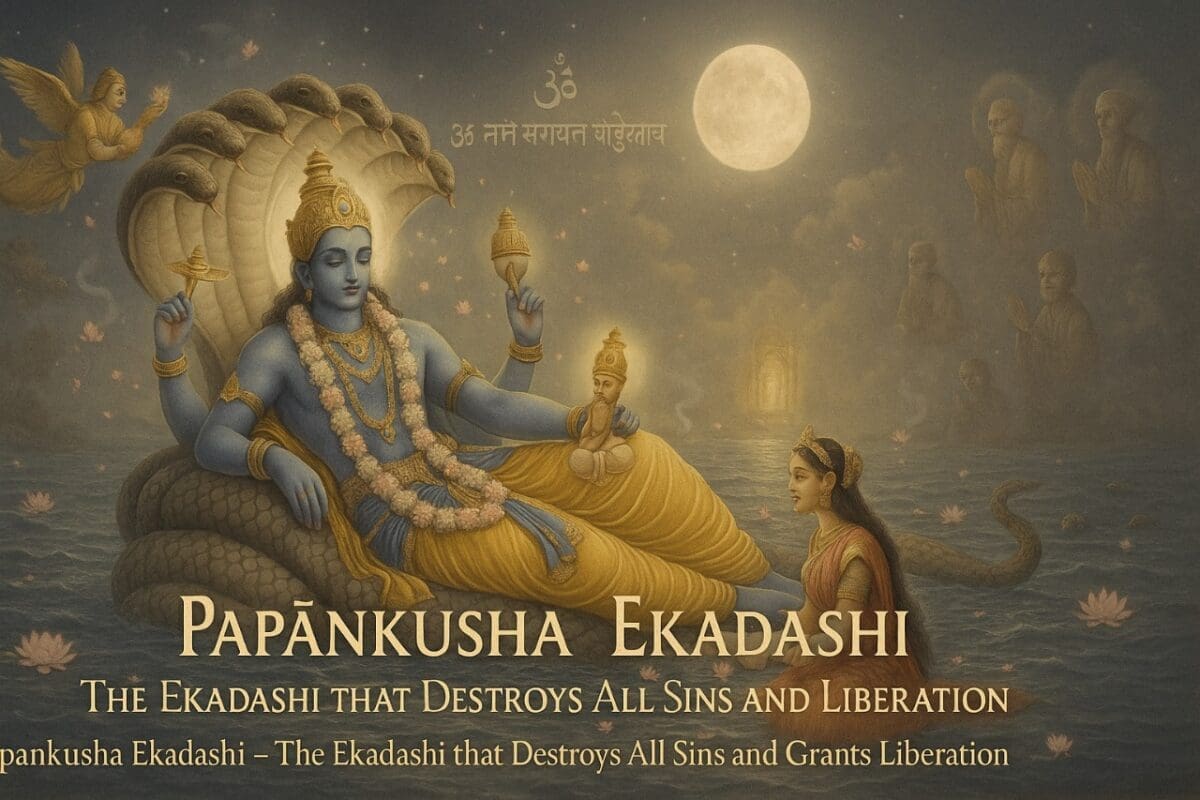
In the Hindu religion, the Ekadashi tithi (the 11th lunar day) is extremely significant. An Ekadashi occurs in both the dark (Krishna Paksha) and bright (Shukla Paksha) fortnights of every month. On Ekadashi day, Lord Vishnu is worshipped, and a strict fast (vrat) is observed. While every Ekadashi has its own importance, each also has a different name. Papankusha Ekadashi falls on the Ekadashi of the bright fortnight in the month of Ashwina. It is believed that by observing the Ekadashi fast, a person can destroy their inauspicious karmic imprints. Lord Sri Krishna himself narrated the significance of this Ekadashi to Dharmaraja Yudhisthira. On this Papankusha Ekadashi, Lord Padmanabha (a form of Vishnu) is worshipped with proper rites and rituals.
Why is this Ekadashi called Papankusha?
There is a significant legend behind its name. The virtue of this fast is such that the merit (punya) acquired from this observance, acting as a goad (ankusha), destroys the elephant of sin (pāpa). For this reason, this Ekadashi is called Papankusha Ekadashi. On this day, one should observe silence (mauna) and remember the Bhagavad Gita. There are also specific rules for food. If the Lord is worshipped with a pure mind on this day, the person’s mind becomes purified.
It is believed that if one worships Lord Vishnu and Lord Shiva on this Ekadashi, they are blessed with happiness and prosperity. Additionally, they attain Baikunthadham (the celestial abode of Vishnu). This Ekadashi is the destroyer of all sins, bestower of heaven and liberation (moksha), and provider of good health, a beautiful spouse, wealth, and friends. It is a popular belief that if a person observes this Ekadashi with devotion, they will never have to suffer the torments of Yama (the god of death). It is described in the Puranas that a person who fasts during the day and keeps a vigil at night effortlessly attains the abode of Vishnu. It is said that the observer of this Ekadashi liberates ten generations of their maternal lineage, ten generations of their paternal lineage, and ten generations of their spouse’s lineage.
The Legend of Papankusha Ekadashi
Yudhisthira asked: “O Madhusudana! Please be kind enough to tell me which Ekadashi falls in the bright fortnight of the month of Ashwina and what its glory is.”
Lord Sri Krishna replied: “O King! The Ekadashi that falls in the bright fortnight of Ashwina is known as ‘Papankusha.’ It is the destroyer of all sins, the bestower of heaven and liberation, and the provider of good health, a beautiful spouse, wealth, and friends. Even if for some other reason a person observes only this one Ekadashi fast, they will never have to suffer the torments of Yama.
O King! A person who fasts during the day and keeps a vigil through the night effortlessly attains a divine, four-armed form, adorned with a garland and yellow robes, holding the Garuda flag, and proceeds to the abode of Lord Vishnu. O great King! Such a person liberates ten generations of their mother’s side, ten of their father’s side, and ten of their wife’s side. On this day, to fulfill all desires, one should worship my form as Vasudeva. The fruit that a self-controlled sage obtains from performing harsh penance for a very long time can be obtained on this day simply by bowing down to Lord Garudadhwaja (Vishnu).
A person who donates gold, sesame seeds, land, cows, food, water, shoes, and umbrellas never has to see Yamaraja. O best of kings! Even a poor person should make their day fruitful by performing bathing, chanting (japa), and meditation, and then, according to their ability, perform homa (fire ritual), yajna (sacrifice), and charity. Those who perform meritorious deeds like homa, bathing, chanting, meditation, and yajna do not have to face the terrible torments of Yama. Those who are seen in this world as long-lived, wealthy, of noble lineage, and free from disease are virtuous souls from their past lives. This is how a virtuous person appears. What is the use of saying more on this subject? Humans suffer misfortune due to their sins and go to heaven due to their righteous deeds. O King! In accordance with what you asked, I have described the glory of ‘Papankusha Ekadashi.’ Now, what else do you wish to hear?”
In the Hindu religion, the Ekadashi tithi is very significant. An Ekadashi falls in both the dark and bright fortnights of every month. On Ekadashi day, Lord Vishnu is worshipped, and a strict fast is observed. It is believed that by observing the Ekadashi fast, a person can destroy their inauspicious karmic imprints.
The Legend of Papankusha Ekadashi: A person who fasts during the day and keeps a vigil at night goes to the abode of Lord Vishnu. Those who are seen in this world as long-lived, wealthy, of noble lineage, and free from disease are virtuous souls from their past lives.
Papankusha Ekadashi

On this Papankusha Ekadashi day, one should:
-
Observe silence.
-
Remember the Bhagavad Gita.
-
Consume: Fruits, roots, milk, cottage cheese (chhena), ghee.
-
Abstain from: Grains (rice, wheat, lentils).
-
Drink less water. 🙏❤️